T1#storage#standard#japan
CD-ROM — The Standard That Turned the Music Disc Into a Computer Medium
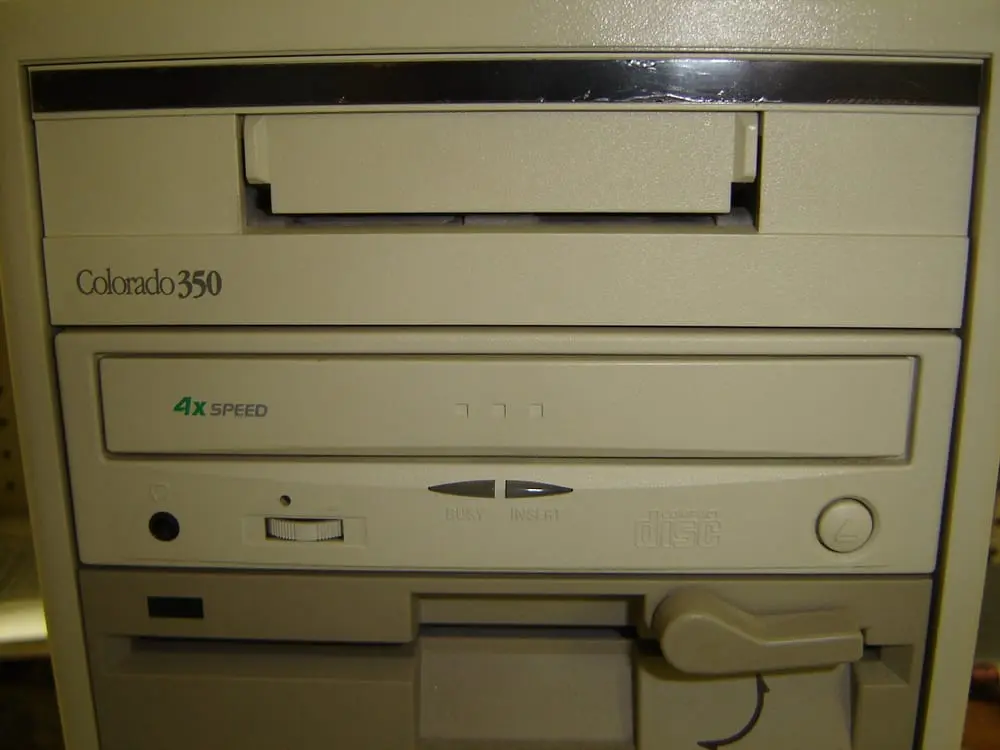
Metadata
- Date
- Decade
- 1980s
- Tier
- T1
- Sources
- 10
- Connections
- 02
- Tags
- #storage#standard#japan
CD-ROM is a read-only format for recording computer data on the same 12 cm disc as the music compact disc. The disc was specified in the "Yellow Book", a document Philips and Sony issued to their licensees only, and Sony's corporate history dates the standardisation of CD-ROM to 1985. A medium of several hundred megabytes that disc-pressing plants could copy cheaply in bulk changed how software and reference material were distributed, and became a premise of the "multimedia PC" of the 1990s.
| Date | Event |
|---|---|
| 1983 | Philips and Sony create the disc standard (English Wikipedia) |
| 1985 | The year Sony's history gives for the standardisation of CD-ROM; in July Philips releases the CM 100 drive (English Wikipedia) |
| October 1985 | US companies begin joint work on a file structure |
| March 1986 | Microsoft holds the first CD-ROM conference in Seattle |
| May 1986 | The High Sierra file-structure proposal is completed |
| 17 September 1986 | Microsoft announces extensions letting MS-DOS use CD-ROM drives |
| December 1986 | The file structure becomes ECMA-119 (later ISO 9660) |
| 8 September 1987 | Microsoft ships Bookshelf, its first CD-ROM application |
| July 1988 | The disc specification becomes a public standard as ECMA-130 |
| 28 February 1989 | Fujitsu announces the FM TOWNS with a CD-ROM drive as standard |
| January 2008 | Apple's MacBook Air makes the optical drive an external accessory |
When did it start? 1983, 1985, 1986
Sources disagree on CD-ROM's starting year. English Wikipedia says Philips and Sony created the standard in 1983 and announced it in 1984, and that Denon and Sony showed it at the first Japanese COMDEX in 1985; the first drive sold to the public, it says, was Philips's CM 100 of July 1985 (these points come from Wikipedia). Sony's corporate history lists "CD-ROM" (standardised 1985) among the CD's offshoots. Microsoft's own history, meanwhile, lists "Sony introduces the CD-ROM" among the world events of 1986. Specification, announcement and first products were spread over several years, and the year depends on which stage you count.
It became a public standard later. According to the foreword to ECMA-130, the Yellow Book that specified the disc was issued by Philips and Sony to their licensees only, and in spring 1987 ECMA was asked to produce a standard reflecting its contents. The first edition of ECMA-130 followed in July 1988, and it was also published as the international standard ISO/IEC 10149.
Inside the disc: 2,048-byte sectors
What separates CD-ROM from music CD is how much protection it adds against errors. ECMA-130 records data in units called sectors and defines two modes.
| Item | As specified in ECMA-130 |
|---|---|
| Mode 1 | 2,048 bytes of user data per sector, protected by an error-detection code (EDC) and an error-correction code (ECC) on top of the CIRC common to all CDs |
| Mode 2 | 2,336 bytes of user data per sector, protected by CIRC only |
| Read rate | 75 sectors per second |
| Audio tracks | A disc may also contain tracks recorded in the music-CD format |
Reading Mode 1 at 75 sectors a second gives 153,600 bytes a second. The Digital Antiquarian (Jimmy Maher) gives the read rate of CD drives in 1986 as 153.6 K per second and describes it as a constraint, for example for video. As for capacity, by English Wikipedia's calculation a 74-minute disc holds about 650 MiB; The Digital Antiquarian stresses how unimaginably large 650 MB was in 1986, when a 40 MB hard disk seemed cavernous.
Deciding where the files go: from High Sierra to ISO 9660
Settling the physical format still left the question of how to lay out files on it. According to the foreword to ECMA-130, in October 1985 a number of US industrial and software companies invited experts to draft a proposal; with members of ECMA's technical committee and experts from Japan taking part, the "High Sierra Group" proposal was completed in May 1986. ECMA reworked it into ECMA-119 in December 1986, which was adopted as ISO 9660.
Microsoft built on that format. According to its corporate history, on 17 September 1986 it announced extensions that let any computer running MS-DOS 3.1 or 3.2 with a CD-ROM drive read discs in the High Sierra format, licensed directly to drive manufacturers. In 1987 it shipped MS-DOS CD-ROM Extensions 1.0.
Microsoft's push and the first application
According to The Digital Antiquarian, in the first week of March 1986 more than 1,000 people turned up to the first Microsoft CD-ROM Conference in Seattle, against the 500 to 600 the organisers had expected. Microsoft's history records that on 8 September 1987 it shipped its first CD-ROM application, Bookshelf, which put ten popular reference works on a single disc. Two years later it also released the Macintosh version of Office on CD-ROM (see the first Microsoft Office).
The Multimedia PC, and Japan's FM TOWNS
It took time for the drive to become standard equipment. PC Watch describes Fujitsu's FM TOWNS, announced on 28 February 1989, as the world's first PC with a CD-ROM drive as standard.
In the US, the Multimedia PC Marketing Council wrote a multimedia PC specification so that hardware and software bearing its logo would work together. Specification 1.0 required a 386SX, 2 MB of RAM and a 30 MB hard drive, plus a CD-ROM drive meeting the following:
| Item | Multimedia PC Specification 1.0 requirement |
|---|---|
| Read rate | Sustained 150 kB per second |
| Average seek time | 1 second or less |
| CPU load | No more than 40% of CPU bandwidth while sustaining 150 kB/s |
| Format | Mode 1 (Mode 2 optional) |
| Driver | MSCDEX 2.2 with the extended audio APIs |
| Audio | Music-CD (Red Book) outputs and a front-panel volume control |
Game consoles took up CD-ROM too, and PlayStation chose it as its software medium.
Decline: DVD, the network, and the external drive
CD-ROM gave way to DVD, which held several times as much data on a disc of the same diameter. As software moved to network distribution, the optical drive itself began to leave the computer. On 15 January 2008 Apple made the MacBook Air's optical drive a $99 external accessory, saying many users would not need one now that they could rent films from the iTunes Store, back up wirelessly to Time Capsule and install software using the drive of another PC or Mac.
Where it fits
The invention in CD-ROM was not a new disc but borrowing, for data, the factories and standards already built for music. The disc specification spread while staying in the hands of Philips and Sony, the file layout came out of work led by US companies, and Microsoft did the evangelising. The line of optical discs continued with writable CD-R and then DVD and Blu-ray. For storage media see the floppy disk, the Zip drive and the hardware timeline; for the companies see Sony and Microsoft.
Questions this page answers
- When was CD-ROM created?
- Sony's corporate history says data CD-ROM was standardised in 1985. English Wikipedia dates the Philips–Sony standard to 1983, the announcement to 1984, and the first drive sold to the public, Philips's CM 100, to July 1985. As a public standard it became ECMA-130 in July 1988.
- How much does a CD-ROM hold?
- Under ECMA-130, a Mode 1 sector holds 2,048 bytes of user data and 75 sectors are read each second. By English Wikipedia's calculation a 74-minute disc holds about 650 MiB.
- What is the Yellow Book?
- The common name of the document specifying the CD-ROM disc. According to the foreword to ECMA-130, Philips and Sony issued it to their licensees only; in spring 1987 ECMA was asked to turn its contents into a public standard, which became ECMA-130 and ISO/IEC 10149.
- Which PC first came with a CD-ROM drive built in?
- PC Watch describes Fujitsu's FM TOWNS, announced on 28 February 1989, as the world's first PC with a CD-ROM drive as standard.
Sources
The foreword's history (High Sierra, ECMA-119 and ISO 9660, the Yellow Book, ISO/IEC 10149), Mode 1 and Mode 2 data sizes, 75 sectors per second
PrimaryECMA-130 — Ecma International (standard page)
First edition July 1988
PrimarySony History 第10章 スタジオ録音もデジタルに — ソニー(Wayback Machine 保存版)
Lists CD-ROM, for audio, images and text, as standardised in 1985 among the CD family
PrimaryThe History of Microsoft — 1986 (Microsoft Learn)
The 17 September 1986 announcement of MS-DOS CD-ROM extensions and the High Sierra format; 'Sony introduces the CD-ROM' in the year's world events
PrimaryThe History of Microsoft — 1987 (Microsoft Learn)
8 September 1987: the first CD-ROM application, Bookshelf (ten reference works); MS-DOS CD-ROM Extensions 1.0 shipped
PrimaryMultimedia PC Specification 1.0 — Multimedia PC Marketing Council (archived copy)
CD-ROM drive requirements (sustained 150 kB/s, average seek of 1 second or less, no more than 40% of CPU, MSCDEX 2.2); 386SX, 2 MB RAM, 30 MB hard drive
SecondaryA Slow-Motion Revolution — Jimmy Maher, The Digital Antiquarian, Sep 30, 2016
The first Microsoft CD-ROM Conference in March 1986 (500–600 expected, more than 1,000 came), the impact of 650 MB, the 153.6 K-per-second read rate
SecondaryFM TOWNS誕生から35周年。初のCD-ROM標準搭載パソコンを振り返る — 大河原克行, PC Watch, 2024年
States that Fujitsu announced the FM TOWNS on 28 February 1989 as the world's first PC with a CD-ROM drive as standard
PrimaryApple Introduces MacBook Air—The World's Thinnest Notebook — Apple Newsroom, Jan 15, 2008
The external MacBook Air SuperDrive ($99), and Apple's claim that many users would not need an optical drive
TertiaryCD-ROM — Wikipedia
The standard of 1983, the 1984 announcement, the 1985 showing at the first Japanese COMDEX, Philips's CM 100 (July 1985), the capacity calculation for a 74-minute disc
Last updated: