T1#personal-computer#japan#nec#hardware
NEC PC-9801 — The 16-Bit Machine That Became Japan's Standard PC
Metadata
- Date
- Decade
- 1980s
- Tier
- T1
- Sources
- 05
- Connections
- 03
- Tags
- #personal-computer#japan#nec#hardware
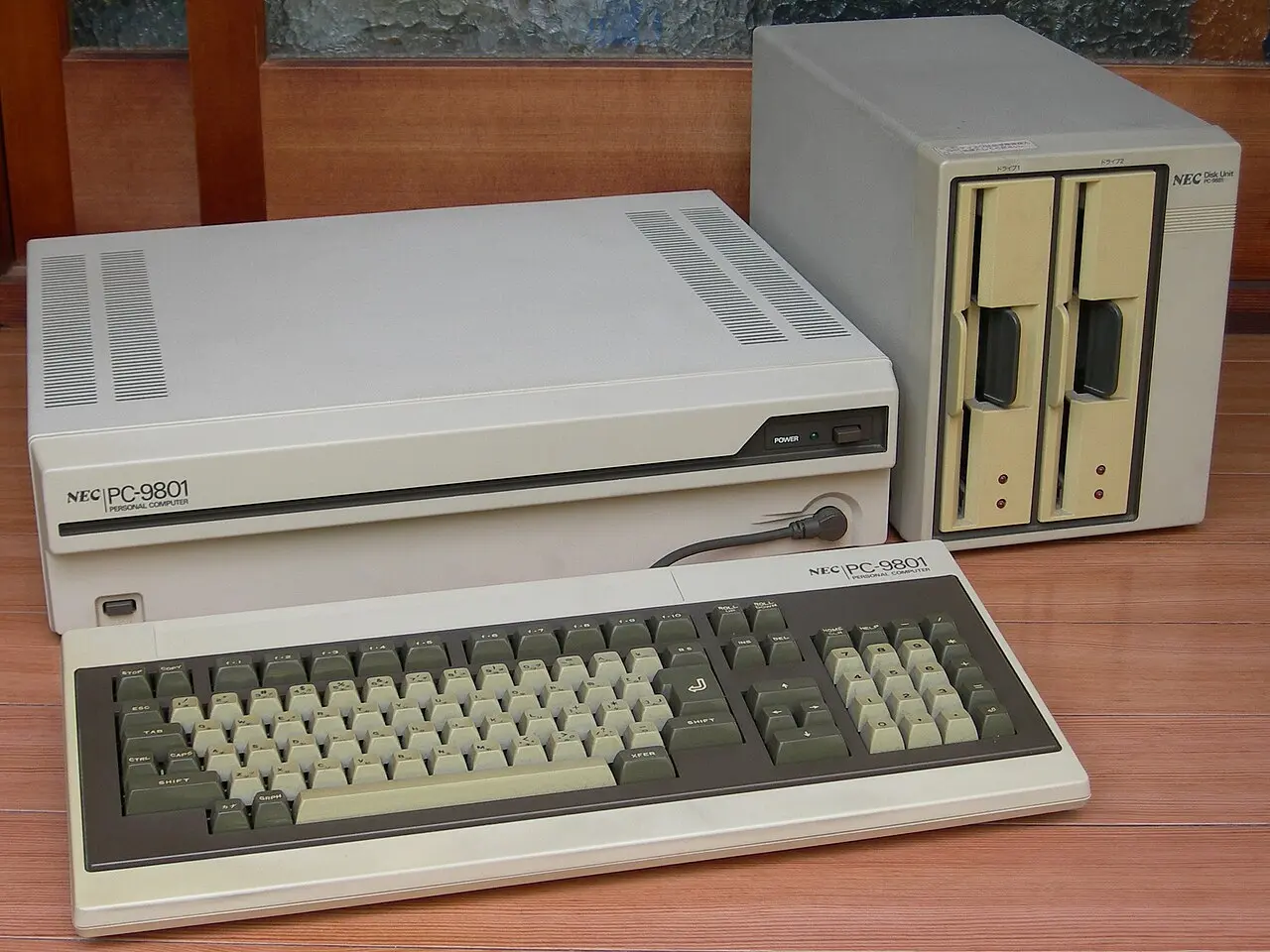
The PC-9801 was a 16-bit personal computer that NEC announced on 13 October 1982. It was the first model of the PC-9800 series, which people in Japan shortened to "PC-98" or simply "98" (kyuhachi). For roughly a decade the PC-98 was the standard business computer in Japan, in the way IBM-compatible PCs were elsewhere — but it was NEC's own design, and software written for it did not run on IBM compatibles. The line lasted until NEC stopped taking orders on 30 September 2003.
The first PC-9801 cost 298,000 yen.
What the first PC-9801 was
| PC-9801 (1982) | |
|---|---|
| Announced | 13 October 1982 |
| CPU | NEC μPD8086, 8086-compatible, 5 MHz |
| Graphics | NEC's own μPD7220 graphic display controller |
| Memory | 128KB built in, up to 640KB main memory |
| Floppy drives | External |
| Japanese text | Kanji ROM covering JIS level 1 offered as an option |
| BASIC | NEC's own 16-bit N88-BASIC, compatible with programs for its 8-bit machines |
| Price | 298,000 yen |
Why a 16-bit machine for Japan
The Information Processing Society of Japan's computer museum explains the background. Eight-bit computers, aimed mainly at games and hobbies, were ill suited to Japanese text, because Japanese character codes need 16 bits. NEC's eight-bit PC-8001 and PC-8801 were the best-selling PCs in Japan, so the PC-9801 was designed to keep both their software and hardware assets while running much faster, and was aimed at the business market.
According to a history of NEC by Katsuyuki Okawara, the company's information-processing group developed two product lines for its entry into personal computers. One was the N5200/05 personal terminal of July 1981, a "closed" product for which NEC developed everything, applications and peripherals included. The other was the PC-9800 series, an "open" line that inherited the PC-8001 architecture and left applications and peripherals to third parties. NEC's 1982 release stressed that the PC-9801 had the largest main memory of any Japanese personal computer when fully expanded, 640KB, and could run the many programs written in N-BASIC and N88-BASIC.
Keeping that compatibility was hard. NEC asked Microsoft, which had written the PC-8001's BASIC, to develop a 16-bit version, but Microsoft declined for lack of time and resources, so NEC wrote the 16-bit N88-BASIC itself.
Software first
What made the PC-98 dominant was the software library, and NEC built it deliberately. One to two months before the PC-9801 began shipping, it gave prototypes to about fifty software companies. The IPSJ notes that providing development machines and technical documentation to independent software vendors meant a range of applications was ready early in the sales period. Okawara gives the result: about 200 titles by March 1983 and about 600 by March 1984.
Sales started well. NEC's annual target was 70,000 units; orders passed 10,000 in the first month and reached 50,000 by March 1983. In October 1983 NEC released the PC-9801F, which came with a floppy drive and the JIS level 1 kanji ROM as standard and bundled MS-DOS. Cumulative shipments of the series passed one million in March 1987 and two million in February 1989, by which time it held more than 90% of Japan's 16-bit PC market, according to the same history.
The economics reinforced themselves. Each Japanese maker had its own MS-DOS and its own hardware, and software or peripherals built for the PC-9800 series did not work on rivals' machines. Users chose the PC with the most applications, and developers wrote for the PC with the most users.
Compatibles and the "national machine"
The PC-98's position invited imitation. On 13 March 1987 Seiko Epson announced the PC-286, a PC-98-compatible machine. NEC sued in the Tokyo District Court on 7 April, citing similarities in the BIOS and ROM, and Epson withdrew the announced models before they reached the market. It announced a PC-286 Model 0, said to have been developed by a separate group, on 24 April, and the two companies settled in November. Epson kept making compatibles, and around this time the PC-98 came to be called the kokuminki — the "national machine".
The series branched out. NEC released the PC-98LT in October 1986, which the IPSJ describes as the first laptop PC made in Japan; the PC-98XL² in September 1987, which it calls Japan's first 32-bit desktop; and the notebook PC-9801N, nicknamed 98NOTE, announced in October 1989.
The end of a closed standard
The 1990s eroded the advantage. In March 1991 IBM Japan set up the OADG consortium around the operating system later called DOS/V, giving Japan a camp of machines built on the international IBM-compatible platform; Compaq launched its ProLinea at 128,000 yen on 1 October 1992, the so-called "Compaq shock"; and Microsoft released Japanese editions of Windows 3.1 in May 1993 and Windows 95 in November 1995. Once applications were written for Windows rather than for one maker's hardware, the PC-98's distinctiveness counted for less. According to IDC Japan, NEC's share of the Japanese PC market fell below half for the first time in 1993, to 49.0%. In 1997 NEC launched the PC98-NX series, built to the PC97/PC98 specifications drawn up by Microsoft and Intel, as its new standard.
On 7 August 2003 NEC announced that it would stop taking orders for the PC-9800 series on 30 September 2003, ending a line sold since 1982, while continuing maintenance. The IPSJ recognised the PC-9801 as an Information Processing Technology Heritage item in fiscal 2008, crediting it with helping to form the structure of Japan's PC industry — software houses, peripheral makers, publishers, distributors and dealers.
The PC-9801's story runs parallel to the IBM PC, which became the open standard everywhere else. For context see the hardware timeline and the overview timeline.
Questions this page answers
- When was the PC-9801 released?
- NEC announced the PC-9801 on 13 October 1982, priced at 298,000 yen. It gave prototypes to about 50 software companies one to two months before shipments began.
- What was the PC-98?
- The common name for NEC's PC-9800 series, the family of 16-bit and later PCs that began with the PC-9801 in 1982. Its design was NEC's own and not software-compatible with IBM PC compatibles, and it was the standard business PC in Japan from the 1980s into the early 1990s.
- What CPU and memory did the PC-9801 have?
- It used NEC's μPD8086, an 8086-compatible chip running at 5 MHz, with 128KB of built-in memory expandable to a maximum of 640KB. Graphics were handled by NEC's own μPD7220 display controller, and the floppy drives were external.
- When did the PC-98 line end?
- On 7 August 2003 NEC announced that it would stop taking orders for the PC-9800 series on 30 September 2003, while continuing maintenance service.
Sources
Secondary【日本電気】 PC-9801 — 情報処理学会 コンピュータ博物館
October 1982 announcement, CPU, GDC and memory; later PC-98LT, PC-98XL² and 98NOTE
PrimaryPC-9801 — 情報処理学会 情報処理技術遺産(2008年度)
Development machines and documentation for independent software vendors
PrimaryPC-9800シリーズ受注終了のお知らせ — 日本電気株式会社, 2003年8月7日
Orders end on 30 September 2003
Secondary大河原克行「変革の軌跡~NECが歩んだ125年(10) 国民機『PC-9801』誕生」 — マイナビニュース, 2025年1月21日
The 13 October 1982 announcement, price, sales, the compatible-machine dispute and PC98-NX
TertiaryPC-9800シリーズ — Wikipedia
Last updated: