PERSON
Bill English
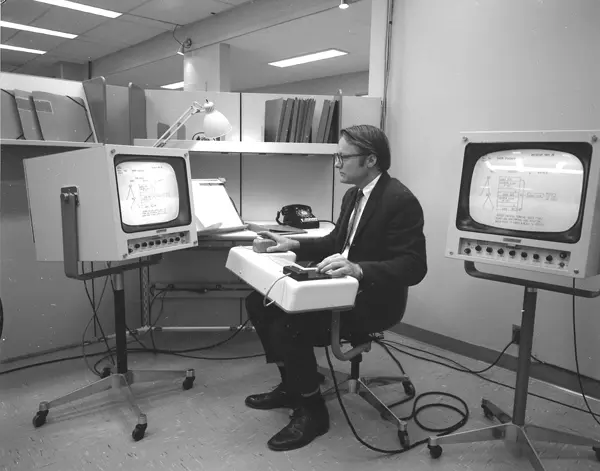
William Kirk English built the apparatus, and staged the demonstration, that carried Douglas Engelbart's ideas into the world. Born in Lexington, Kentucky in 1929. After the US Navy he joined the Stanford Research Institute around 1960, working on Hewitt Crane's all-magnetic logic computer before moving to Engelbart's project. Working from a sketch in Engelbart's notebook he built the first mouse prototype and was its first user, and the comparative test of screen-selection devices that followed was published in 1967 in IEEE Transactions on Human Factors in Electronics with English as first author. For the demonstration of 9 December 1968 he engineered the video and audio links between the hall and a laboratory thirty miles away, and directed the whole production from the back of the auditorium. In 1971 he moved to Xerox PARC, where he ran the Office Systems Research Group; the rolling-ball mouse his group produced was used with the early Altos. He joined Sun Microsystems in 1989. He died in 2020.
Profile
- Born
- 1929
- Died
- 2020
- Span
- 91 years
- Appearances
- 02
- Name
- ENBill EnglishJAビル・イングリッシュ
William Kirk English (27 January 1929, Lexington, Kentucky – 26 July 2020, San Rafael, California) built the first computer mouse and staged the demonstration that made it famous. Neither is the same as having conceived either, and that distinction is the whole point of his career. Douglas Engelbart could see what a computer ought to become and, by his own admission, struggled to explain it to anyone. English was one of the few who understood, and the one who could make the thing exist.
Before ARC
His father was an electrical engineer who managed coal mines in eastern Kentucky and West Virginia. English attended a boarding school near Tucson in the early 1940s, studied electrical engineering at the University of Kentucky, and served in the US Navy with postings in Northern California and Japan.
He joined SRI's Computer Techniques Laboratory around 1960, working on Hewitt Crane's all-magnetic logic computer — the same group Engelbart had been in since 1957 — and on a rotating-drum memory. By 1964 he was chief engineer of SRI's computer laboratory. He was among the first into the Augmentation Research Center once Engelbart's ARPA and NASA money arrived, and stayed as its Assistant Director until 1971.
Designed, Built, Measured
Engelbart had the idea for the mouse in 1961 and wrote it into a notebook, where it sat for three years. In 1964 a small NASA grant paid for a study of which pointing device was most efficient on a display. Engelbart went back to his notes with English, and English built the prototype — perpendicular wheels in a hollowed-out block of wood with a button on top — to be tested against the rest. He was its first user.
What the test found is worth stating accurately, because the folk version has flattened it. The paper — Display-Selection Techniques for Text Manipulation, by English, Engelbart and Melvyn Berman, in IEEE Transactions on Human Factors in Electronics HFE-8 no. 1, March 1967 — set a light pen, a Grafacon, a joystick in two modes, a knee control and the mouse against one another. Its conclusions record that the mouse, the knee control and the light pen all showed up well and were generally faster and more accurate than the rest; that inexperienced subjects did not do quite as well with the mouse as with the light pen or the knee control; and that experienced subjects found the mouse the best of the devices tested, satisfying to use and causing little fatigue. The knee control, which leaves both hands on the keyboard, is called very promising.
So the mouse did not sweep the field on first contact. It won on sustained use, by people who had learned it — the harder and more durable result, and the reason it became standard equipment in the lab.
Two further details survive from that paper. The wooden case held two orthogonally mounted potentiometers with a wheel on each shaft, and needed about five inches of travel to cross the screen. And the thing it moved is called, throughout, the bug — not the cursor, and not a cat.
The patent — US 3,541,541, "X-Y position indicator for a display system", filed 21 June 1967 and granted 17 November 1970 — names Engelbart as inventor and SRI as assignee. English is not on it. He built the device; the patent records who conceived it.
The Demo Was a Production
By 1967 ARC was acquiring its own SDS 940, and English worked out how to drive high-resolution display images to a dozen relatively cheap workstations at once using television cameras.
Then came 9 December 1968. Engelbart sat on stage at the San Francisco Civic Auditorium; the computer was thirty miles away in Menlo Park. English and his team built everything in between: workstations at the venue, cameras aimed both at Engelbart and at his colleagues in the lab, two-way live video and audio between the sites, and a master control booth. He got the video link working after befriending a telephone company technician, and borrowed a projector the size of a Volkswagen from a nearby NASA facility to throw the image thirty-two feet wide.
For the ninety minutes English sat at the back of the auditorium and directed it — choosing shots, mixing feeds, keeping the two sites in step. The conference paper, A Research Center for Augmenting Human Intellect, carries his name alongside Engelbart's. He did the job again in October 1969 for the sequel at the Conference on Information Science.
Bill Duvall, who worked beside him, told the New York Times that English was the man who made everything happen: if you told him something needed doing, he figured out how to do it.
Xerox PARC
In 1971 English left SRI for Xerox's new Palo Alto Research Center, and a good part of ARC went with him. Alan Kay's history of Smalltalk gives the reason plainly: they wanted to reimplement NLS as a distributed network system, and Engelbart wanted to stay with time-sharing.
At PARC he managed the Office Systems Research Group, and that group produced PARC's first mouse: a rolling-ball design of the same family as the 1968 Telefunken Rollkugel, built around 1972 and known in the lab as the "Hawley" mouse. It was used with the PARC video terminal system and with the early Altos. With Butler Lampson he also specified the experimental character generator built for the POLOS terminals, PARC's attempt at a successor to NLS.
And he did something less visible and possibly more consequential: he taught Alan Kay how to run a research group. Kay, by his own account a lone wolf who had no idea how to start one, was told by English to make a budget — and had to ask him what a budget was.
English took international assignments for Xerox and left in 1989 for Sun Microsystems, as director of internationalisation.
Who Conceived, Who Built, Who Directed
- Engelbart conceived the mouse. The 1961 notebook entry, and the patent, are his.
- English built it and was the first person to use one. The Doug Engelbart Institute and SRI both date the prototype to 1964; the Computer History Museum's profile says 1963. The year is not perfectly settled.
- English designed and ran the experiment that chose the mouse over the alternatives, and is first author of the paper reporting it.
- English engineered and directed the 1968 demonstration. Engelbart performed it.
- English's group at PARC produced the ball mouse used on early Altos — but the rolling-ball form was not new with them, and English did not design the Alto.
In 1990 the ACM gave its Software System Award for NLS to Engelbart, English and Jeff Rulifson. For the demo's fiftieth anniversary in 2018, the Doug Engelbart Institute had two replicas made of the trophy the 1968 conference organisers had given Engelbart, and handed them to English and Rulifson.
Appearances
Sources
A scan of the original; the apparatus and the conclusions
SecondaryEngelbart, C. (2020). A Tribute to Bill English (WKE) — Doug Engelbart Institute
When he joined SRI, the 1967 display work, the preparation for the 1968 demo, and the ACM Software System Award
nytimes.com refuses automated fetches, so the syndicated printing of the same article is cited
SecondaryBill English — Computer History Museum
Deputy director of ARC, the Office Systems Research Group at PARC, the Hawley mouse, and the move to Sun
SecondaryRolling ball mouse for Alto computer — CHM Revolution, Computer History Museum
Around 1972; the first mouse built at PARC
PrimaryKay, A. (1993). The Early History of Smalltalk. ACM HOPL-II
dl.acm.org refuses automated fetches, so Bret Victor's mirror of the full text is cited
SecondaryFirsts: The Mouse — Doug Engelbart Institute
The 1961 idea, the prototype of autumn 1964, and the patent
SecondaryThe computer mouse and interactive computing — SRI International
1964: English, then the lead engineer, built the first prototype
Last updated: