T1#energy
The First ARM Processor
Metadata
- Date
- Decade
- 1980s
- Tier
- T1
- Sources
- 11
- Connections
- 03
- Tags
- #energy
The history of the ARM architecture starts with a chip delivered to Acorn Computers in Cambridge, England, on 26 April 1985: the ARM1, whose instruction set was designed by Sophie Wilson and whose microarchitecture was designed by Steve Furber. The name then stood for Acorn RISC Machine. In Furber's account the chips arrived in the morning, and after a few board-level problems with the test card were fixed, they were running BBC BASIC by the afternoon. The Arm instruction set used today in everything from phones to data centres descends directly from this 32-bit RISC processor.
Why Acorn designed its own CPU
Acorn made the BBC Micro, Britain's educational home computer, which ran a 6502 at 2 MHz. Looking for a processor for its next machine, the company was not happy with anything on the market. According to Furber's Computer History Museum oral history, co-founder Hermann Hauser brought in papers describing the Berkeley RISC and Stanford MIPS processors, and the idea of a reduced instruction set — making the processor much simpler — seemed to address their problem.
A trip in October 1983 mattered. Wilson and Furber visited the team in Phoenix, Arizona, that was designing a successor to the 6502 (the 65C816), and found a small group working out of a suburban bungalow, with local school kids helping on some of the cell design in their summer holidays. Furber names the visit as one of the major points in putting ARM on a formal footing.
The birth of ARM1
| ARM1 (1985) | |
|---|---|
| Designers | Sophie Wilson (instruction set), Steve Furber (microarchitecture) |
| Fabrication | VLSI Technology |
| Process | 3 micron |
| Transistors | About 25,000 |
| Data width | 32 bits |
| Pipeline | Three stages |
| First silicon | 26 April 1985 |
| Power | Under 0.1 W, against a 1 W target (Furber) |
The method was close to handmade. Furber wrote a reference model of the instruction set in BBC BASIC and broke it into block specifications; the whole development environment, he says, was about 850 lines of BBC BASIC. The final checks on the design were done at VLSI Technology's offices in Munich in January 1985. From serious start to working silicon took about 18 months.
The team's fear was that RISC ideas were widely published, so some big company would build a commercial RISC processor first and trample them. When they had working silicon in April 1985, nobody else had.
Was low power an accident?
The designers tell the low-power story, the trait that later suited ARM to portable devices, slightly differently.
Furber says the goal was to fit a cheap plastic package, which meant staying under about a watt. The tools of the time could not predict power accurately, so the team used generous margins and ended up under a tenth of a watt. He describes the result as somewhat serendipitous but "not accidental".
Wilson's version, as told to The Register, is more dramatic. When the first chip went onto a development board, the meter in series with the power supply read zero: a fault meant no current was reaching the supply lines, and the processor was running on leakage from the logic circuits. The low power for which ARM is valued, she said, was "a complete accident".
The Evaluation System, then Archimedes
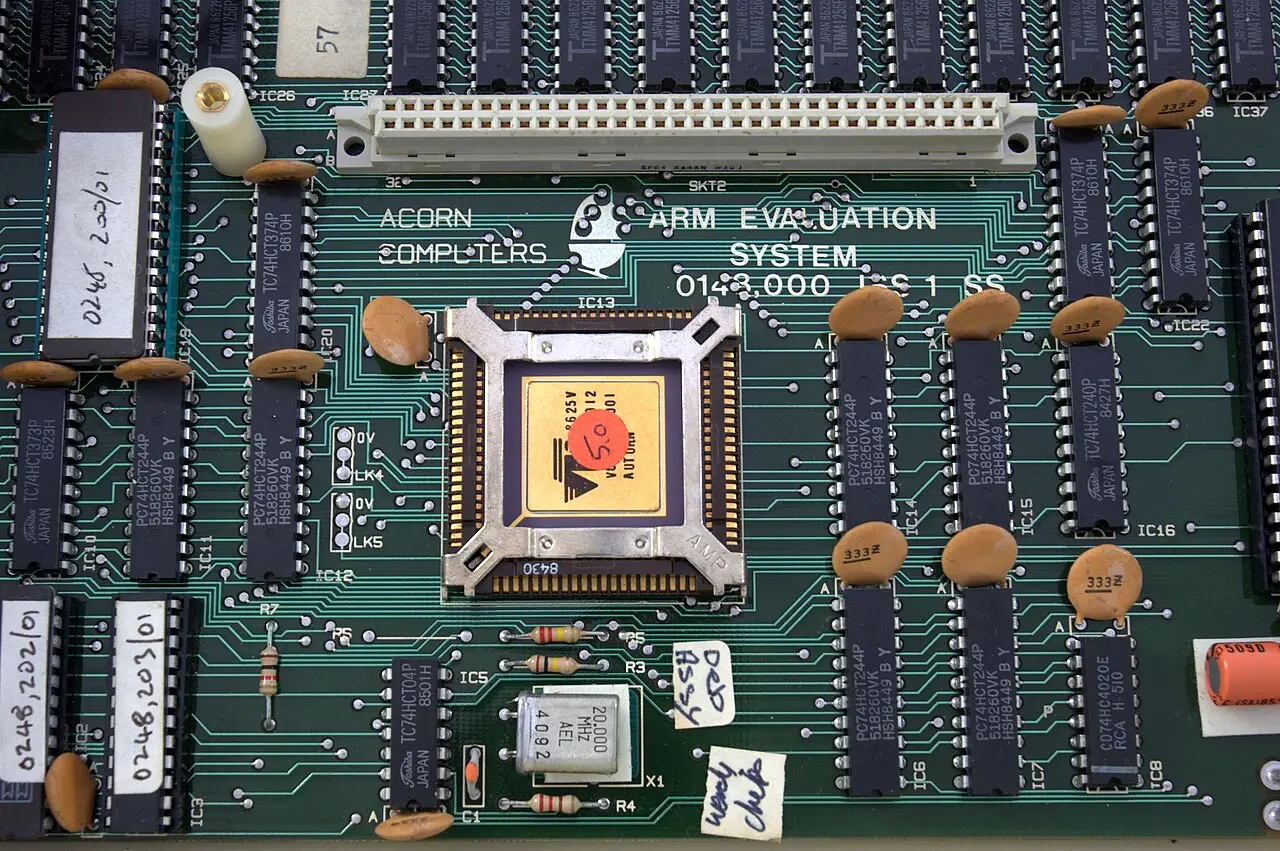
ARM1 never became a product chip. In a press release dated 7 July 1986, Acorn announced an evaluation system for the ARM, which it said it had first announced in August of the previous year. One version attached to the BBC Micro and Master Series, another to IBM PCs and compatibles; the BBC version cost £4,500 excluding VAT. The release described the ARM as a single-chip 32-bit RISC in low-power CMOS, averaging 4 MIPS on an 8 MHz clock with 44 basic instructions, and listed applications from communications and microcomputers to expert systems and laser printer controllers. VLSI Technology would manufacture and market the chip set.
What reached homes and schools was the Acorn Archimedes, with the second-generation ARM2; the first models were released in June 1987. Furber explains that the Archimedes chip set was the ARM2 plus three support chips, MEMC, VIDC and IOC. ARM had never been conceived as a single chip but as one of the four needed to build that machine.
Arm as a company
| Year | Event |
|---|---|
| November 1990 | Advanced RISC Machines Ltd. founded as a joint venture of Acorn, Apple and VLSI Technology, with 12 designers as founders |
| 1991 | Robin Saxby joins as first chairman and CEO and introduces the IP licensing model |
| 1993 | Apple Newton launches on the ARM architecture |
| 17 April 1998 | ARM Holdings lists on the London Stock Exchange and NASDAQ |
| 5 September 2016 | SoftBank completes its acquisition of Arm |
| 14 September 2023 | Trading begins on Nasdaq under the symbol ARM, priced at $51 per share |
Saxby's model, licensing designs instead of making chips, put ARM into the silicon of many companies. In its May 2026 results Arm said more than 350 billion chips had shipped. The Japanese connection is SoftBank: it bought Arm in 2016, and in the 2023 Nasdaq listing a wholly owned SoftBank Group subsidiary was the selling shareholder.
Apple moved the Mac to its own ARM-based chips with the M1 in 2020. For the contrast with x86 see ARM vs x86 in the glossary; for an instruction set opened to everyone, see RISC-V. The machines of the period are on the hardware timeline.
Questions this page answers
- When did the first ARM processor run?
- The ARM1 chips reached Acorn on the morning of 26 April 1985. According to Steve Furber, after a few problems with the test board were fixed, they were running BBC BASIC that afternoon.
- Which computer first shipped with an ARM chip?
- The Acorn Archimedes, first released in June 1987, and it carried the ARM2, not the ARM1. From July 1986 the ARM1 was offered as an evaluation system attached to a BBC Micro or an IBM PC compatible.
- What did ARM originally stand for?
- Acorn RISC Machine. The design team was spun out in November 1990 as Advanced RISC Machines Ltd., a joint venture of Acorn, Apple and VLSI Technology.
- Was ARM's low power consumption an accident?
- The designers differ. Steve Furber says the team designed with generous margins to stay under 1 W for a cheap plastic package, landed under 0.1 W, and that this was not accidental. Sophie Wilson tells of the first evaluation board running on leakage current with no supply current at all, and calls it an accident.
Sources
The Berkeley RISC and Stanford MIPS papers, the October 1983 Phoenix visit, the BBC BASIC reference model, Munich in January 1985, the 26 April arrival and BBC BASIC that afternoon, the 1 W target and sub-0.1 W result, and the four-chip Archimedes set
The evaluation system, first announcement the previous August, £4,500, 8 MHz and 4 MIPS average with 44 basic instructions, and the VLSI Technology manufacturing agreement
PrimaryThe official history of Arm — Arm Newsroom
The November 1990 founding and its 12 founders, Saxby in 1991, the listing of 17 April 1998, and SoftBank's acquisition on 5 September 2016
SecondaryBidmead, C. (2012). ARM creators Sophie Wilson and Steve Furber — The Register, May 3, 2012
The zero-reading meter anecdote, Wilson's complete-accident remark, and the 25,000 transistors
Last updated: