T1#storage#consumer#market
The Zip Drive — Iomega's 100 MB Bid to Succeed the Floppy
Metadata
- Date
- Decade
- 1990s
- Tier
- T1
- Sources
- 08
- Connections
- 00
- Tags
- #storage#consumer#market
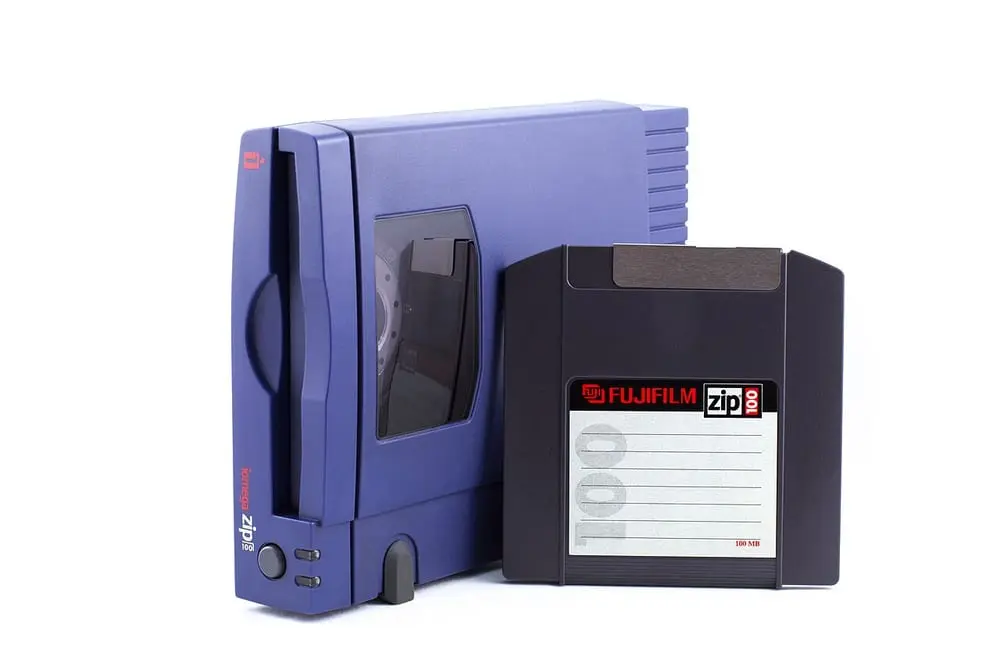
The Zip drive was a removable magnetic-disk storage system that Iomega, of Roy, Utah, announced in 1994 and began shipping in 1995. A cartridge slightly thicker than a 3.5-inch floppy held 100 MB, about seventy times the 1.44 MB of a high-density 3.5-inch floppy of the day. The external drive, with one disk, cost $199, and it became a common way to carry work files too large for floppies. It also became known for a failure called the "click of death", which ended in a class action.
| Year | Event |
|---|---|
| 1994 | Iomega announces Zip |
| 1995 | Shipping begins, first with the external parallel-port model |
| 1998 | A class action over the click of death is filed in a Delaware state court |
| c. 1999 | The 250 MB ZIP 250 |
| 2001 | Iomega proposes a settlement |
| 2002 | The 750 MB ZIP 750 |
| 2008 | EMC announces it will buy Iomega for about $213 million |
| 2013 | LenovoEMC, a joint venture of EMC and Lenovo, takes over the business |
When did it come out? Announced 1994, shipped 1995
The announcement and the first shipments fall in different years. Iomega's annual report of March 1995, as quoted by English Wikipedia, said it expected to start shipping the Zip products it had announced in 1994 in the first half of 1995, and Wikipedia gives the product's sales period as 1995 to 2003. The retro-PC site DOS Days says it was announced in early 1994 and went on sale for $199, and that the first model in shops was the external parallel-port version.
What was new about it
| Item | Details (per DOS Days) |
|---|---|
| Capacity | 100 MB (25 MB disks also existed) |
| Price | External drive $199 with one disk; extra 100 MB disks $19.95 each |
| Interfaces | Parallel port, SCSI; later internal IDE/ATAPI and USB |
| Compatibility | Macintosh, and PCs running Windows, OS/2 or DOS |
| UK price | £150 for the drive, £15 per disk |
According to DOS Days, under Windows a Zip drive showed up in Explorer just like a floppy drive, so it took almost no effort to start using. More than 2 million units shipped in the first 15 months, far ahead of even Iomega's most optimistic projections.
Several accounts point to price as the reason it spread. Iomega's earlier Bernoulli Box had cost $2,695 for a 10 MB model in 1985 (DOS Days). A Tedium article republished by Vice says that at the late-1990s peak the drives sold for $149 external and $99 internal, and that Dell fitted them as standard on its machines. At a time when recordable CDs were not yet common, a rewritable 100 MB disk was an affordable way for designers and others with big files to hand work around.
The click of death
According to a 1998 explainer on Low End Mac, Zip and Jaz drives were designed to retract, clean and recalibrate their heads when they went to sleep or failed to read a disk. Continuous clicking was a sign that the disk had become unreadable, usually because a drive had damaged it by writing incorrectly. The nasty part was that putting a damaged disk into another drive made that drive click too, and could even damage its heads. DOS Days attributes the fault to misaligned read heads and says it mainly affected early ZIP 100 drives.
In 1998 a class action was filed in a Delaware state court. According to the Deseret News in April 2001, the plaintiffs alleged a manufacturing or design defect in Zip drives and disks that caused data to be lost. The settlement Iomega proposed offered US customers who bought a Zip drive between 1 January 1995 and 19 March 2001 rebates on Iomega products, free technical support for "clicking" problems, and a donation of $1 million in products and services to schools. The plaintiffs' lawyer said the class could cover as many as 28 million buyers. According to The Globe and Mail, the rebates ranged from $5 to $40, and the only cash went to the plaintiffs' lawyers, up to $4.7 million. Iomega's CEO said the company continued to dispute the underlying allegations but believed that bringing closure was in the interests of shareholders and customers.
More capacity, still overtaken
Iomega kept raising capacity. According to DOS Days, by 1999 it had the 250 MB ZIP 250 ($180), and in 2002 the 750 MB ZIP 750, the first Zip disk to hold more than a CD. But Silicon UK's look back puts the Zip's sales peak in the mid-to-late 1990s and says that in the early 2000s it lost out to CD-R, CD-RW and then USB flash drives. As PCs shipped with hard disks of several gigabytes, the need for external media itself faded.
On 8 April 2008 EMC announced a cash tender offer for Iomega at $3.85 a share, about $213 million. EMC's release said Iomega would form the core of a new consumer and small-business division, and it no longer mentions Zip at all. According to Silicon UK and Low End Mac, in 2013 LenovoEMC, a joint venture of EMC and Lenovo, took over the business and the products were rebranded under its name.
Where it fits
Zip was one of the furthest-reaching attempts by a single company, rather than a standards body, to build the next floppy. On capacity it extended the floppy disk; on distribution, the read-only CD-ROM was already becoming the medium for software. Once writable optical discs and flash memory with no moving parts became cheap, the reason to stand between them disappeared. For hardware of the same era, see the hardware timeline.
Questions this page answers
- When did the Zip drive come out?
- Iomega announced it in 1994 and began shipping in 1995. Iomega's annual report of March 1995, as quoted by English Wikipedia, said it expected to start shipping the Zip products it had announced in 1994 in the first half of 1995.
- How much did a Zip disk hold?
- 100 MB at first, about seventy times a 1.44 MB 3.5-inch floppy. Later models held 250 MB and, from 2002, 750 MB.
- What was the 'click of death'?
- A symptom in which a Zip drive kept clicking as it repeatedly tried to recalibrate on a disk it could not read. The usual cause was said to be a faulty drive, and a damaged disk put into another drive could damage that drive too. A class action was filed in 1998 and a settlement proposed in 2001.
- What happened to Iomega?
- On 8 April 2008 EMC announced it would buy Iomega for $3.85 a share, about $213 million. In 2013 LenovoEMC, a joint venture of EMC and Lenovo, took over the business and rebranded the products.
Sources
SecondaryIomega Drives (Part 1) — DOS Days
Announcement in 1994 and $199, the external parallel-port model first, $19.95 disks and $9.95 25 MB disks, more than 2 million units in the first 15 months, the head-misalignment fault, ZIP 250 and ZIP 750
SecondaryTales In Tech History: Iomega Zip Drive — Silicon UK
Designed in 1994; SCSI and parallel, later USB and FireWire; the 1998 lawsuit; decline against CD-R, USB flash and large hard disks; the EMC purchase in 2008 and LenovoEMC in 2013
Late-1990s prices ($149 external, $99 internal), Dell fitting it as standard, paid support calls from 1996
SecondaryThe Zip Disk Click of Death — Low End Mac, 1998
The symptom and mechanism (heads retracting, cleaning and recalibrating), the risk that a damaged disk damages another drive, the April 2001 settlement with rebates of up to $40
SecondaryIomega proposes settlement to end suit — Deseret News, Apr 13, 2001
The suit filed in a Delaware state court in 1998; the class (US buyers from 1 January 1995 to 19 March 2001); rebates and free support; a $1 million donation to schools; the plaintiffs' lawyer's estimate of up to 28 million buyers; Iomega's statement
SecondaryLawyers are big winners in Iomega suit — The Globe and Mail, 2001
The only cash payout was up to $4.7 million to the plaintiffs' lawyers; rebates of $5 to $40; court approval pending in June
PrimaryEMC to Acquire Iomega — EMC press release, Apr 8, 2008 (Dell Technologies newsroom)
A cash tender offer at $3.85 a share, about $213 million; Iomega to form the core of a consumer and small-business division
TertiaryZip drive — Wikipedia
Sold from 1995 to 2003; the quotation from Iomega's March 1995 annual report (announced in 1994, shipping expected in the first half of 1995)
Last updated: