T1#market#standard#consumer#enterprise
The IBM Personal Computer 5150 — An Open Design and the Market It Lost
Metadata
- Date
- Decade
- 1980s
- Tier
- T1
- Sources
- 06
- Connections
- 06
- Tags
- #market#standard#consumer#enterprise
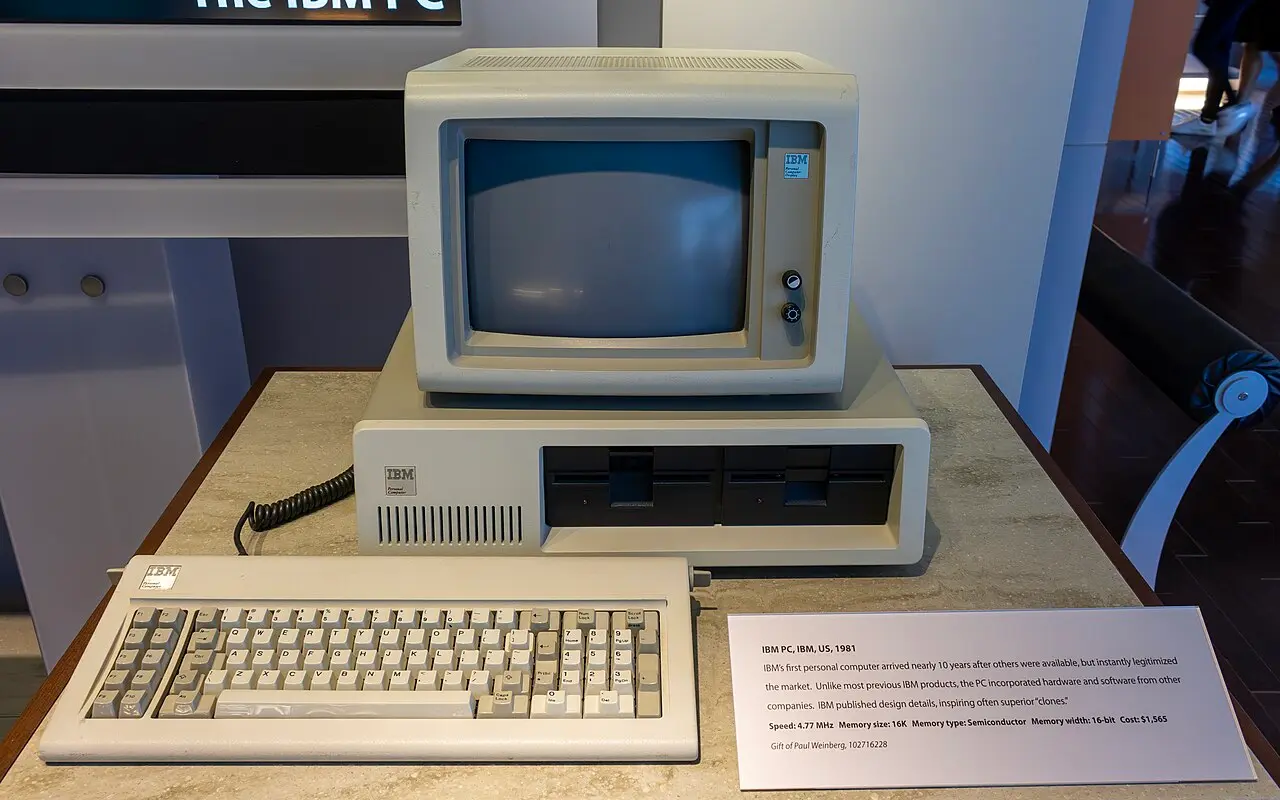
On 12 August 1981 IBM announced what its own press release called "its smallest, lowest-priced computer system": the IBM Personal Computer. C. B. Rogers, Jr., an IBM vice president and group executive, was quoted in that release calling it "the computer for just about everyone who has ever wanted a personal system at the office, on the university campus or at home."
As a machine it was unremarkable for 1981. What was remarkable was how it had been built and how it was sold.
The 8088 and the $1,565 Entry Price
The press release, issued by IBM's Information Systems Division, priced the system "for as little as $1,565". That entry configuration was the barest one — system unit and keyboard, attached to a household television through a frequency modulator, with an audio cassette for storage. From there:
- a typical home or school system, with 64,000 bytes of memory, one diskette drive and its own display, was priced "around $3,005";
- an expanded business system, with colour graphics, two diskette drives and a printer, "about $4,500".
Standard user memory was 16,384 characters, expandable to 262,144. The keyboard had 83 keys on a six-foot coiled cable, so it could be used on the lap. The processor appears in the release only as "a high-speed, 16-bit microprocessor" — it was the Intel 8088, running at 4.77 MHz according to the Computer History Museum. The 8088 was internally 16-bit with an 8-bit external bus: the cheaper sibling of the 8086, and the choice that made the price possible.
Every system shipped with an enhanced version of Microsoft BASIC and operating manuals. VisiCalc, EasyWriter and Peachtree's accounting packages appear in the release as programs available for the machine, not as bundled software; IBM's own later corporate history describes the first two as included, which the announcement does not support. Nor was there one operating system. IBM adapted a disk operating system with Microsoft and, in the same paragraph, announced contracts with Digital Research and SofTech Microsystems to bring CP/M-86 and the UCSD p-System to the machine. Distribution ran through ComputerLand dealers, Sears, Roebuck's new business machine stores, IBM Product Centers and a special unit inside the Data Processing Division. First deliveries were scheduled for October.
Boca Raton, Outside the Process
The machine was built outside IBM's normal product process, deliberately.
By IBM's own account the project began in 1980, when William Lowe — director of the General Systems Division lab in Boca Raton, Florida — pitched CEO Frank Cary on a personal computer that would sell for $1,500. Cary gave him a month for a prototype and a year for a product. Lowe was promoted shortly afterwards and the project, code-named Chess, passed to Don Estridge, who obtained permission to run it as a skunkworks entirely outside IBM's standard procedures. Bill Sydnes took hardware, Jack Sams software, Dave Bradley the interface code; Mark Dean and Dennis Moeller created the ISA bus that let the drives and printer talk to the machine.
The historian James Cortada, quoted in IBM's corporate history, put the constraint plainly: "The normal process to get a new product to market took four or five years, but the incipient PC market was moving too quickly for that." There was no time to test components individually, so pre-tested sub-assemblies were combined and only the finished product was tested. About half the system — expansion bus, display, floppy interface, keyboard — was lifted from the existing IBM System/23 Datamaster. The motherboard took forty days to design and four months to reach a working prototype; manufacturing took over in April 1981.
Three Decisions
Three choices, all made under deadline pressure, decided the next twenty years of the industry.
Buy off the shelf. Before the PC, IBM designed and made nearly everything it sold. The team concluded that the only way to hit both the deadline and the price was to stop doing that. Intel supplied the processor, Microsoft the operating system, Epson the dot-matrix printer.
Publish the design. IBM issued a technical reference containing the circuit designs and source listings so that other companies could build software and peripherals against it. Within a year of launch more than 750 software packages existed for the machine, and dozens of firms were selling memory expansion cards.
Do not take the operating system exclusively. What Microsoft delivered as PC DOS 1.0 was 86-DOS, whose rights Microsoft had bought outright from Seattle Computer Products the month before — and Microsoft kept the right to sell the same software to anyone else as MS-DOS (see MS-DOS 1.0). That single term of the contract is why Microsoft eventually became larger than IBM.
The BIOS: the One Closed Part
The single element IBM held proprietary was the BIOS — the Basic Input/Output System burned into ROM. The distinction here is easy to get wrong. IBM printed the BIOS source listing in the technical reference. Publishing it is not the same as licensing it: the listing was copyrighted, and copying it was infringement.
So anyone wanting a compatible machine had to produce a different implementation with identical behaviour, written by engineers who had never seen the original. This is clean-room design: engineers who had read IBM's listing wrote specifications describing what each call and interrupt did, lawyers reviewed the specifications, and a second, isolated team who had never been exposed to IBM's code wrote the implementation from the specifications alone.
In February 1982, three Texas Instruments alumni — Rod Canion, Jim Harris and Bill Murto — founded Compaq in Houston with exactly that goal: no-compromise, 100% compatibility. The Compaq Portable was announced on 4 November 1982 and shipped from March 1983. In 1983, its first full year, Compaq shipped 53,000 machines for more than $111 million in revenue — at the time the largest first-year revenue of any company in US history.
What Compaq demonstrated was not a technical trick but a legally safe route. Once the route existed it could be sold: independent vendors such as Phoenix Technologies began licensing compatible BIOS code to anyone who wanted it, and building a clone changed from an engineering feat into a purchasing decision.
The Market the Openness Cost
Over the following decade IBM raised the processing speed of its personal computers tenfold, instruction execution a hundredfold, memory from 16 kilobytes to 16 megabytes, and storage by a factor of ten thousand. The IBM architecture became the de facto standard and "PC" became a common noun.
And IBM lost the market. Cortada again, in IBM's own history: "While IBM continued to sell millions of personal computers, over time the profit on its PC business declined." The company's share of the PC market fell from roughly 80% in 1982–83 to 20% a decade later. In 2005 IBM completed the sale of its PC division to Lenovo for US$1.75 billion in cash, stock and debt.
The causation is not simple. Without the open design the IBM PC would never have become the standard in the first place; having become the standard, the company that set it became replaceable. What the 5150 left behind was not a product but an industrial shape — buy the parts, conform to the specification, compete on price. Four decades later, data centres and smartphones are still built on it.
Sources
Last updated: