Detailed · 44 events
A History of Semiconductors and Hardware
1940s
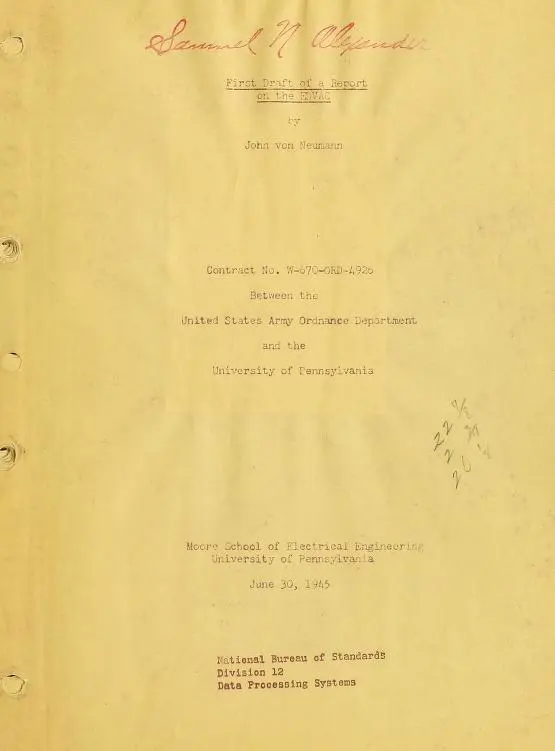
John von Neumann / Internet Archive scan of Samuel N. Alexander's copy (Wikimedia Commons) · Public Domain · Commons ↗ At the Moore School of Electrical Engineering, University of Pennsylvania, an unfinished typescript titled First Draft of a Report on the EDVAC went out bearing John von Neumann's name alone. It divided a computing machine into a central arithmetic part (CA), a central control (CC), a memory (M), input (I) and output (O), and described a store holding instructions and numbers alike — all in the language of logic, stripped of vacuum tubes and delay lines. Being a draft, its forward references were left blank, and it cited exactly one paper: McCulloch and Pitts on neural nets. Eckert and Mauchly disputed the attribution, and the unrestricted circulation was later held in court to be a prior public disclosure that voided their patent claim.
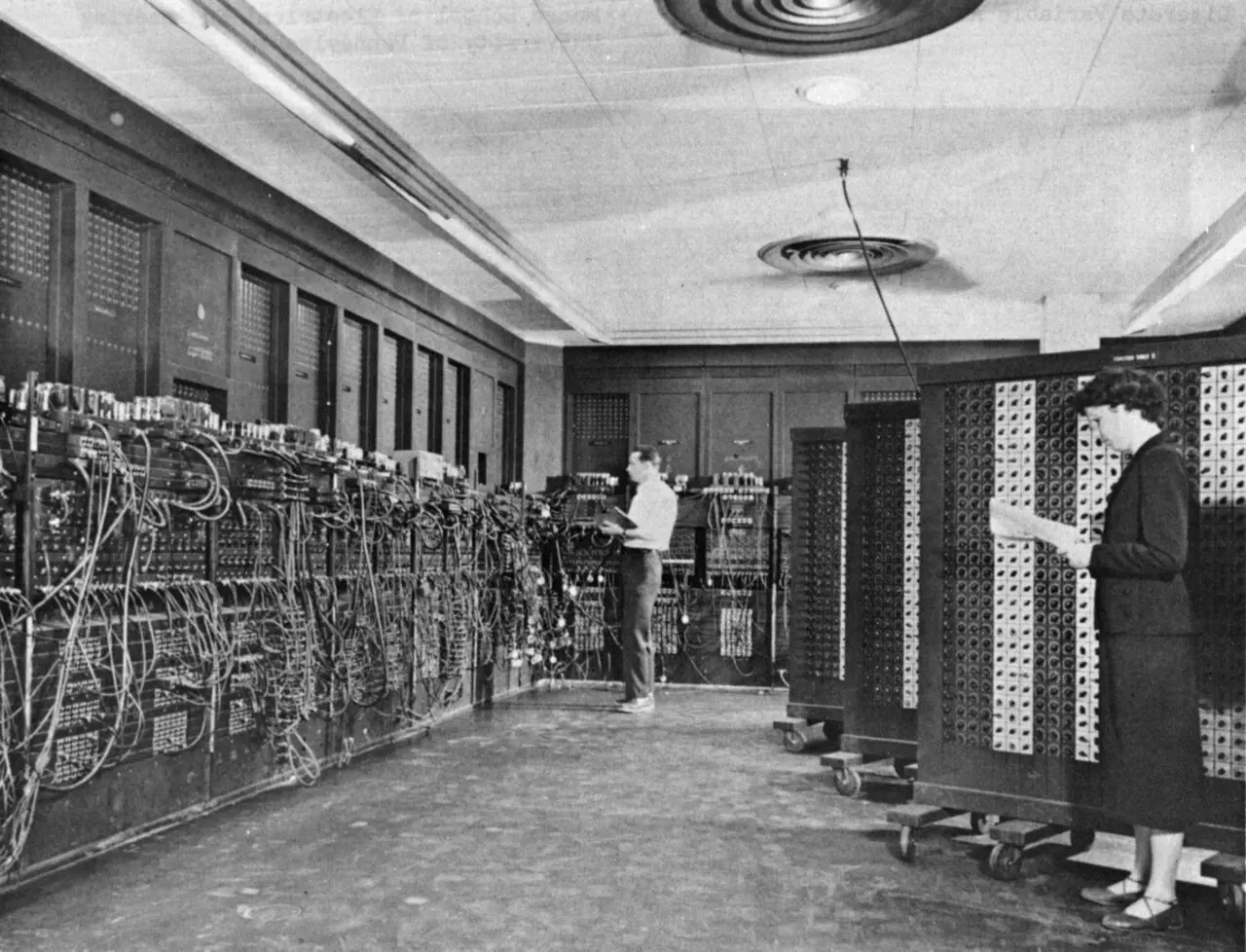
U.S. Army Photo (Wikimedia Commons) · Public Domain · Commons ↗ ENIAC, built for the Army Ordnance Department's ballistics calculations, was shown to the press at the Moore School of Electrical Engineering, University of Pennsylvania; the formal dedication followed on 15 February. It held 17,468 vacuum tubes, weighed about 30 tons, and added roughly 5,000 numbers a second. It was not, at its unveiling, a stored-program machine: each problem was set up by replugging cables and turning switches. The demonstration's trajectory program was written by Betty Snyder and Jean Jennings, and the six women who programmed the machine are almost entirely absent from the coverage. Nor was it the first electronic computer — Colossus and the Atanasoff-Berry Computer came earlier. What ENIAC was first at is being a general-purpose programmable electronic computer that was actually finished, actually used, and publicly known.
1950s
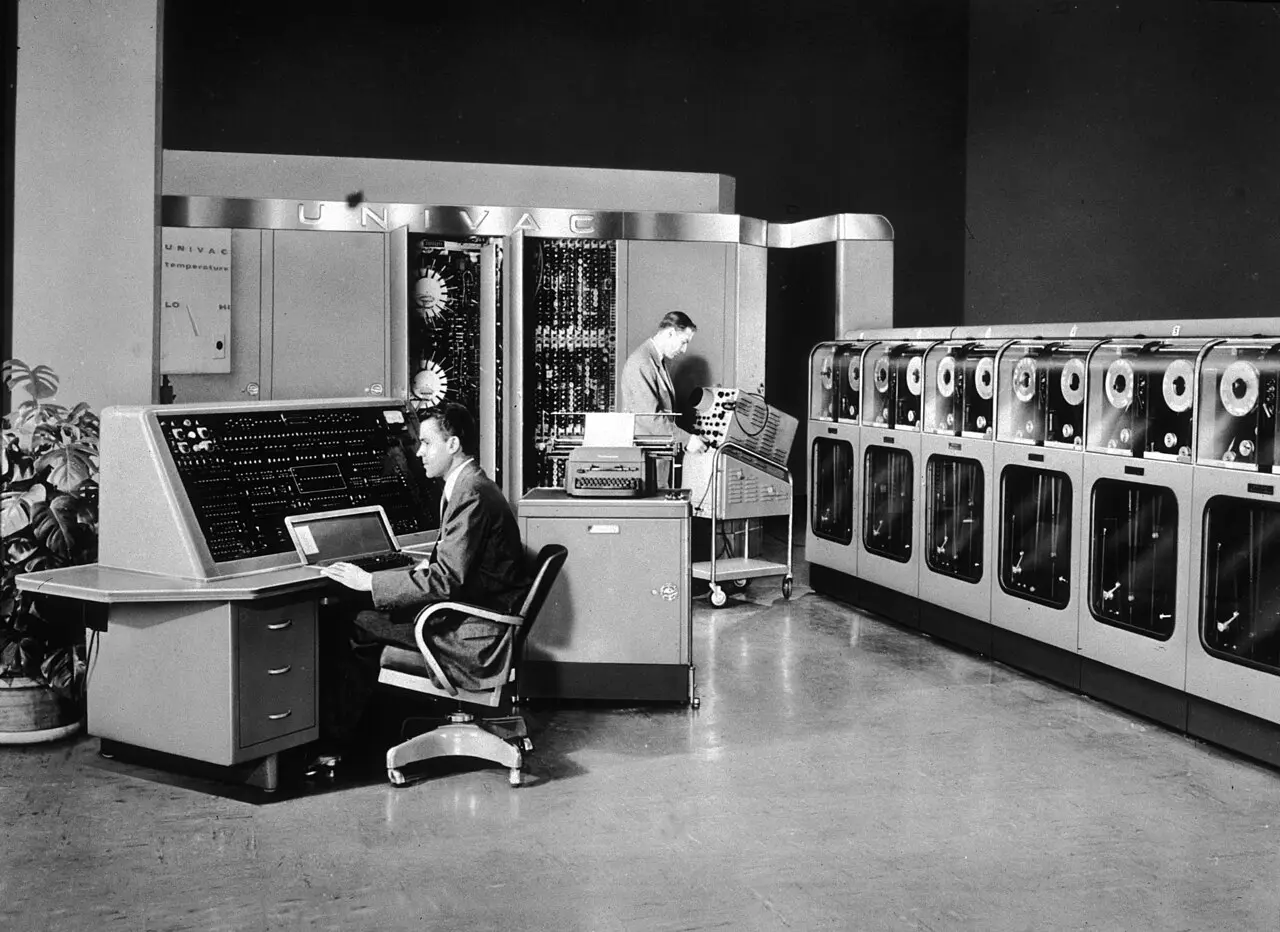
U.S. Census Bureau (via Wikimedia Commons) · Public domain · Commons ↗ The US Census Bureau accepted the first UNIVAC I on 31 March 1951. It was designed by ENIAC's J. Presper Eckert and John Mauchly, whose Eckert-Mauchly Computer Corporation had run out of money and been sold to Remington Rand in February 1950, so UNIVAC I reached the world as an acquirer's product. It was not the world's first commercial computer: the Ferranti Mark 1 was delivered to the University of Manchester in February 1951. What UNIVAC I was first at is narrower — the first commercial electronic computer built in the United States, and the first computer received by a civilian US government agency. Serial number 1 stayed at the Philadelphia plant after acceptance and was not moved into a Census Bureau building until December 1952. On election night, 4 November 1952, a UNIVAC appeared on CBS television and produced an early forecast of an Eisenhower landslide that was never put on the air.
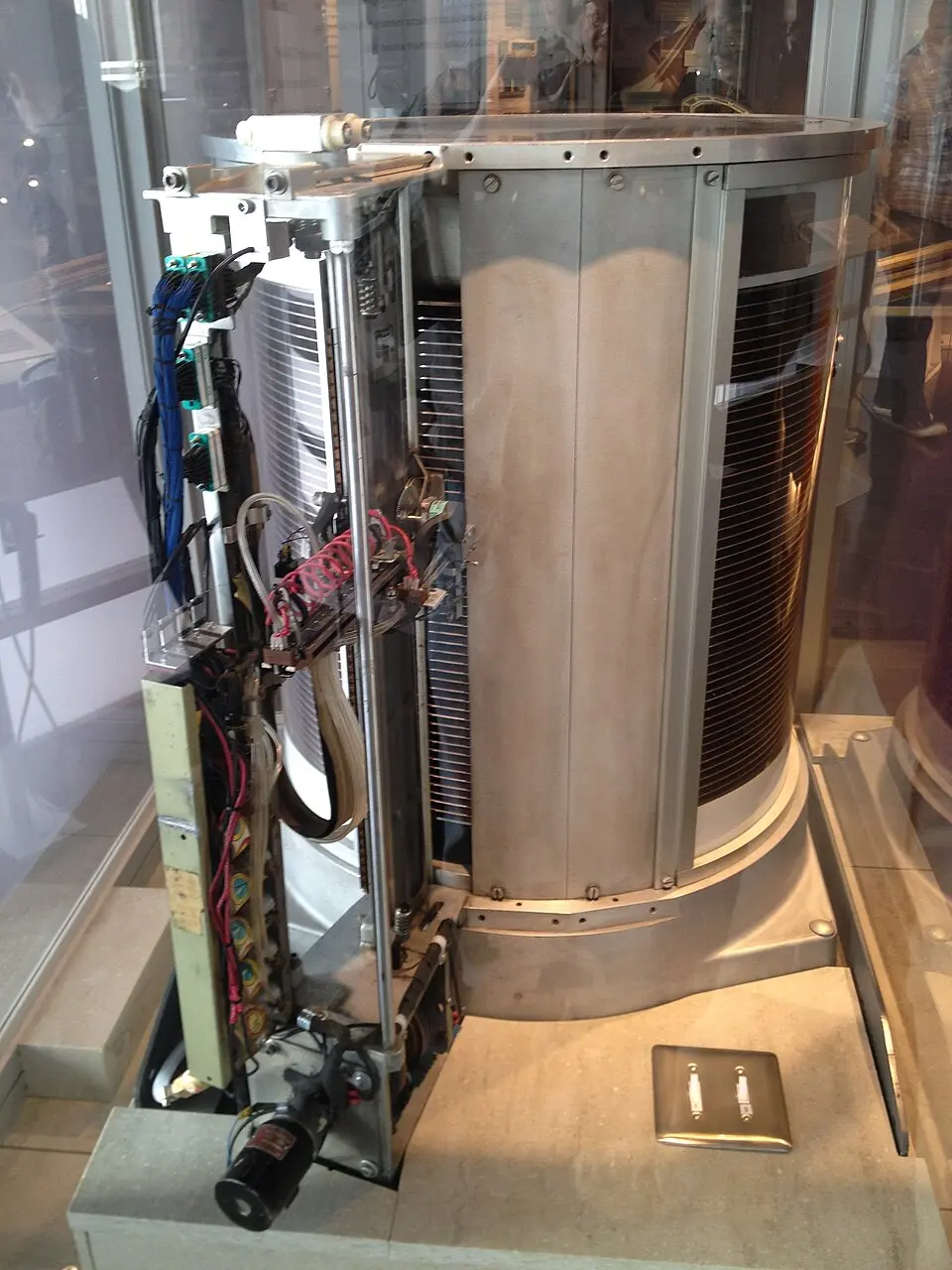
Arnold Reinhold (Wikimedia Commons user ArnoldReinhold) · CC BY-SA 3.0 · Commons ↗ IBM announced the 305 RAMAC at a press conference. Its central component, the IBM 350 disk storage unit, was the first commercial hard disk drive. A stack of 24-inch disks presented 100 recording surfaces, spun at 1,200 rpm, and a single pair of heads moving up and down and in and out reached any record in about 0.6 seconds on average. Capacity was five million characters — 3.75 MB if you count six data bits per character, 5 MB if you count a character as a byte, a number whose answer depends on the conversion. Tape forced you to read down the reel until you reached the record you wanted; RAMAC took the same time to reach any of them. That is where looking up stock or an account on the spot, rather than in the overnight batch, begins. The 305 system leased for US$3,200 a month.
1960s
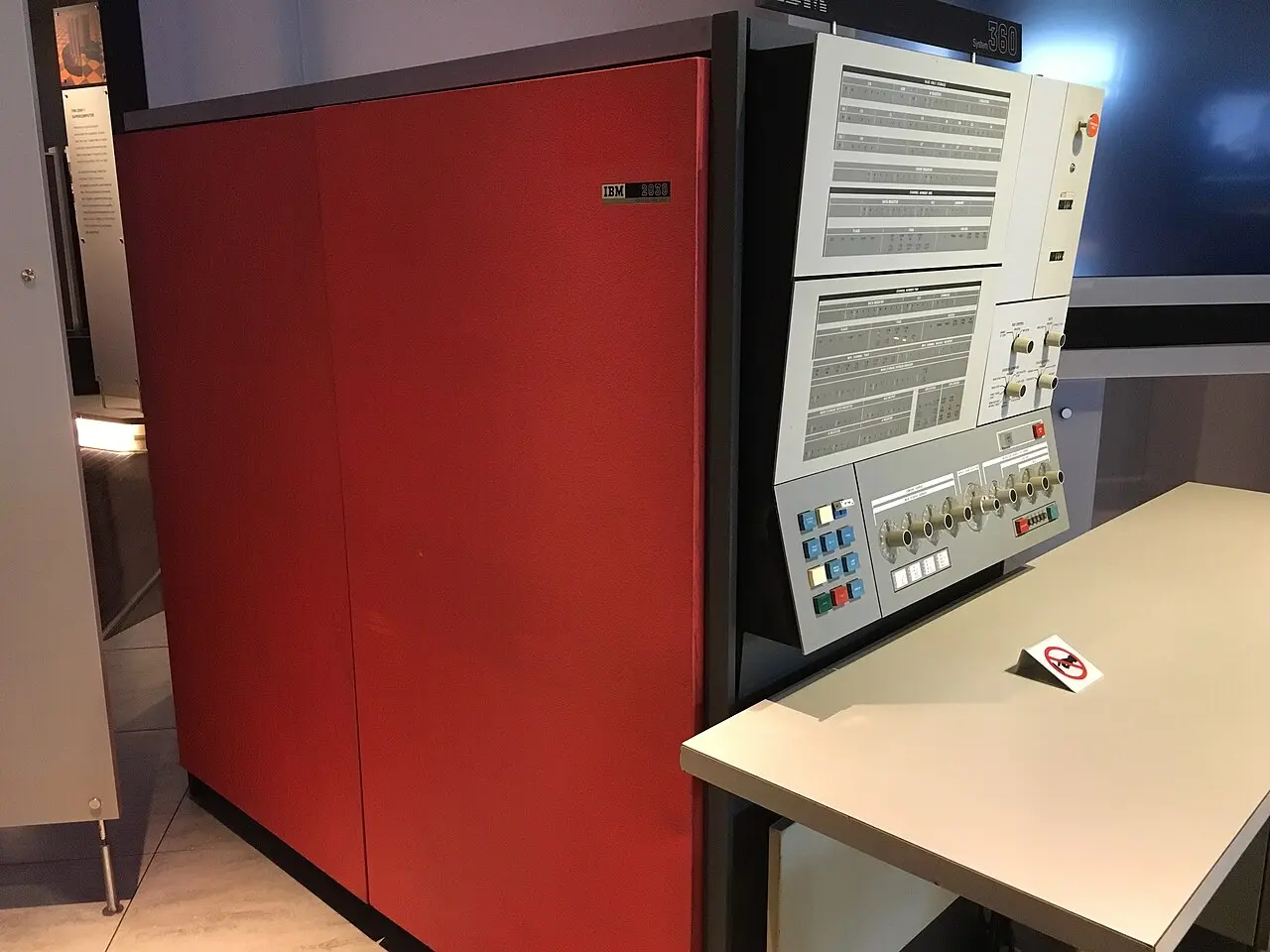
ArnoldReinhold (Wikimedia Commons) · CC BY-SA 3.0 · Commons ↗ IBM announced System/360, a family of computers spanning the whole price and performance range on one architecture. The Data Processing Division press release issued that day records that more than 100,000 people attended announcement meetings in 165 American cities, that the central processors offered 19 combinations of speed and memory capacity, and that more than 40 types of peripheral equipment came with them. The product on sale was not speed but compatibility: a program written for one model ran on any other in the line with the same class of I/O, ending the practice of throwing away software with every upgrade. IBM's own account puts development at USD 5 billion over four years — more than the company's annual revenue at the time. Deliveries were announced for the third quarter of 1965 (small configurations) and the first quarter of 1966 (largest); of the six models announced, the 60, 62 and 70 never shipped and were replaced by the 65 and 75. The struggle to deliver OS/360 produced Fred Brooks's The Mythical Man-Month.
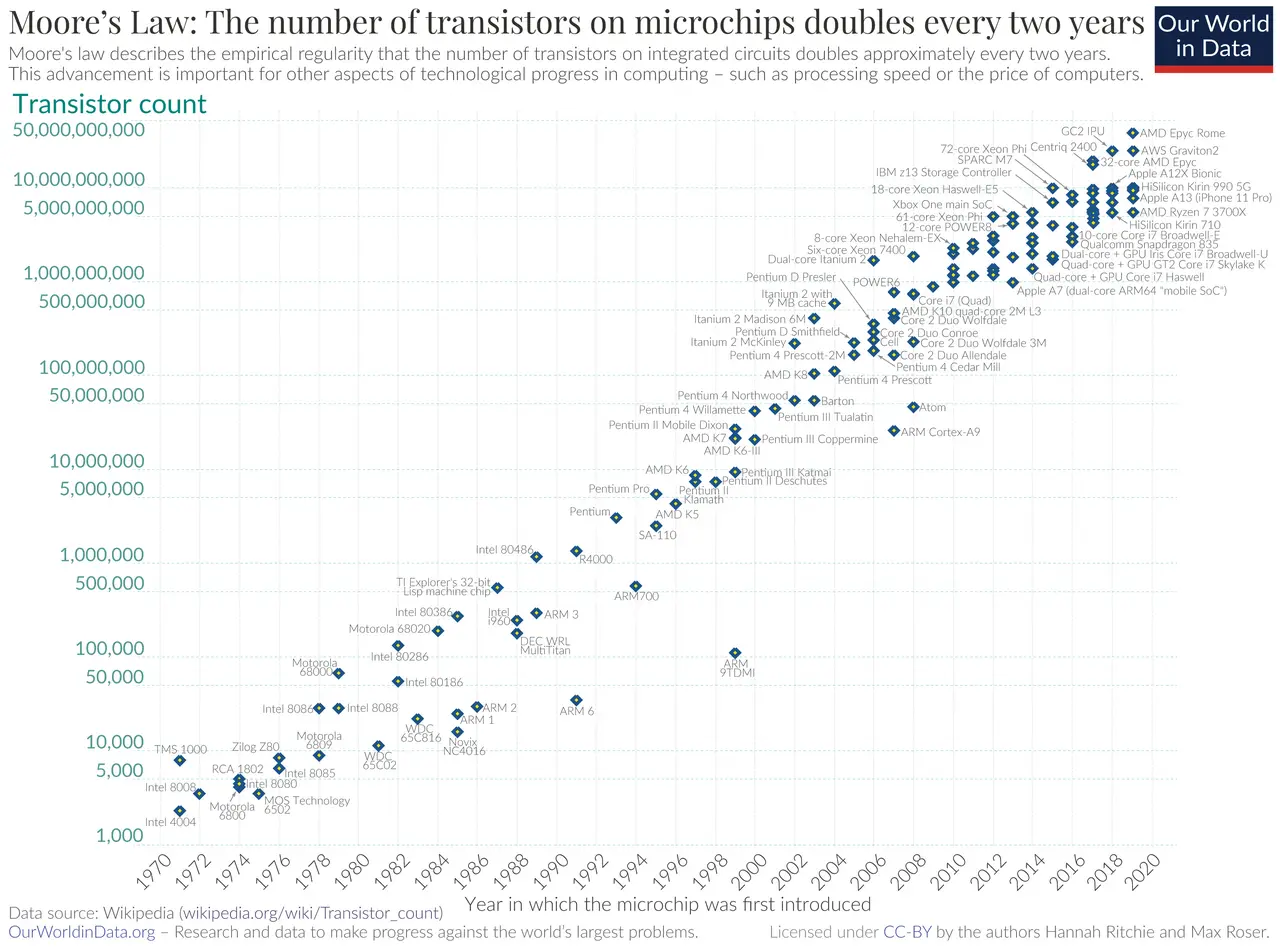
Max Roser, Hannah Ritchie / Our World in Data (Wikimedia Commons) · CC BY 4.0 · Commons ↗ Gordon Moore, director of R&D at Fairchild Semiconductor, wrote in Electronics that the number of components on an integrated circuit at minimum cost per component had been doubling roughly every year, and that the rate should hold for at least ten years: an extrapolation from a handful of data points between 1959 and 1964 that put 65,000 components on a chip by 1975. In 1975, by then at Intel, he revised the future rate at the IEEE International Electron Devices Meeting to a doubling every two years, and it is that revised figure, not the 1965 one, that circulates today as Moore's Law. In 1968 Moore and Robert Noyce co-founded Intel.
1970s
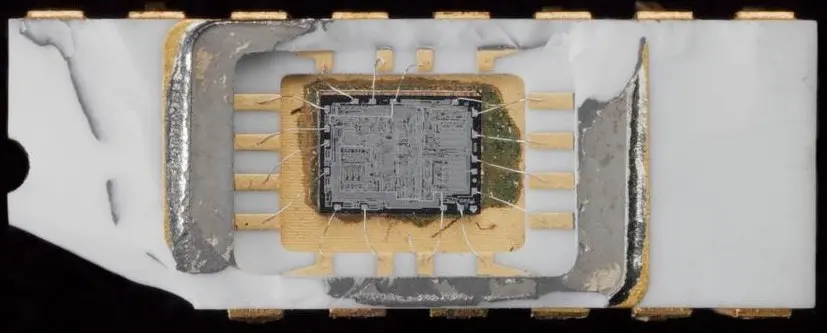
the Science Museum (Science Museum Group), via Wikimedia Commons · CC BY 4.0 · Commons ↗ A 4-bit processor conceived by Ted Hoff and Stan Mazor at Intel, laid out by Federico Faggin in silicon-gate MOS, and finished with Masatoshi Shima of the Japanese calculator maker Busicom. About 2,300 transistors in a 16-pin package, with a 10.8 μs instruction cycle of eight clock periods. It was completed in March 1971 and went on sale inside Busicom's 141-PF calculator that October; in May Intel had returned Busicom's $60,000 development money to buy back the right to sell the chip for everything but calculators. On 15 November 1971 it was announced to the public in an Electronic News advertisement. It was the first single-chip CPU sold as a component: earlier LSI processors such as Four-Phase's AL1 and the F-14's MP944 were multi-chip designs. The 8-bit 8008 was not a successor to the 4004 but a separate design for Computer Terminal Corporation, developed in parallel.
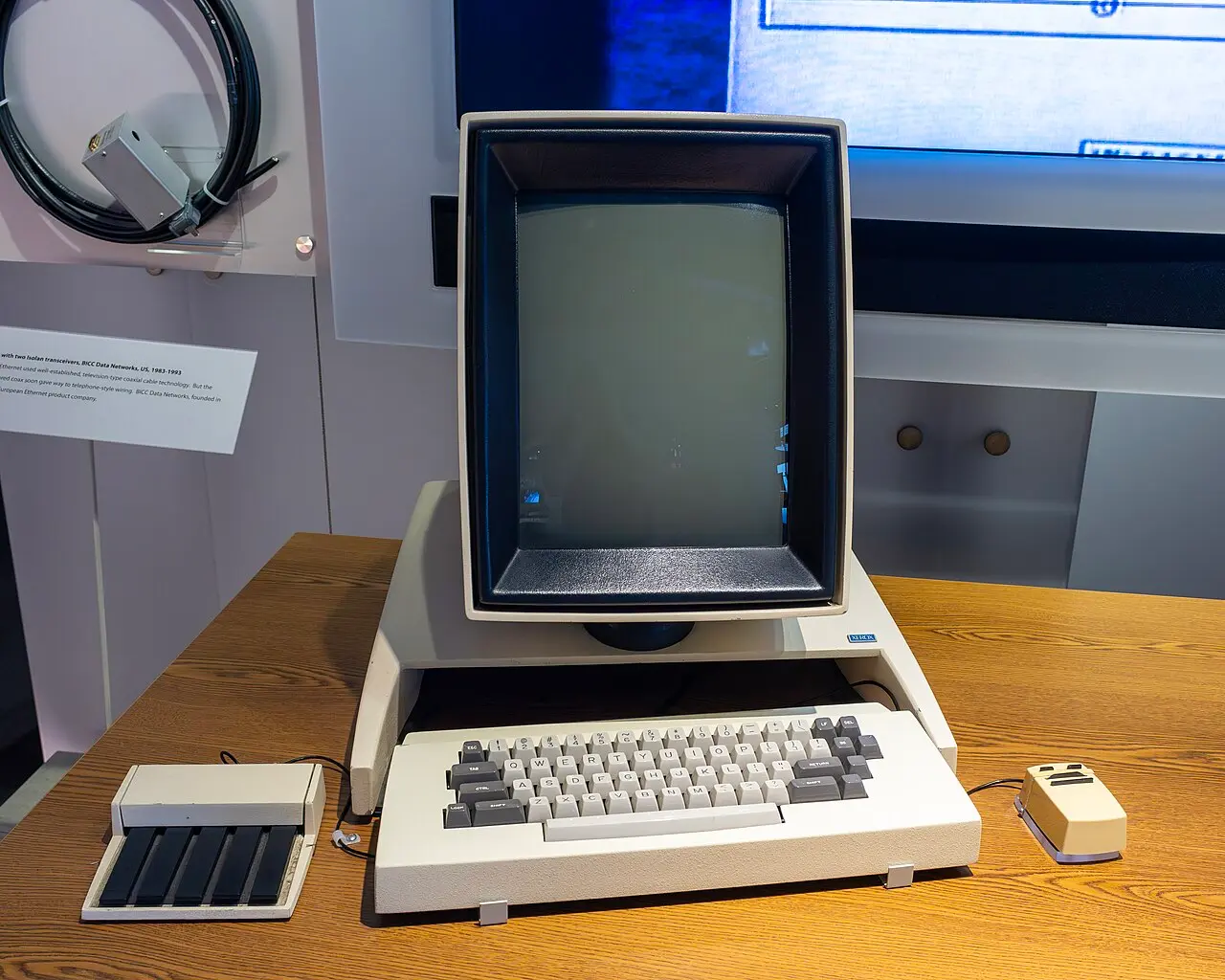
The wub (Wikimedia Commons) · CC BY-SA 4.0 · Commons ↗ An experimental machine designed at Xerox's Palo Alto Research Center (PARC) in early 1973. It stood a bitmapped CRT on its end so the screen matched a sheet of paper, gave it a three-button mouse and a five-finger chord keyset, and wired it to an Ethernet — nearly every component of the modern workstation, assembled at once. Bravo made document editing look on paper the way it looked on screen; Smalltalk made object-oriented computing a live environment. The Alto was never sold as a product, yet by the summer of 1979 close to a thousand of them were in daily use by researchers, engineers and secretaries. The demonstrations Apple received here in December 1979 fed into the Lisa and the Macintosh.
1980s
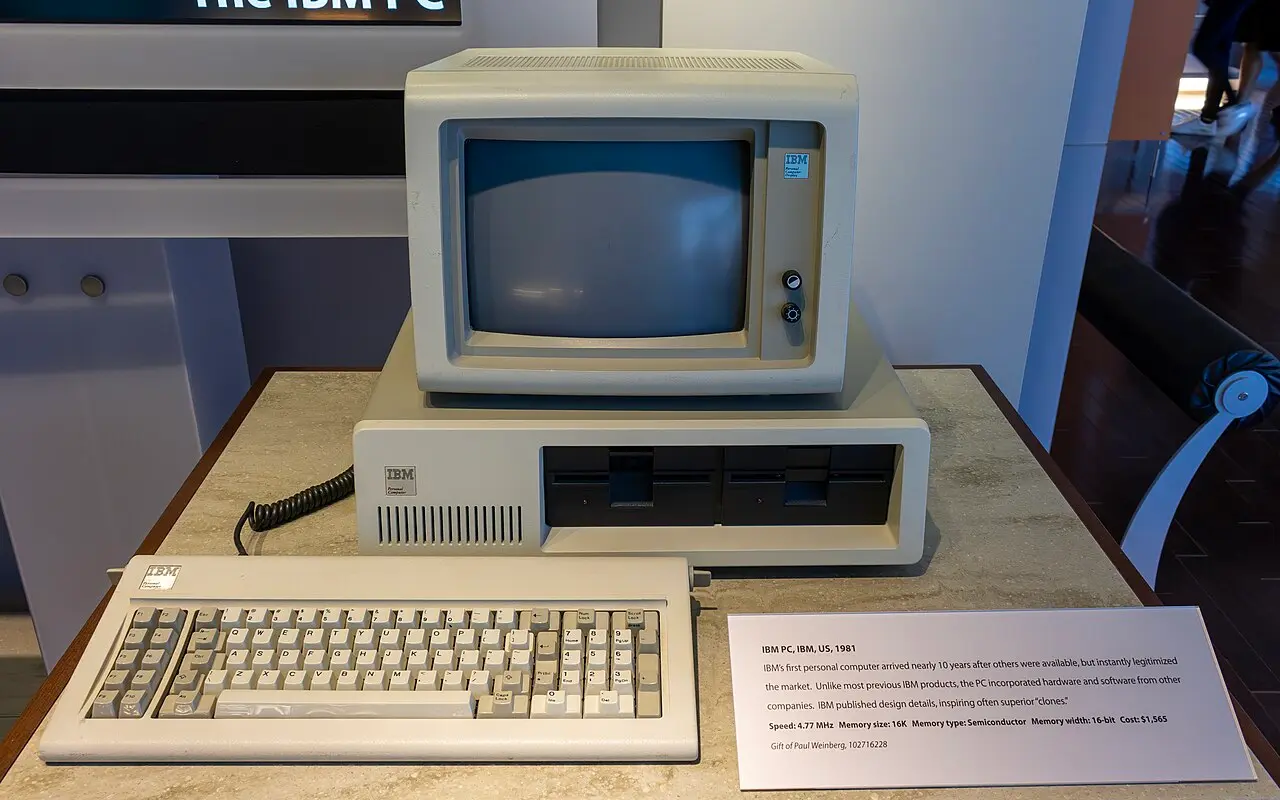
The wub (Wikimedia Commons) · CC BY-SA 4.0 · Commons ↗ IBM announced its smallest, lowest-priced computer system: the press release put it at "as little as $1,565", with 16,384 bytes of standard memory, an 83-key keyboard, and first deliveries scheduled for October. The specification mattered more than the machine. The Boca Raton team bought off-the-shelf parts, published the circuit designs in a technical reference, and left Microsoft free to sell the same operating system to anyone else. The one piece IBM kept proprietary was the BIOS in ROM — and when Compaq, founded in 1982, reimplemented it by clean-room method, the compatible-machine industry had its opening. IBM's own corporate history quotes the historian James Cortada: the company's PC market share fell from roughly 80% in 1982–83 to 20% a decade later. In 2005 IBM sold the PC division to Lenovo.
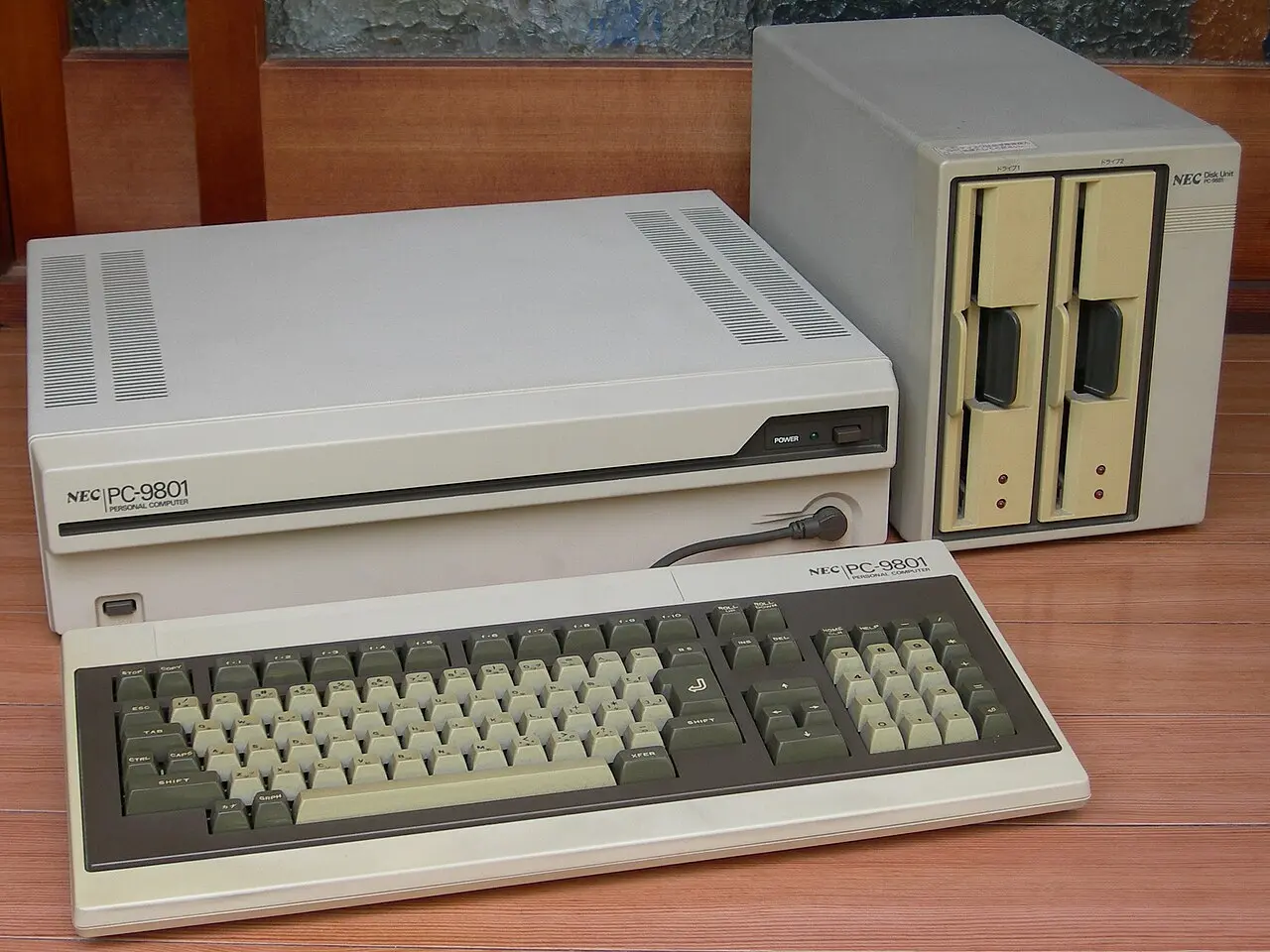
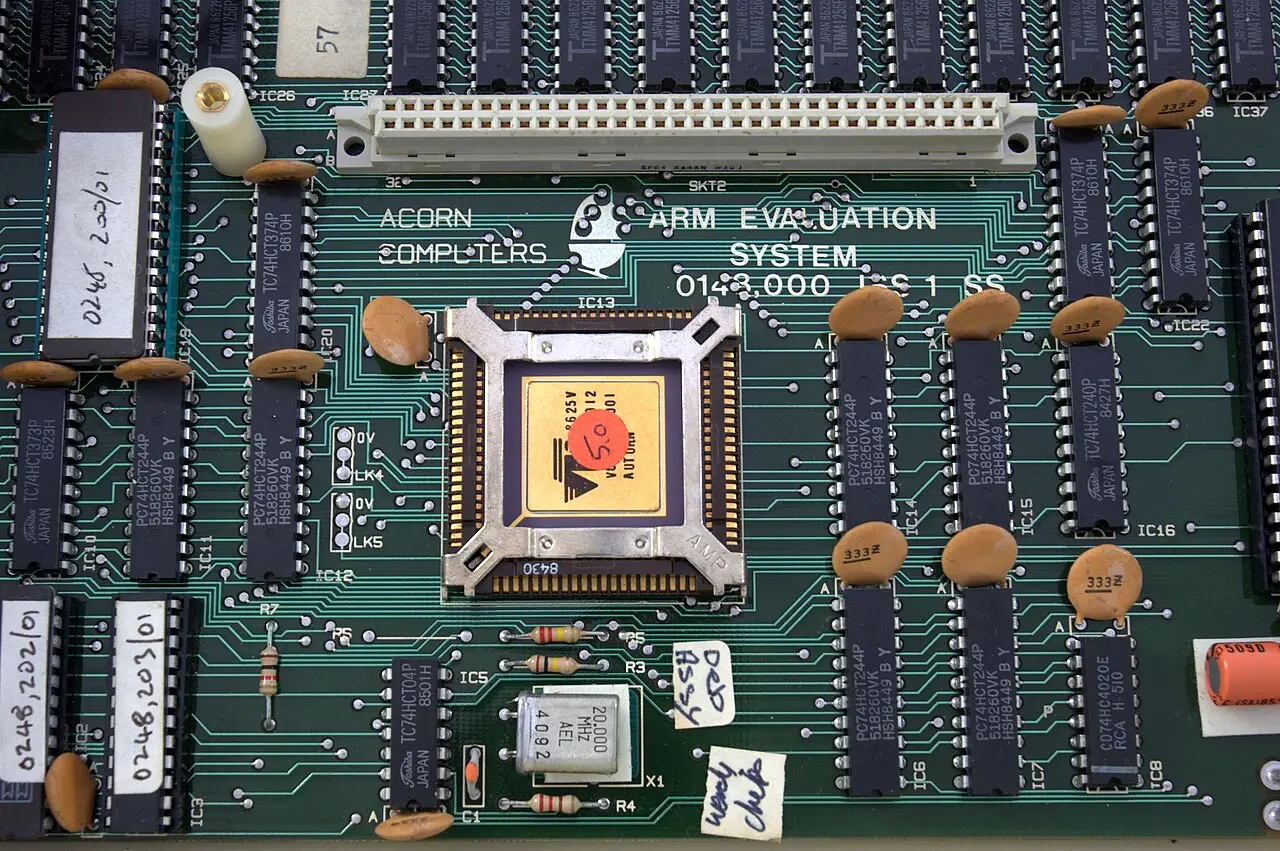
MH0301 (Wikimedia Commons) · CC BY-SA 4.0 · Commons ↗ A 16-bit personal computer announced by NEC on 13 October 1982 and the first model of the PC-9800 series, usually called the PC-98. It used NEC's 8086-compatible μPD8086 at 5 MHz and NEC's own μPD7220 graphics controller, handled Japanese text and colour graphics, and cost 298,000 yen. By giving software firms prototypes before shipment and later bundling MS-DOS, NEC built a software library that made the PC-98 the standard business PC in Japan. After the challenge of compatibles and DOS/V machines, NEC took its last orders for the PC-9800 series on 30 September 2003.
1990s
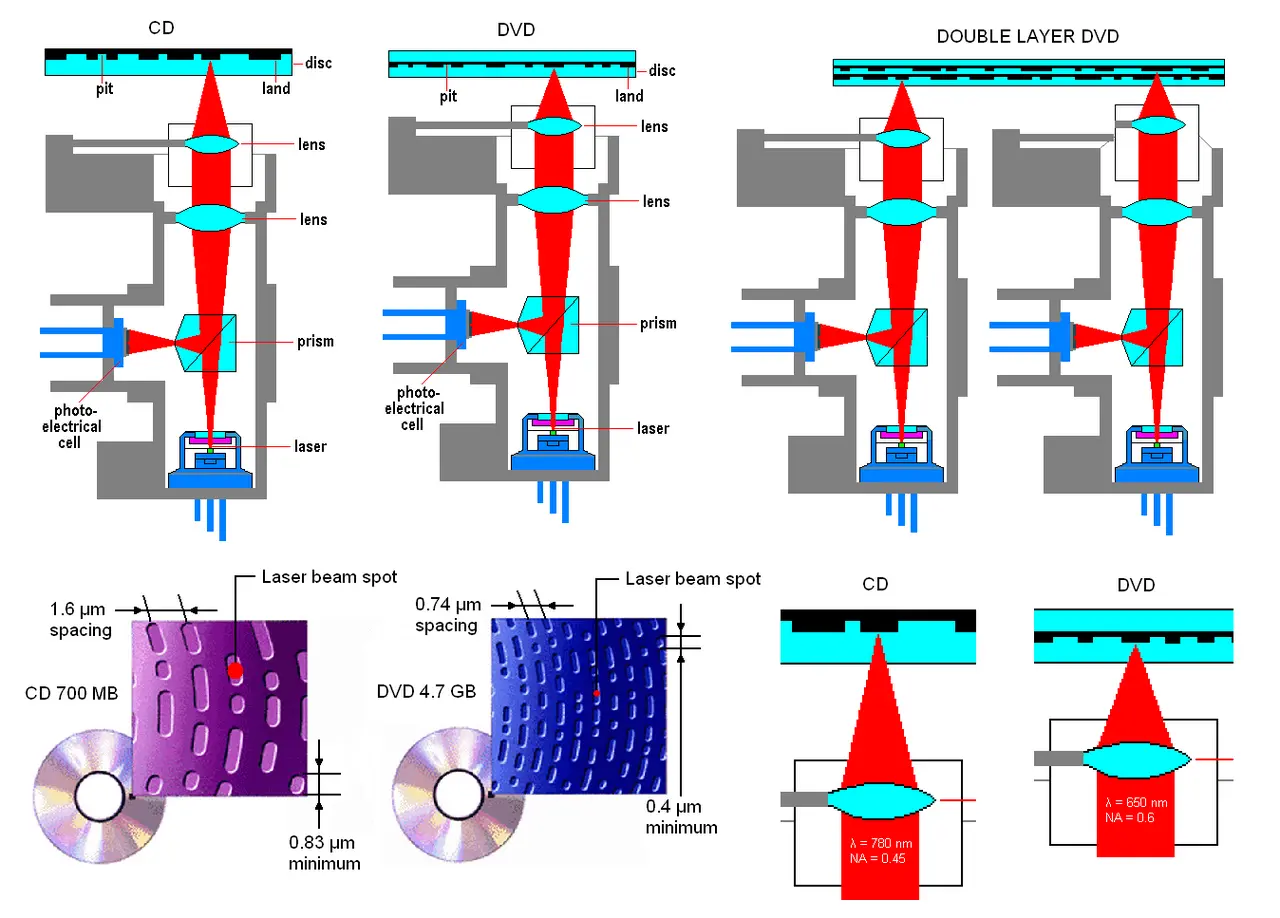
Hoikka1 (Wikimedia Commons) · CC BY-SA 3.0 · Commons ↗ An optical disc standard that fits a feature film on a 12 cm disc the size of a CD. Sony and Philips proposed MMCD in December 1994 and a camp led by Toshiba and Time Warner countered with SD in January 1995; after mediation by IBM and others in the computer industry, Sony and Philips conceded in August 1995 and the SD camp accepted the compromise on 15 September, and ten companies formed the DVD Consortium, later the DVD Forum. The first players went on sale in Japan in November 1996; Toshiba's SD-3000 (77,000 yen) had been announced for 1 November. Matsushita (Panasonic) also released its DVD-A300 in 1996, and each company calls its own model the first home player. In the United States sales began in March 1997, limited at first to seven cities including Los Angeles. PlayStation 2, released in Japan on 4 March 2000, played DVDs and helped spread the format.
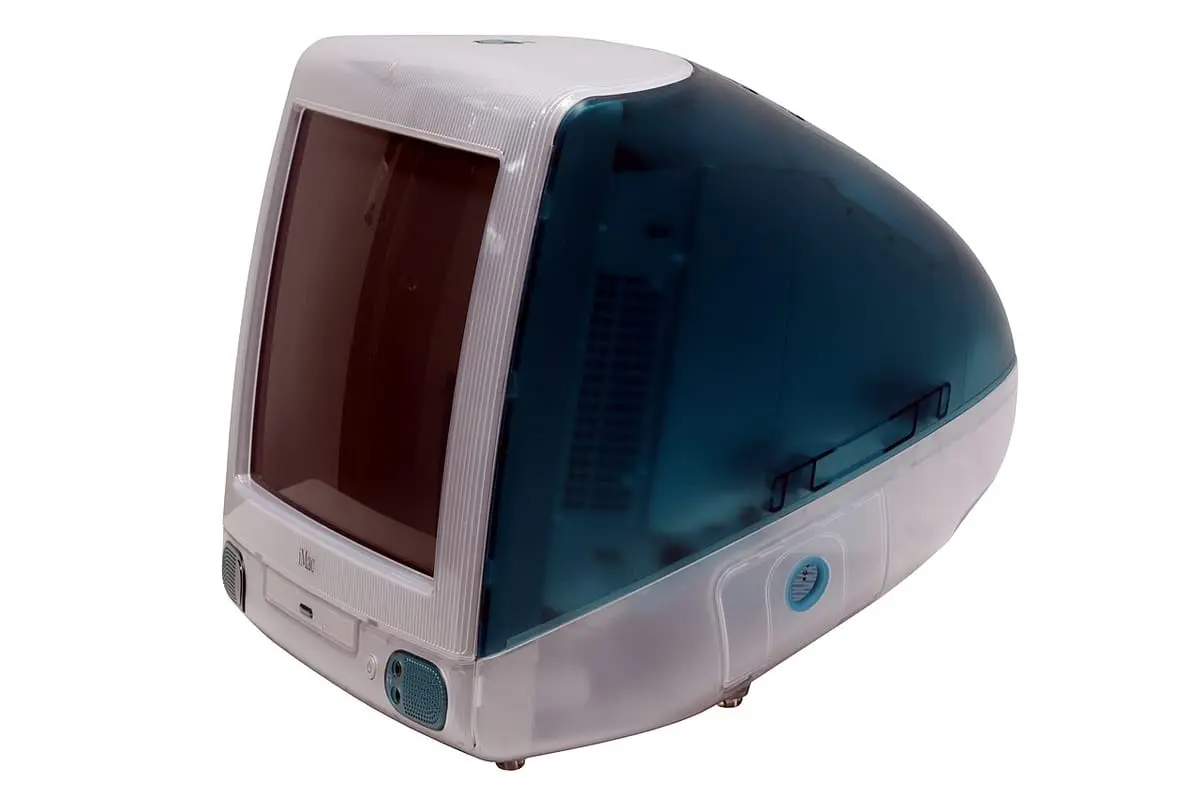
Rama & Musée Bolo (Wikimedia Commons) · CC BY-SA 2.0 FR · Commons ↗ On 6 May 1998 Apple, with Steve Jobs as interim CEO, announced the all-in-one iMac and called it the Internet-age computer. A 233 MHz PowerPC G3, a 15-inch CRT, Ethernet, a modem and two USB ports sat in a translucent case with no floppy disk drive. It cost $1,299 in the US, took orders from 3 August and went on sale in stores on Saturday 15 August. Japan got it on 29 August at 178,000 yen, with a JIS keyboard. In October Apple said it had shipped 278,000 in the first six weeks and that 29.4 percent of buyers were buying their first computer.
2000s
- EVT.021T1The First iPod — 1,000 Songs in Your PocketA History of Mobile Phones and SmartphonesRead more →
- EVT.022T1Roomba — The Robot That Went HomeA History of Artificial IntelligenceRead more →
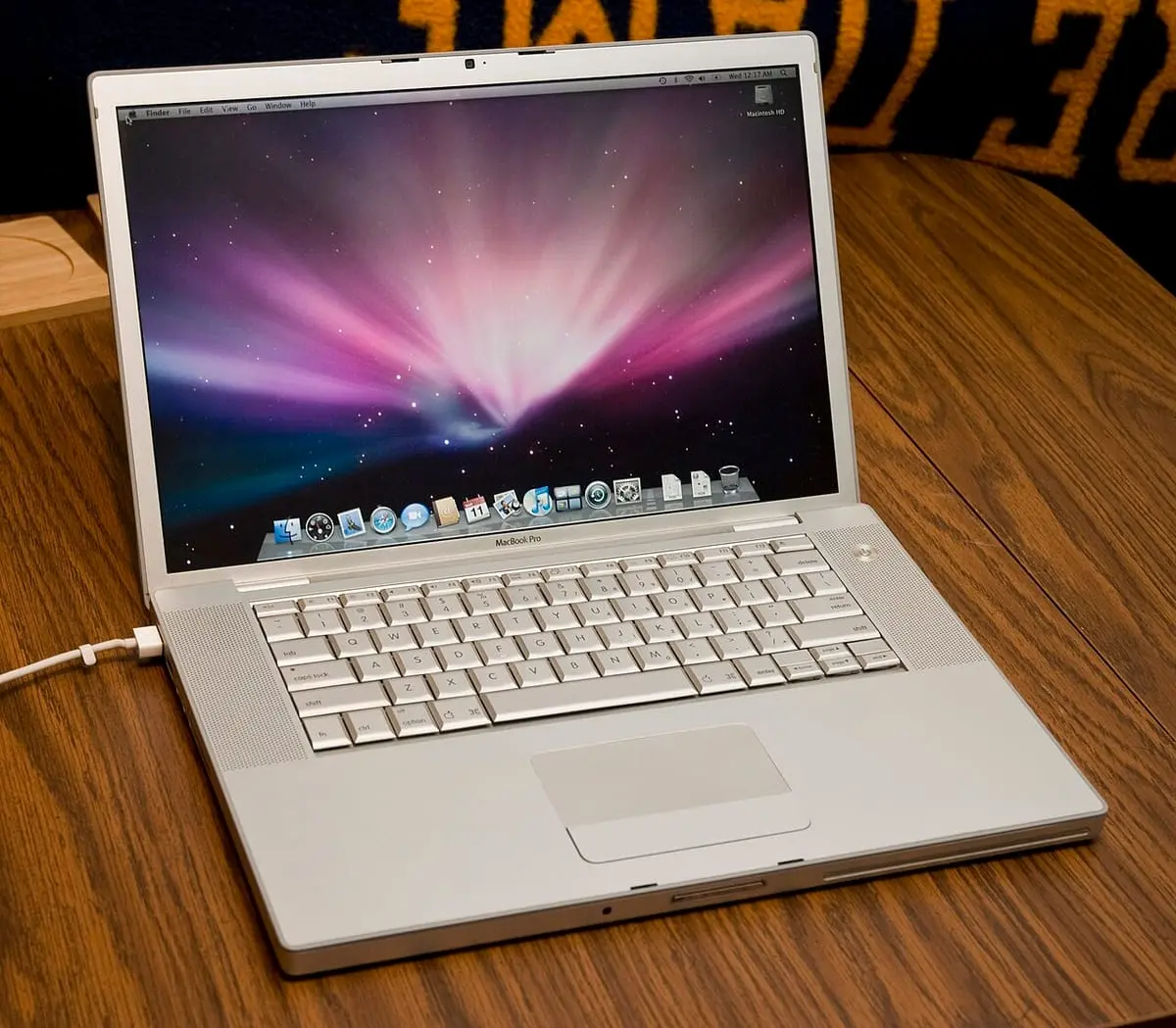
Jeff Geerling (Flickr, via Wikimedia Commons) · CC BY 2.0 · Commons ↗ Apple announced MacBook Pro at Macworld San Francisco on 10 January 2006. Replacing the PowerBook G4, it was the first Mac notebook with an Intel processor, the Core Duo. A 15.4-inch display sat in an aluminium case one inch thick and 5.6 pounds, with a built-in iSight camera, Front Row with the Apple Remote, and MagSafe, a power connector held on by magnets. It cost $1,999 and $2,499 in the US, and 249,800 and 309,800 yen in Japan. On 14 February Apple announced it was shipping and raised the processors to 1.83 GHz and 2.0 GHz at the same prices; Japanese shipments began in late February. PowerPC applications ran through Rosetta.
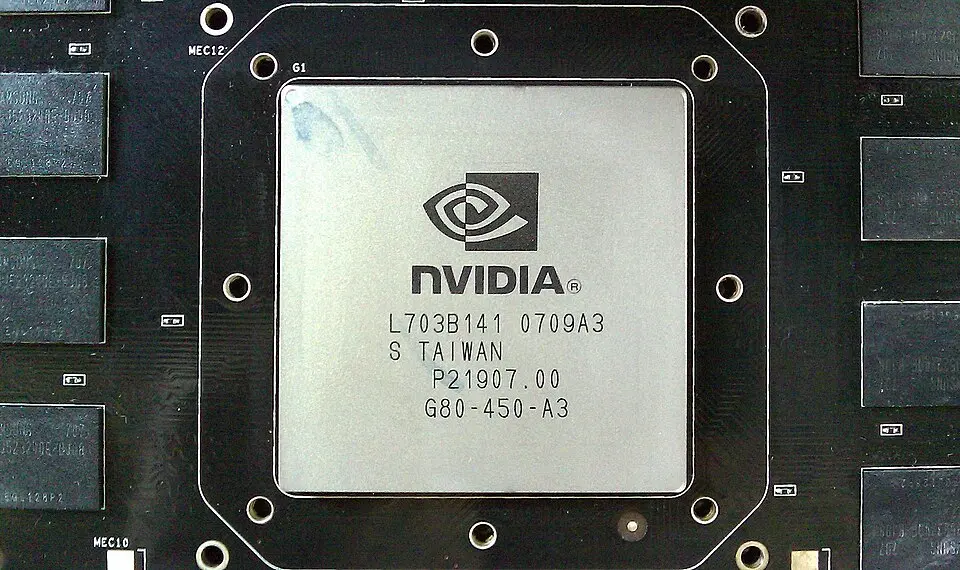
Hyins (Wikimedia Commons) · Public domain · Commons ↗ NVIDIA released version 1.0 of CUDA (Compute Unified Device Architecture), a way to use the GPU as a general-purpose parallel computer without mapping work to a graphics API. It was announced with the GeForce 8800 (G80) in November 2006; version 0.8 became the first public beta in February 2007 and 1.0 followed in June (the 1.0 Programming Guide is dated 23 June). It supported the GeForce 8 Series, Quadro FX 5600/4600 and Tesla, with C-language extensions and the CUFFT and CUBLAS libraries. Behind it lay Brook, the stream-computing language Ian Buck led at Stanford before joining NVIDIA in 2004. Scientific computing was the intended market, but in 2012 AlexNet won ILSVRC on two GTX 580s with convolution code written in CUDA, opening the road to CUDA as the computing base of deep learning.
2010s
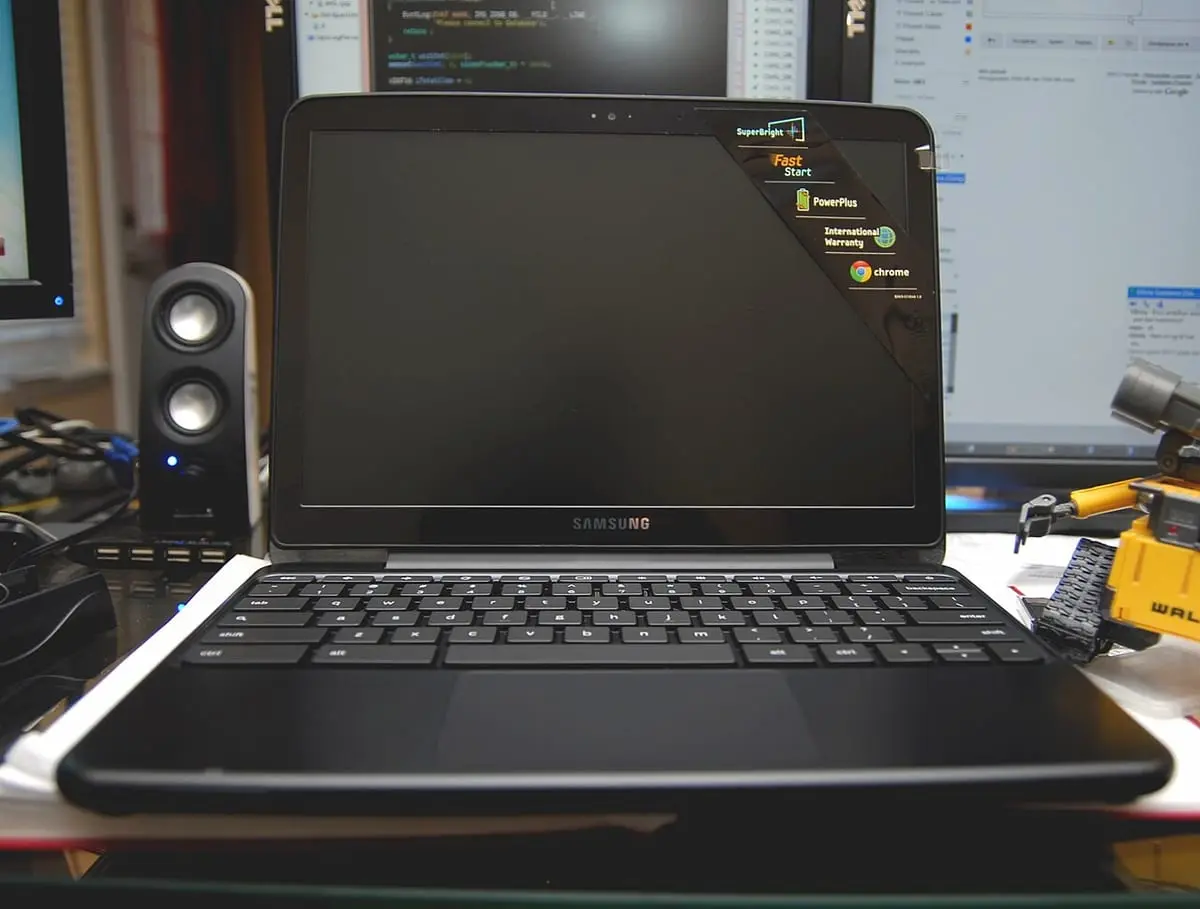
Closari (Flickr, via Wikimedia Commons) · CC BY 2.0 · Commons ↗ A Chromebook is a laptop running Google's Chrome OS. On 7 December 2010 Google began a pilot programme that gave unbranded test notebooks to selected users, developers, schools and businesses, and on 11 May 2011 at Google I/O it announced the first Chromebooks, from Samsung and Acer. Online sales began on 15 June in the US, UK, France, Germany, the Netherlands, Italy and Spain, through Amazon and Best Buy in the US. Google also announced a monthly subscription of devices plus a management console for schools and businesses, from $20 per user for schools. Google said 40 million students and educators used Chromebooks in January 2020 and 50 million students and teachers in February 2022; in Japan, ChromeOS ran on 40.0% of devices delivered to public primary and lower-secondary schools as of the end of July 2021.
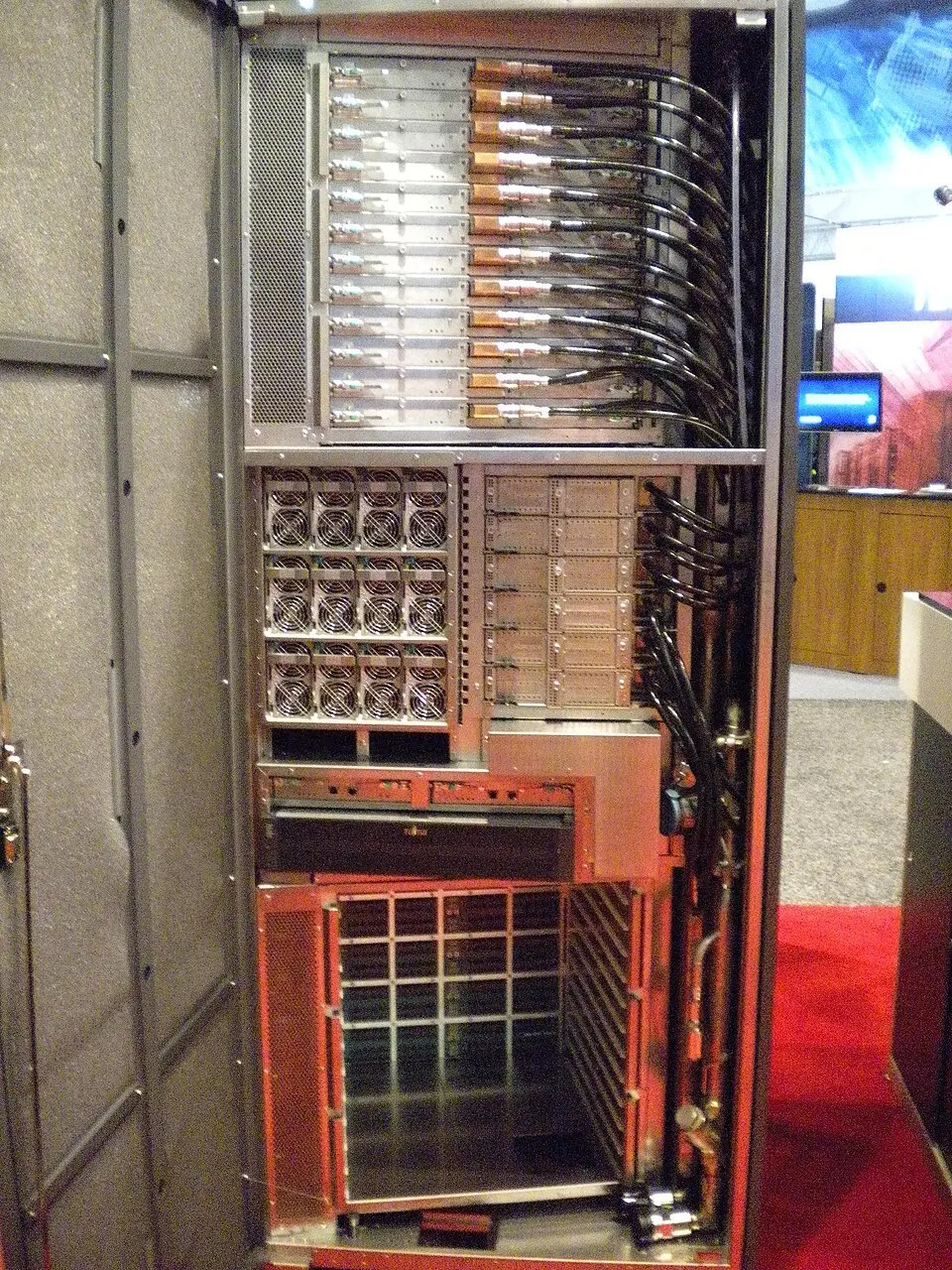
CES1596 (Wikimedia Commons) · CC BY-SA 3.0 · Commons ↗ A supercomputer developed jointly by RIKEN and Fujitsu. On 20 June 2011, in the 37th TOP500 list announced at ISC'11 in Hamburg, it took first place while still under construction: 672 racks with 68,544 CPUs delivered 8.162 petaflops on LINPACK at 93.0% efficiency. It was the first Japanese machine at No. 1 since June 2004. In November 2011, fully built with 864 racks and 705,024 cores, it reached 10.51 petaflops, which TOP500 called the first system ever to pass 10 petaflops. It used no GPUs or other accelerators, relying on Fujitsu's SPARC64 VIIIfx processors and the custom Tofu interconnect. The name 'Kei' is the Japanese unit for 10 to the 16th power. Its budget had been put under review in the 2009 government spending screening. Completed on 29 June 2012, it opened for shared use that September, ended shared use on 16 August 2019 and was shut down on 30 August, handing over to its successor, Fugaku.
- EVT.030T1AlexNet — The Deep-Learning Era BeginsA History of Artificial IntelligenceA General History of Information TechnologyRead more →
- EVT.031T1Microsoft Surface — The Windows Company Builds Its Own TabletA History of MicrosoftRead more →
- EVT.032T1iPhone 5s — Touch ID and the 64-bit A7A History of the iPhoneA History of Mobile Phones and SmartphonesRead more →
2020s
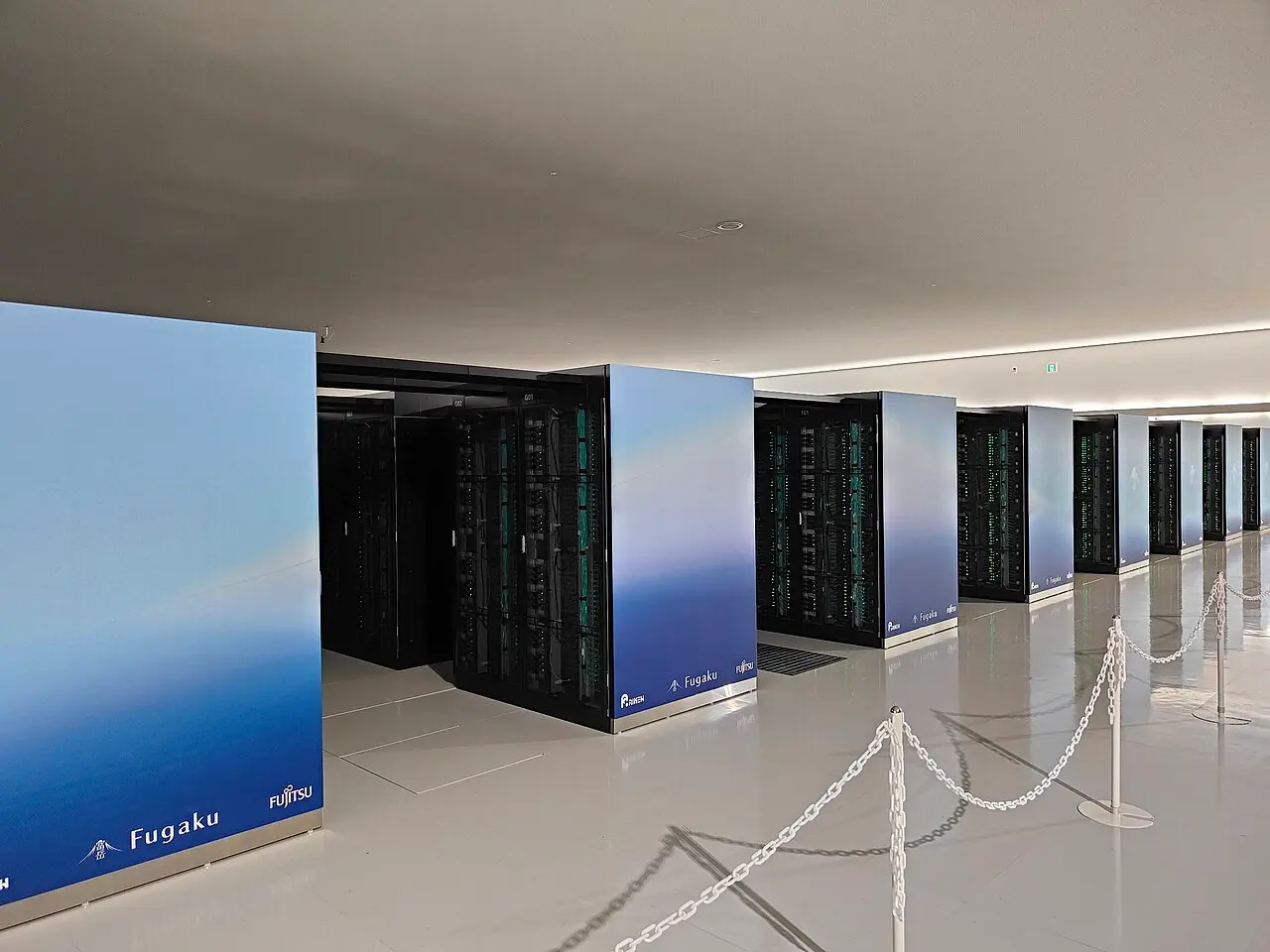
Barsaka2 (Wikimedia Commons) · CC0 · Commons ↗ A supercomputer developed by RIKEN and Fujitsu from 2014 as the successor to the K computer. On 22 June 2020, at the online ISC2020 conference, it took first place in all four rankings announced: TOP500, HPCG, HPL-AI and Graph500. Its LINPACK score of 415.5 petaflops was 2.8 times that of the second-place US Summit. It used about 7.3 million cores of Fujitsu's 48-core Arm processor, the A64FX, and TOP500 called it the first No. 1 system powered by Arm processors. It repeated the four titles in November 2020 and held the TOP500 lead for four lists until November 2021, ceding it to the US Frontier in June 2022. Before completion it was used from April 2020 for COVID-19 research, including simulations of droplet and aerosol spread that informed debate on masks and ventilation. It was completed and opened for shared use on 9 March 2021. In August 2025 RIKEN announced the team for its successor, FugakuNEXT, which adds NVIDIA GPUs.
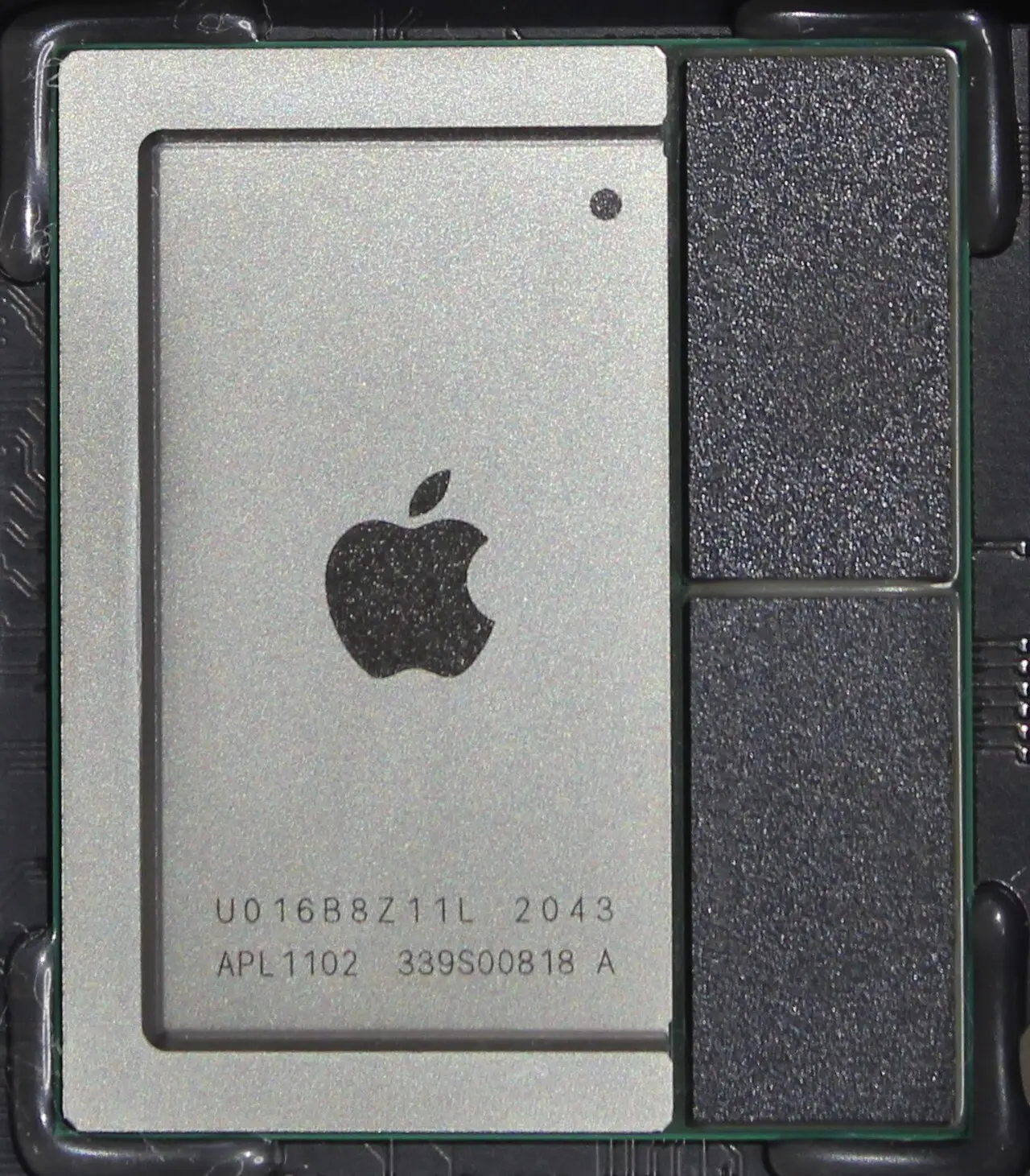
Sonic8400 · CC BY-SA 4.0 · Commons ↗ The Mac system on a chip Apple designed in-house, announced on 10 November 2020. Orders opened the same day for the M1 MacBook Air, 13-inch MacBook Pro and Mac mini, which reached stores and customers on 17 November, Japan included. US prices started at $699 for the Mac mini, $999 for the MacBook Air and $1,299 for the MacBook Pro. It put 16 billion transistors on a 5nm process, with an 8-core CPU (four performance, four efficiency), a GPU of up to eight cores, a 16-core Neural Engine and unified memory. Apple claimed up to 3.5x the CPU and 6x the GPU performance, but those were its own best-case figures gathered from different models against their predecessors. The Intel era did not end here: announcing the transition in June, Apple had said new Intel Macs were in development, and an Intel iMac followed in August. Apple declared the transition complete only with the Mac Pro in June 2023.