T1#consumer#market#hobbyist
The Altair 8800 — The Personal Computer That Started on a Magazine Cover
Metadata
- Date
- Decade
- 1970s
- Tier
- T1
- Sources
- 06
- Connections
- 03
- Tags
- #consumer#market#hobbyist
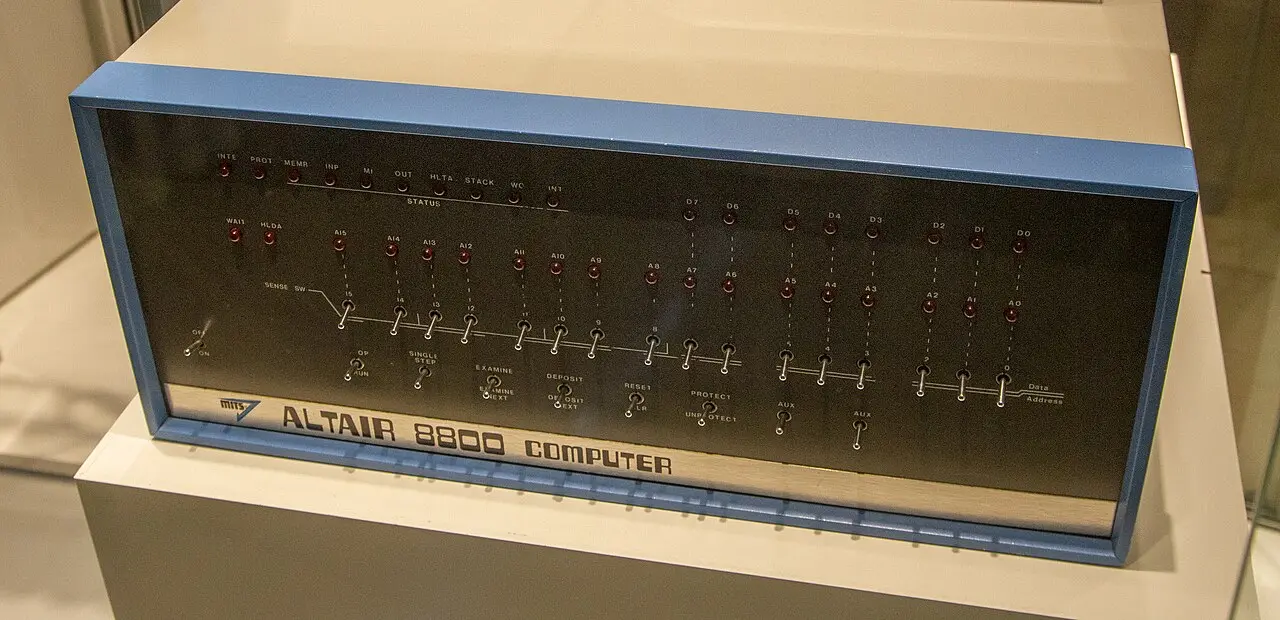
The Altair 8800 was a microcomputer built around the Intel 8080 by MITS (Micro Instrumentation and Telemetry Systems), a small company in Albuquerque, New Mexico. It was introduced in the January 1975 issue of Popular Electronics, which put it on the cover and carried a construction article by MITS's H. Edward Roberts and William Yates. Most buyers got it as a kit of parts and soldered it together themselves. It had no keyboard and no screen: programs went in through a row of switches on the front panel and results came out as patterns of LEDs. Even so, it caused a sensation for one reason — an individual could own a computer.
The January 1975 issue
The cover line read "PROJECT BREAKTHROUGH!", followed by "World's First Minicomputer Kit to Rival Commercial Models..." — the magazine's own billing. The editorial in the same issue was headed "THE HOME COMPUTER IS HERE!" and announced, with evident pride, a minicomputer project priced within reach of many households.
According to that editorial, the magazine had already turned down three computer project proposals because they would have been little more than demonstrators with blinking LEDs. The breakthrough, it said, was the availability of the Intel 8080, which it described as the highest-performance single-chip processor then available.
The construction article, "Altair 8800 Minicomputer, Part I", gave these specifications:
| As described in the article | |
|---|---|
| CPU | Intel 8080, 8-bit parallel |
| Addressing | 16-bit; up to 65,000 words of memory, all directly addressable |
| Basic memory | 256 words |
| Instruction cycle | 2 µs minimum |
| Machine instructions | 78 basic instructions (compared with 40 in the usual minicomputer) |
| Input/output | 256 inputs and 256 outputs, all directly addressable |
| Operation | Program entered on front-panel switches; LED readout in binary |
This was Part I; the second part was promised for the following month's issue.
The price
| Configuration | Price in the January 1975 issue |
|---|---|
| Partial kit (boards and electronic components; no case, switches or power supply) | $298 |
| Complete kit (all parts, including case, switches and power supply) | $397 |
| Assembled and tested (with a 90-day warranty) | $498 |
Postage was extra, and orders went to MITS's Albuquerque address. The article put the complete kit in a colour-TV receiver's price class, under $400. Later references also give $439 for the kit and $621 assembled, but the January 1975 article itself lists the prices above.
The machine on the cover
According to the Computer History Museum, the computer had not been finished, or even named, when the editor Les Solomon solicited the article; the magazine photographed an empty box and chose the name "Altair." The Centre for Computing History in the UK says the first prototype was lost in transit during a strike at the shipping company, so the machine on the cover was a hastily assembled replacement. The same organisation says the issue went on sale in the week before Christmas 1974.
The flood of orders
The Computer History Museum says that an avalanche of orders followed the cover. Its 1995 oral history with Ed Roberts covers the challenge of responding to thousands of unforeseen orders as the Altair sold far beyond projections. The Centre for Computing History reports that Roberts had originally forecast total sales of 800 machines, but that MITS received 1,000 orders in February 1975 alone.
In the same interview Roberts describes the Altair "ecosystem": the large network of people and companies who created add-on products for the computer. Memory, input/output and disk boards were built to plug into its bus, and the Altair became less a single product than a platform for peripherals.
What started with the Altair
The best-known consequence was in software. Bill Gates and Paul Allen wrote a BASIC for this machine, and that led to the founding of Microsoft; the story is told there. It was also the moment when BASIC, born at Dartmouth in 1964, began running on a machine an individual could own.
In hardware, two years later in 1977, the Apple II arrived as a finished machine that worked without opening the case and displayed colour on a television. From a box of switches and LEDs to a machine you could use as soon as you bought it — the shape of the personal computer changed from there.
MITS itself did not last. The Computer History Museum's catalogue entry says MITS was sold to Pertec in 1977, so the Altair line was short-lived. The same entry calls the Altair widely credited with sparking the personal computer revolution, while noting that home-brew experimental systems existed well before it; none had the Altair's wide-reaching popularity. The accurate claim is therefore not "the first personal computer" but the first computer kit to reach a wide public.
For the microprocessors that led to the 8080, see the Intel 4004; for the companies, Intel and Microsoft; for the person, Bill Gates; and for the period as a whole, the hardware timeline and the overview timeline.
Questions this page answers
- What was the Altair 8800?
- It was an Intel 8080 microcomputer made by MITS in the US and introduced on the cover of, and in a construction article in, the January 1975 issue of Popular Electronics. It was usually bought as a kit and assembled at home, and it had no keyboard or screen: you worked it through front-panel switches and LEDs.
- How much did the Altair 8800 cost?
- The January 1975 article listed $397 for the complete kit with case, switches and power supply, $498 assembled and tested with a 90-day warranty, and $298 for a partial kit of boards and components. Later references also give other figures, such as $439 and $621.
- What is the connection between the Altair 8800 and Microsoft?
- Bill Gates and Paul Allen wrote a BASIC for the Altair 8800 and offered it to MITS; that is how Microsoft began. The story is told on the Microsoft founding page.
- Was the Altair 8800 the first personal computer?
- Not without qualification. The Computer History Museum notes that home-built experimental systems existed before the Altair but none had its reach, and describes it as the first popular computer kit.
Sources
Cover, editorial and construction article: Intel 8080, 256 words, 78 instructions, 2 µs, 256 I/O, prices of $298, $397 and $498
SecondaryComputer in a Box: The Altair 8800 — Revolution, Computer History Museum
The first popular computer kit; the flood of orders; the cover machine and the name
TertiaryAltair 8800 — Wikipedia
Last updated: