T1#consumer#launch#standard#japan
The Compact Disc — The 12 cm Disc That Replaced the Record
Metadata
- Date
- Decade
- 1980s
- Tier
- T1
- Sources
- 08
- Connections
- 01
- Tags
- #consumer#launch#standard#japan
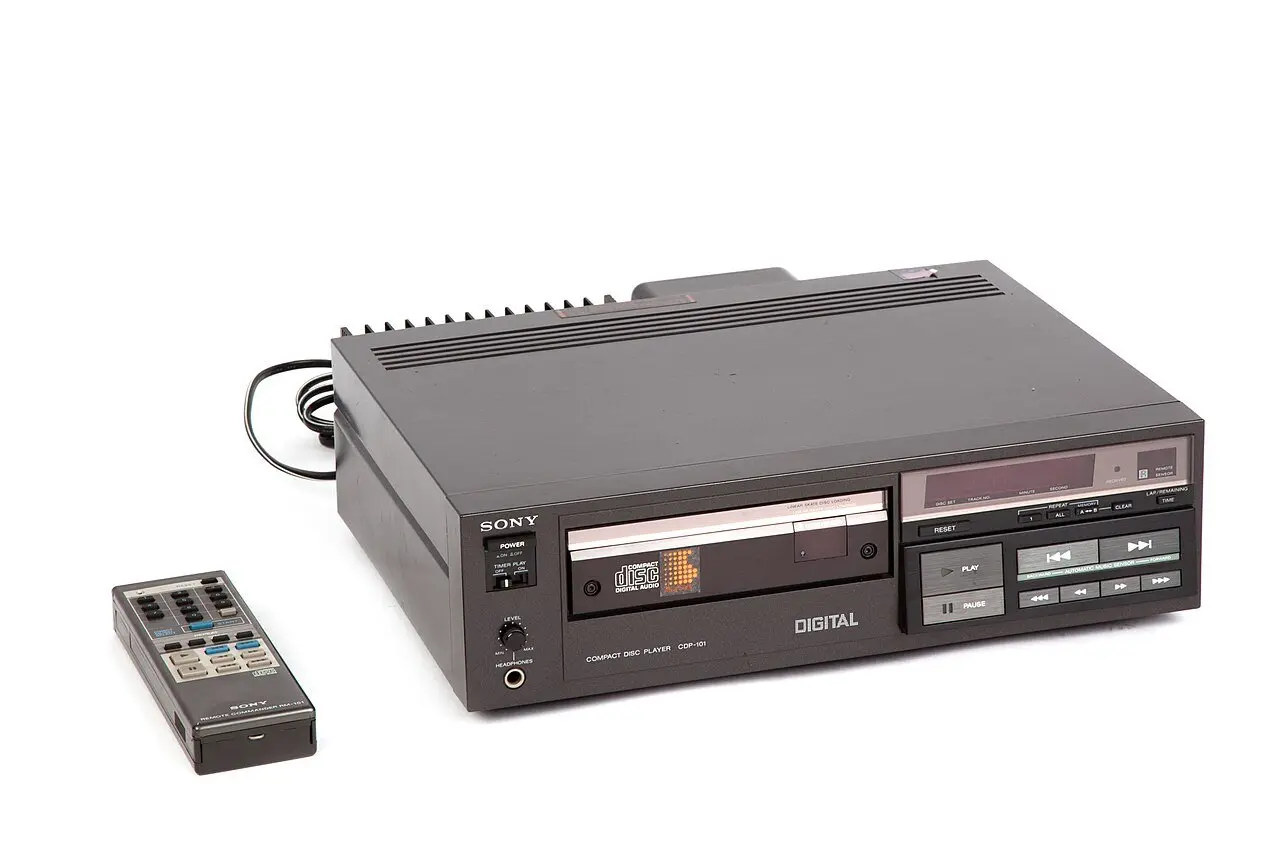
The compact disc went on sale in Japan on 1 October 1982. That day Sony released its first CD player, the CDP-101, at 168,000 yen, and CBS/Sony released 50 CD titles. According to Sony's history, the first CD to come off the production line was Billy Joel's 52nd Street. The standard was worked out jointly by Philips of the Netherlands and Sony; Philips says it introduced the CD in Europe in 1983, after the launch in Japan at the end of 1982.
| Item | Detail |
|---|---|
| Joint development begins | August 1979 (Sony and Philips) |
| Common standard settled | June 1980 |
| Announcement | 31 August 1982 (Sony, CBS/Sony, Philips and PolyGram) |
| Release | 1 October 1982 (Japan) |
| First player | Sony CDP-101, 168,000 yen |
| Disc | 12 cm diameter, maximum playing time 74 min 42 s |
| Audio | 44.1 kHz sampling, 16-bit |
| Coding | CIRC error correction, EFM modulation |
| Specification | The "Red Book", also published as IEC 60908 |
Dates, price and disc dimensions are from Sony's history; coding and the specification are from the account of Philips engineer Hans B. Peek.
Philips' "ALP" and Sony's PCM
The CD joined two technologies that had grown up separately. According to Peek, Philips had shown its optical video disc system (VLP) to the press in 1972, and early in 1974 it set up a project to use the same technology for music, called ALP (Audio Long Play). A prototype CD system with a small disc, now digital and with error correction, was presented in public on 8 March 1979.
Sony, according to its history, had been working on digital audio (PCM) under Heitaro Nakajima, who came from NHK's research laboratories. In September 1977 it put a PCM processor on sale, the PCM-1 at 480,000 yen, which recorded and played digital sound together with a video tape recorder, and it had begun research on recording digital audio directly on an optical disc.
Sony's history says that when Norio Ohga, then vice president, visited Philips headquarters in Eindhoven in June 1978, he was shown the ALP disc with the explanation that a disc 11.5 cm across could hold an hour of music, and was sounded out about developing it together. The two companies had worked together on standardising the Compact Cassette in the 1960s, and each owned a record company: PolyGram and CBS/Sony.
16 bits, 12 cm, 74 minutes 42 seconds
Joint development began at the end of August 1979. Peek writes that the first meeting was held in Eindhoven on 27 and 28 August, that six meetings followed in turn with Tokyo, and that the last took place in Tokyo on 17 and 18 June 1980. Error correction became CIRC (cross-interleaved Reed-Solomon code) and modulation became EFM (eight-to-fourteen modulation), and the two companies applied for patents on both.
In Sony's account the arguments were about numbers. On quantisation, Philips wanted 14 bits and Sony's Toshitada Doi refused to accept anything less than 16. On the disc, Philips proposed 60 minutes on 11.5 cm and Sony wanted 75 minutes on 12 cm. Ohga argued that an opera act must not be cut off mid-way and that Beethoven's Ninth had to fit; a survey of classical performances showed that 75 minutes would hold more than 95 percent of works. When Philips objected that a 12 cm disc would not fit in a jacket pocket, Sony measured jacket pockets in Japan, the US and Europe and found none smaller than 14 cm. The result was a maximum playing time of 74 minutes 42 seconds, a 12 cm disc, 44.1 kHz sampling and 16 bits.
Peek tells the same story from the Philips side, attributing to J. Sinjou the account that the change to 12 cm was Ohga's personal wish, so that his favourite 74-minute performance of the Ninth would fit. The size of the centre hole, he adds, was settled when Sinjou put a Dutch dime on the table.
The combined system was named the Compact Disc Digital Audio System. Peek notes that the full standard is described in the so-called Red Book and is also available as IEC 60908 from the International Electrotechnical Commission.
One industry standard, one year to launch
According to Sony's history, standards for a digital audio disc were being discussed in the DAD (Digital Audio Disc) conference of 29 companies from Japan and abroad. In June 1980 the conference began evaluating three systems: the optical system from Sony and Philips, a mechanical system from Telefunken and a capacitance system from JVC. In April 1981 the field was narrowed to two, the optical system and JVC's. By the time Sony launched the CD, Sony's history says, nearly every company had announced it would adopt the CD system, making it the de facto world standard.
Ohga set the launch for October 1982. The optical pickup, the semiconductor laser and the LSI chips that had to do the work of 500 ICs in three were not yet ready. On the disc side, CBS/Sony built CD pressing equipment at its plant in Shizuoka Prefecture and started the line in April 1982. The last problem, warping, was solved with polycarbonate, a material used in car bumpers, and pressing reached steady production only in mid-September, a fortnight before launch.
1 October 1982
On 31 August 1982 Sony, CBS/Sony, Philips and PolyGram held a joint announcement at the Keidanren Kaikan in Otemachi, Tokyo, and said sales in Japan would begin that autumn. On 1 October Sony released the CDP-101. The model number came from the binary "0101"; Nobuyuki Idei, head of the audio division, chose it because "5" often marked a mid-range model.
The same day CBS/Sony released 50 CD titles, covering pop, rock and Japanese kayōkyoku as well as classical music, and just over 100 titles were out by the end of the year. Sony's history names Billy Joel's 52nd Street as the first CD produced.
Philips' media library describes the Japanese launch as "end 1982" and its own European introduction as 1983. The companies date it differently, but both put Japan first.
A player under 50,000 yen, and the LP overtaken
The CDP-101 sold well for a while, but Sony's history says buyers were mainly classical and jazz enthusiasts who cared most about sound quality, and the market then stalled for about a year. What changed it was the D-50 portable CD player, released in November 1984 at 49,800 yen. Akio Morita set the policy of pricing it under 50,000 yen; it was sold at a loss, with costs at 200 percent of the price, but moved into profit within a year and a half. Its small-player successors were named "Discman", positioned like the Walkman as something you could listen to while walking.
In production figures from the Recording Industry Association of Japan (RIAJ), CDs reached 45.12 million discs in 1986, ahead of the 42.75 million 25/30 cm LPs (33 rpm). Sony's history makes the same point: just four years after the first player, the CD had become the majority format.
The peak and after
In RIAJ figures, Japanese production of CDs, 8 cm and 12 cm combined, was about 457 million discs in both 1997 and 1998. Production value peaked in 1998 at about 587.9 billion yen. In 2025 the figures were about 102.7 million discs and about 144.5 billion yen, roughly 22 percent of the 1998 volume and 25 percent of its value.
In the United States, the RIAA's 2006 statistics (covering 1996 to 2006) show CD shipments at their highest in 2000, at 942.5 million units and $13,214.5 million at retail value, falling year after year to 614.9 million in 2006. According to the RIAA's 2024 report, 33 million CDs were shipped in 2024, fewer than the 44 million vinyl albums for the third year in a row, and CD revenue was $541 million.
The decline coincided with the spread of music files in MP3, file sharing through Napster, download sales on iTunes and streaming services such as Spotify. The statistics above give volumes and values only; they do not break down the causes.
From music carrier to a family of optical discs
The CD did not stay a music format. Sony's history records that CD-ROM for data was standardised in 1985 and Video CD in 1993, and Peek lists the line that followed: CD-ROM, CD-R, CD-RW, DVD and Blu-ray. The same 12 cm disc carried on in DVD and Blu-ray. Ten years after the CD, Sony released a small recordable disc, the MiniDisc.
For the wider story of the hardware, see the hardware timeline.
Questions this page answers
- When did the CD first go on sale?
- According to Sony's history, Sony released its first CD player, the CDP-101, in Japan on 1 October 1982, and CBS/Sony released 50 CD titles the same day. Philips gives 1983 for the launch in Europe.
- What was the first CD?
- Sony's history says that of the 50 titles CBS/Sony released on 1 October 1982, the first CD to come off the production line was Billy Joel's 52nd Street.
- Why is a CD 12 cm across?
- According to Sony's history, Philips first proposed an 11.5 cm disc holding 60 minutes. Sony, following Norio Ohga's view that the disc had to hold Beethoven's Ninth, wanted 75 minutes, which needed 12 cm, so the maximum playing time became 74 minutes 42 seconds and the diameter 12 cm.
- When did CD sales peak?
- In the Recording Industry Association of Japan's figures, CD production in Japan peaked in value at about 587.9 billion yen in 1998, with volume at about 457 million discs in both 1997 and 1998. In the US, RIAA figures put CD shipments at 942.5 million units in 2000.
Sources
Primary第8章 「レコードに代わるものはこれだ」<コンパクトディスク> — ソニーグループ「Sony History」(archived Oct 11, 2021)
Ohga's June 1978 visit to Philips, the start of joint development in August 1979, 14 versus 16 bits, 11.5 versus 12 cm and 74 minutes 42 seconds, 44.1 kHz, the DAD conference proposal and the end of its evaluation in April 1981, the October 1982 launch target
Primary第9章 石もて追われる大賀 — ソニーグループ「Sony History」(archived Nov 17, 2025)
The CD pressing line from April 1982, the switch to polycarbonate, the four-company announcement on 31 August, the CDP-101 release on 1 October at 168,000 yen, the origin of the model number, the 50 titles and the first production disc (52nd Street), just over 100 titles by year-end, the D-50 of November 1984 at 49,800 yen
Primary第10章 スタジオ録音もデジタルに <ミニディスク> — ソニーグループ「Sony History」(archived Nov 17, 2025)
CDs overtaking LPs in Japanese production in 1986 and passing 300 million in 1992; CD-ROM (standardised 1985) and Video CD (1993)
An account by a Philips engineer who took part: the prototype shown on 8 March 1979, six meetings from 27-28 August 1979 to 17-18 June 1980, CIRC and EFM, 44.1 kHz, 16 bits and 12 cm, the Red Book and IEC 60908
PrimaryCompact Disc, 1982-1983 — Philips Media library
Philips introduced the CD in Europe in 1983 after its launch in Japan at the end of 1982
Primary音楽ソフト種類別生産実績推移 — 一般社団法人 日本レコード協会
Annual production volume and value for CDs (8 cm and 12 cm) and 25/30 cm 33 rpm records; totals in the text add the 8 cm and 12 cm columns
Primary2006 Year-End Shipment Statistics — RIAA (archived Jun 25, 2007)
US CD unit shipments and retail value, 1996-2006; 942.5 million units and $13,214.5 million in 2000
PrimaryRIAA 2024 Year-End Revenue Report
Vinyl albums 44 million versus CDs 33 million in 2024; CD revenue $541 million
Last updated: