Detailed · 26 events
A History of Operating Systems
1960s
- EVT.001T1Engelbart's Demo — Ninety Minutes of Interactive ComputingA History of the Internet and the WebA General History of Information TechnologyRead more →
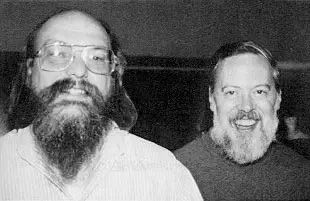
Unknown (via Jargon File, Wikimedia Commons) · Public Domain · Commons ↗ Having left the Multics project, Ken Thompson at AT&T Bell Labs began writing a small timesharing system on an idle PDP-7. Initially an experiment for one user, it gained a second when Dennis Ritchie joined; in 1970 it was named UNICS (later UNIX). Its 1973 rewrite in the C language (designed in 1972) gave it portability, and the operating-system lineage that followed has dominated the next half-century. Linux, macOS, Android, and iOS all descend from it.
1970s
- EVT.003T1The Xerox Alto — The Machine That Was Never SoldA History of Semiconductors and HardwareA General History of Information TechnologyRead more →
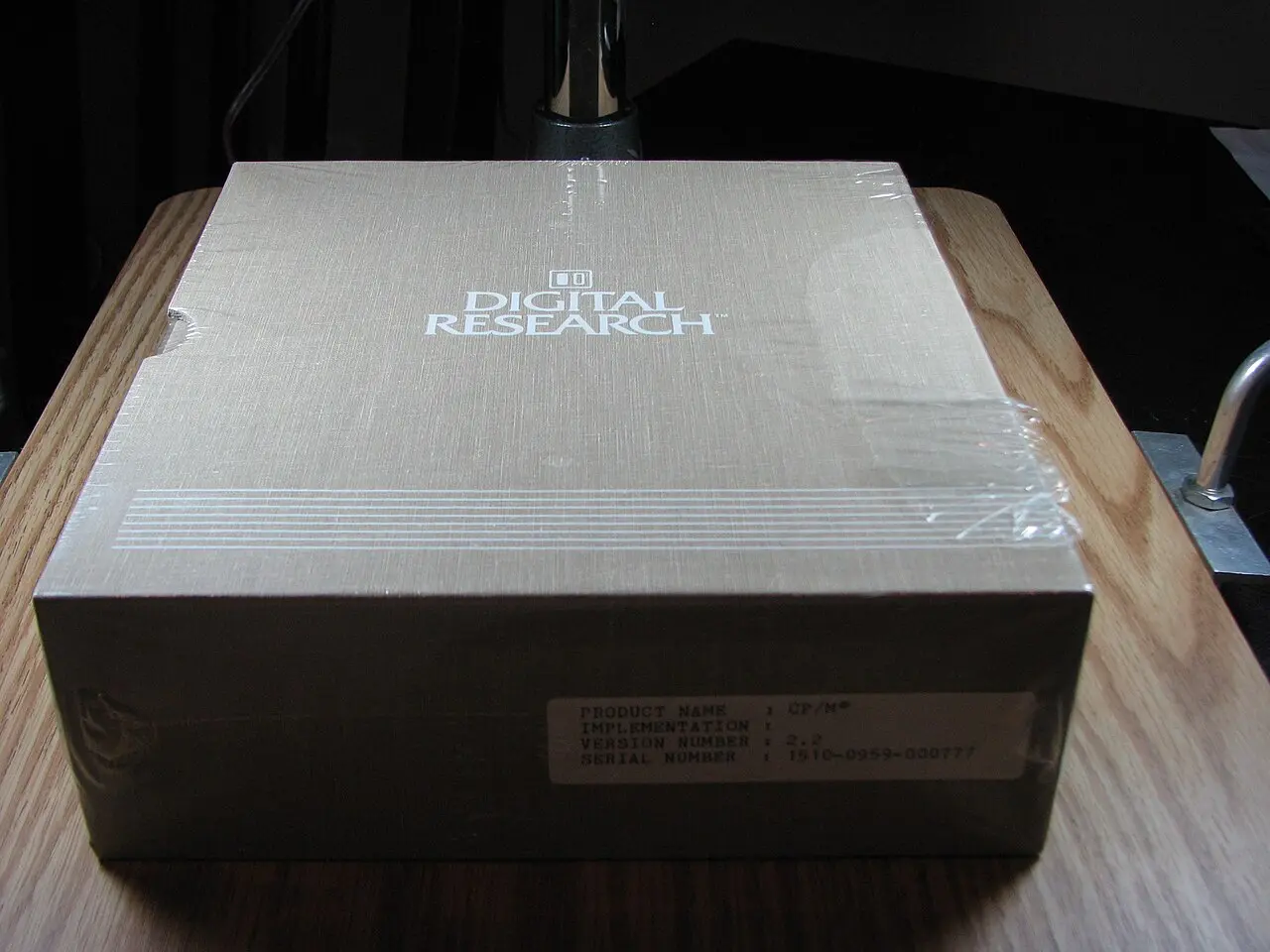
Bill Bradford · CC BY 2.0 · Commons ↗ Gary Kildall's disk operating system for Intel's 8-bit microprocessors; the name stands for Control Program for Microcomputers. The IEEE Milestone dates the first working prototype to 1974 in Pacific Grove, California, and the Computer History Museum places its first boot from diskette in the autumn of that year. The first licence was sold in 1975 and the commercial OS was complete in 1976, the year Kildall and his wife and business partner Dorothy McEwen founded Intergalactic Digital Research, later Digital Research. Separating the hardware-dependent code into a BIOS let it be ported to many makers' machines, and CP/M became the de facto standard OS of the 8-bit microcomputer market. When IBM went looking for an operating system for the IBM PC in 1980, its first stop was Microsoft, and Bill Gates sent the team on to Digital Research. The talks failed (the CHM puts it down to outright purchase versus per-copy royalties; other accounts stress the non-disclosure agreement or the schedule), and IBM took PC DOS, an operating system Microsoft had bought from Seattle Computer Products. On the IBM PC, PC DOS cost US$40 and CP/M-86 US$240, and the price gap settled the matter.
1980s
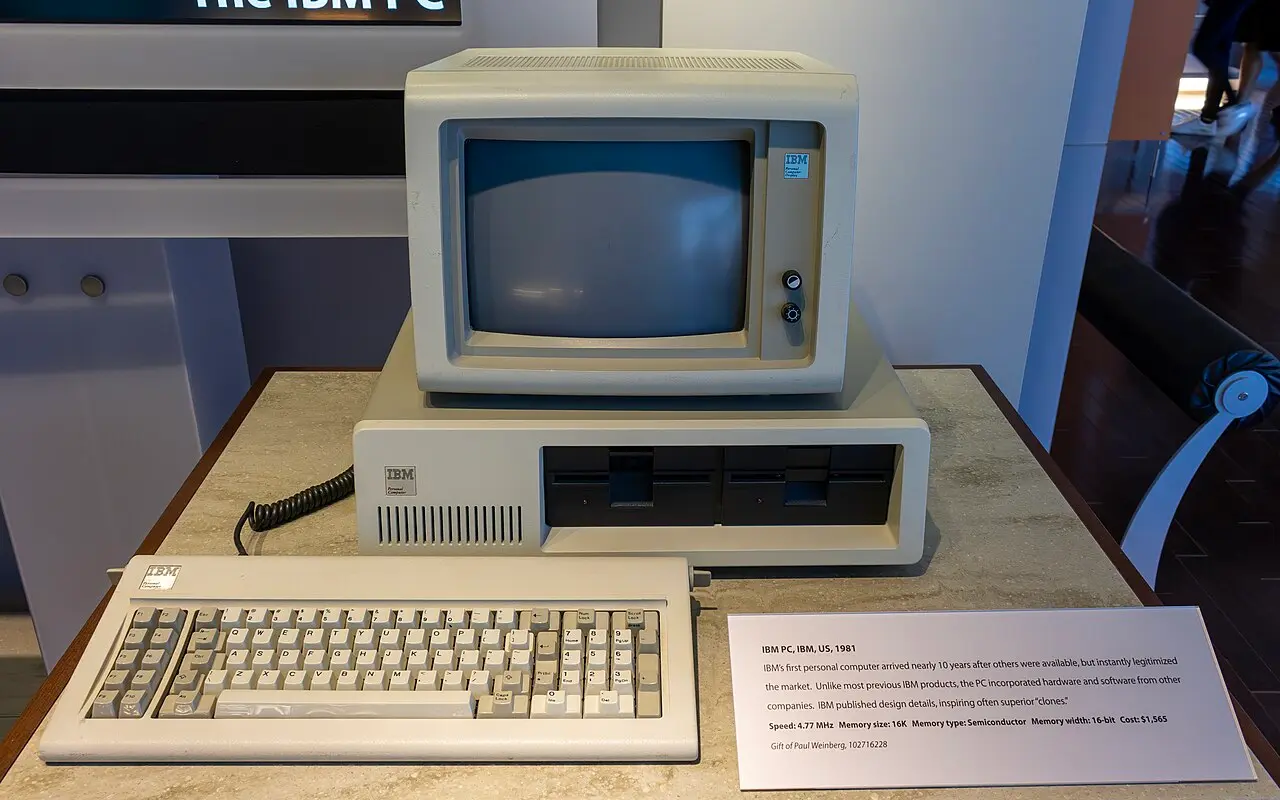
The wub (Wikimedia Commons) · CC BY-SA 4.0 · Commons ↗ IBM announced the Personal Computer on 12 August 1981, to be sold through dealers 'beginning this fall'. Its operating system was 86-DOS, also called QDOS, written by Tim Paterson at Seattle Computer Products: Microsoft had licensed it in December 1980 and bought all rights the following summer, then adapted it for the PC, which IBM shipped as PC DOS 1.0. Microsoft kept the rights and licensed the same software to other computer makers as MS-DOS. In the Computer History Museum's words, for fifteen years DOS was the bedrock on which thousands of applications for IBM PCs and clones depended.
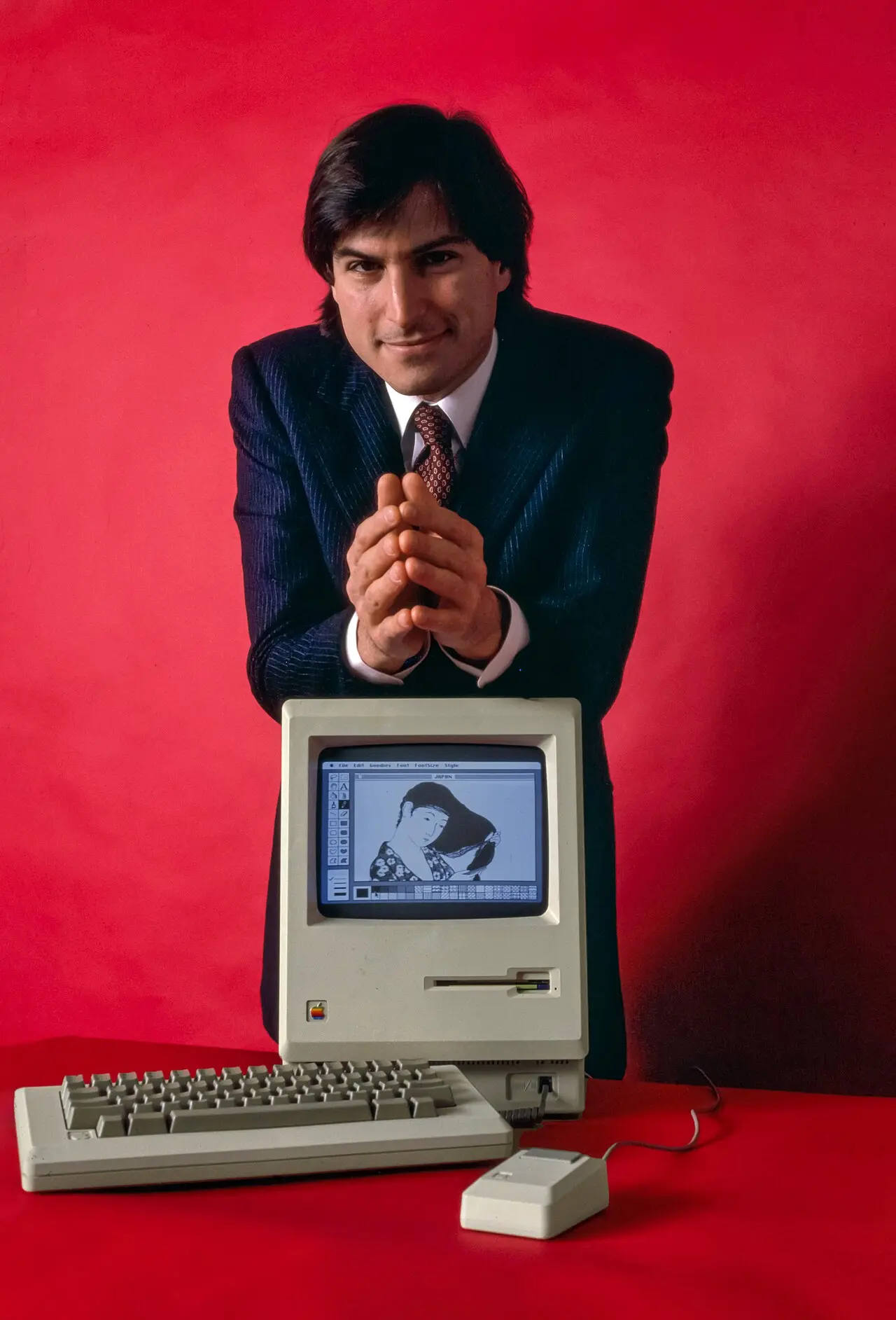
Bernard Gotfryd (Library of Congress, Prints & Photographs Division; edit by Commons user W.carter) · Public domain · Commons ↗ Apple introduced the Macintosh and put it in US dealers the same day, bringing the graphical user interface researched at Xerox PARC and first productised by Apple in the Lisa a year earlier—windows, icons, mouse—to a US$2,495 price. After the commercial failure of the US$9,995 Lisa, Apple deliberately moved the balance of simplicity versus extensibility hard toward the former. The Ridley Scott Super Bowl ad introducing it has its own place in television history.
1990s
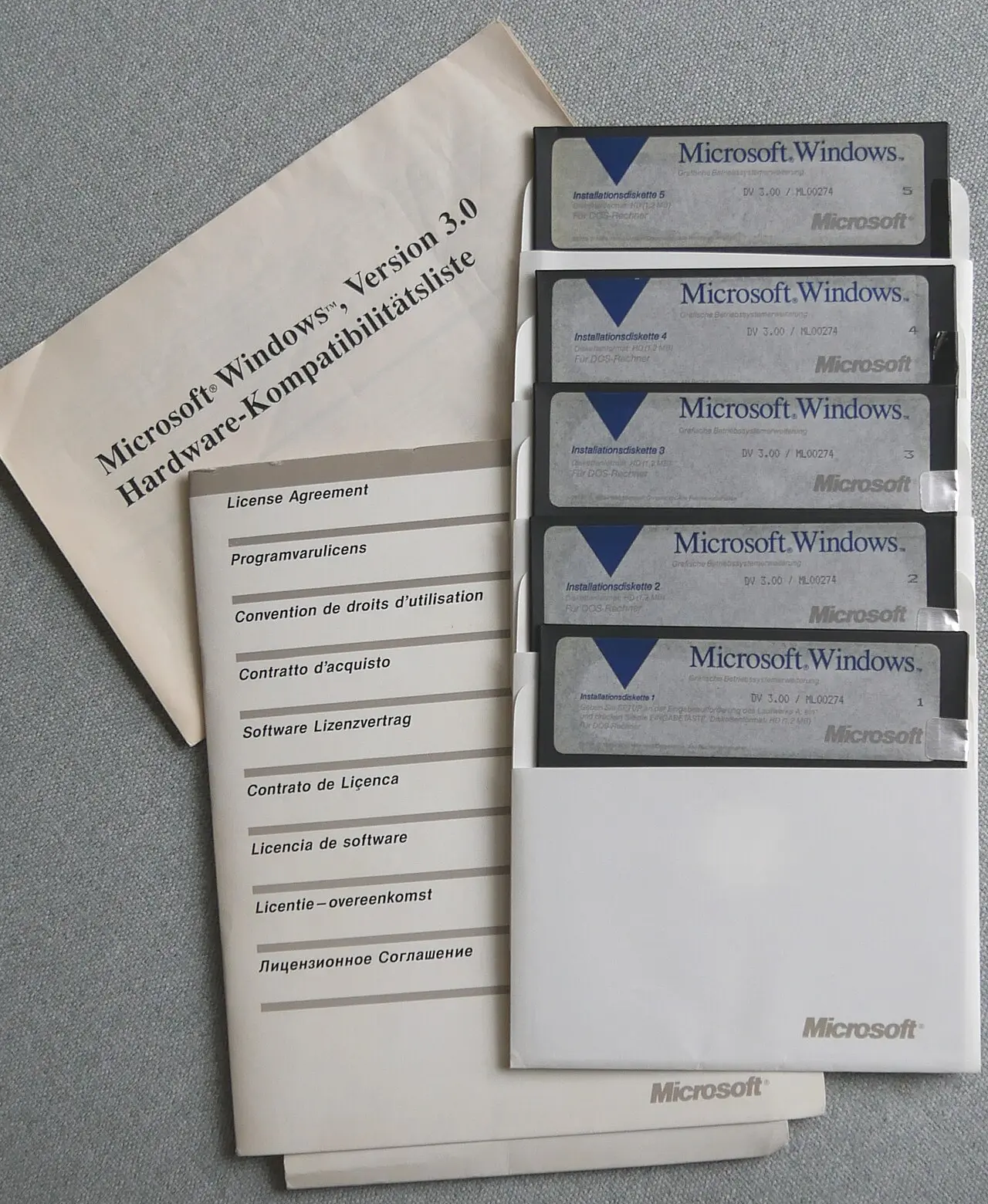
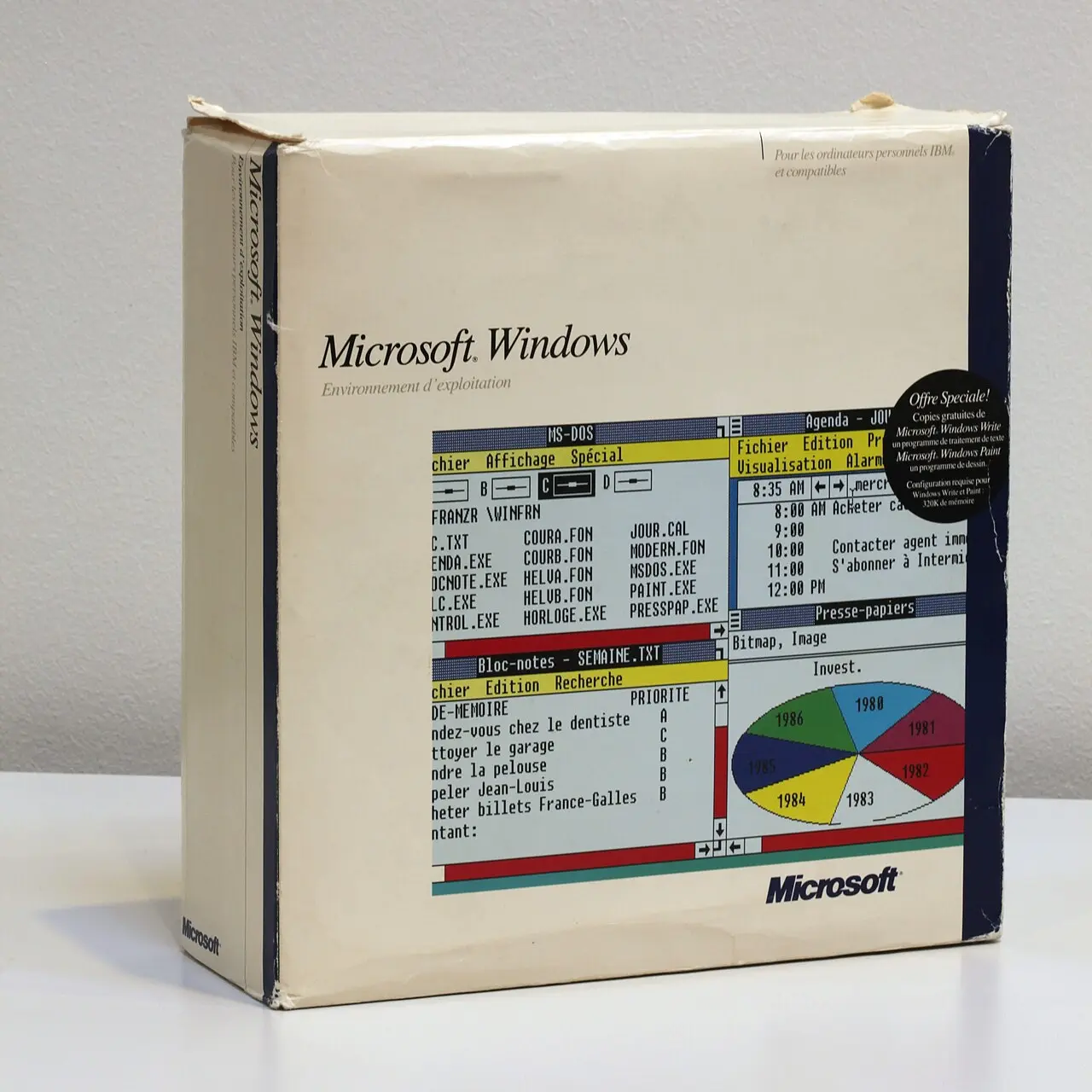
Erkaha · CC BY-SA 4.0 · Commons ↗ Program Manager in place of the MS-DOS Executive, virtual-memory management via 386 enhanced mode, and redesigned icons and graphics (the bundled drivers gave up to 16 simultaneous colours on EGA, MCGA or VGA; 256 colours needed a capable adapter and the Palette Manager). It was launched with great fanfare in New York on 22 May 1990. Diverging from the OS/2 line co-developed with IBM since 1985, Windows 3.0 went to market as an independent DOS-hosted GUI and, by the InfoWorld figure TIME compiled, sold four million copies in its first year; Microsoft's own history counts ten million for 3.0 and the 1992 Windows 3.1 together in their first two years. That success recast the relationship between the two companies and became the turning point at which Microsoft stepped away from joint OS/2 development with IBM and built its own course around Windows.

Lf Asia (Wikimedia Commons) · CC BY 3.0 · Commons ↗ Linus Torvalds, then a student at the University of Helsinki, posted to comp.os.minix: "I'm doing a (free) operating system (just a hobby, won't be big and professional like gnu)." The first sources, version 0.01 released on 17 September, ran to 10,239 lines across 88 files — indebted to Minix but written as an independent kernel. The GPL took effect on 1 February 1992, and the kernel grew through contributions from developers worldwide; by 2026 Linux runs 61.7% of the websites whose OS is known, every machine on the TOP500 supercomputer list, and billions of Android devices.


2000s

Microsoft (Wikimedia Commons) · Public domain · Commons ↗ Microsoft announced general availability of Windows 2000 in San Francisco on 17 February 2000, selling Professional, Server and Advanced Server in more than 60 countries and 16 languages. The Japanese editions of Professional and Server went on sale the next day. Known during development as Windows NT 5.0, it continued the NT line; when Microsoft announced the new name in October 1998, it said NT would become the basis for all of its PC operating systems, from consumer products to servers. The headline server feature was Active Directory, a directory service for managing users and computers centrally. The consumer 9x line ended later that year with Windows Me, and NT technology reached homes with Windows XP in 2001. Extended support ended on 13 July 2010.
Microsoft (Wikimedia Commons) · Public domain · Commons ↗ On 14 September 2000 Microsoft announced the immediate availability of Windows Millennium Edition (Windows Me) for home users. The successor to Windows 98, it added System Restore for rolling a PC's software configuration back to a time when it worked, Windows Movie Maker for editing home video, and a Home Networking Wizard. In Japan an OEM edition came first on 15 September and the regular retail edition followed on 23 September. Before launch Microsoft's Japanese subsidiary said Me would be the final version of the 9x line. In 2006 PC World, saying users had reported problems installing and running it soon after launch, ranked it fourth among the worst tech products of all time. Home Windows moved to the NT line with Windows XP in 2001, and support for Me ended on 11 July 2006.
- EVT.016T1Windows XP — Home Windows Moves onto the NT LineA History of MicrosoftRead more →
- EVT.017T1Windows Vista — XP's Successor, Launched in Two StepsA History of MicrosoftRead more →
- EVT.018T1The Original iPhone Goes on SaleA History of the iPhoneA General History of Information TechnologyA History of Mobile Phones and SmartphonesRead more →
- EVT.020T1Windows 7 — A Fresh Start on Vista's FoundationsA History of MicrosoftRead more →
2010s
2020s

Microsoft (Wikimedia Commons) · Public domain (below threshold of originality; trademark applies) · Commons ↗ In 2015 a Microsoft employee said Windows 10 would be 'the last version of Windows' and the company declined to disown it; six years later Windows 11 arrived anyway—announced 24 June 2021, generally available 5 October 2021. The UI was refreshed: a centred Start menu, rounded windows, Snap Layouts, Android app support. Windows 11 made TPM 2.0 and Secure Boot hard requirements; an audit of some 30 million business devices found fewer than half met the CPU rule, leaving working PCs outside official support. Using hardware requirements to force upgrades proved contentious, and more than 40% of Windows PCs were still on Windows 10 after its 14 October 2025 end of support.
- EVT.023T1Rust Enters the Linux Kernel — A Second Language in MainlineA History of Programming LanguagesA History of Open Source and Free SoftwareRead more →
- EVT.024T1Copilot+ PC and Recall — On-Device AI and an Instant RetreatA History of MicrosoftRead more →

Apple Inc. (Wikimedia Commons) · Public domain (below threshold of originality; trademark applies) · Commons ↗ Apple released macOS 15 'Sequoia' alongside iOS 18 and iPadOS 18 — but the headline feature, Apple Intelligence, was not in 15.0. It arrived in stages: summarisation, rewriting and notification triage in 15.1 on 28 October 2024; Image Playground, Genmoji and ChatGPT integration in 15.2 on 11 December. The architecture paired a roughly three-billion-parameter on-device model with Apple-operated Private Cloud Compute servers. Eligibility was limited to Macs with M1 or later, iPads with A17 Pro or M1 or later, and iPhone 15 Pro or newer. The personal-context Siri shown at WWDC slipped repeatedly and was ultimately rebuilt in 2026 on Google's Gemini.
