T1#standard#storage#japan#regulation
The Floppy Disk — Half a Century from IBM's 8-Inch Disk to Japan's Rulebook
Metadata
- Date
- Decade
- 1970s
- Tier
- T1
- Sources
- 07
- Connections
- 01
- Tags
- #standard#storage#japan#regulation
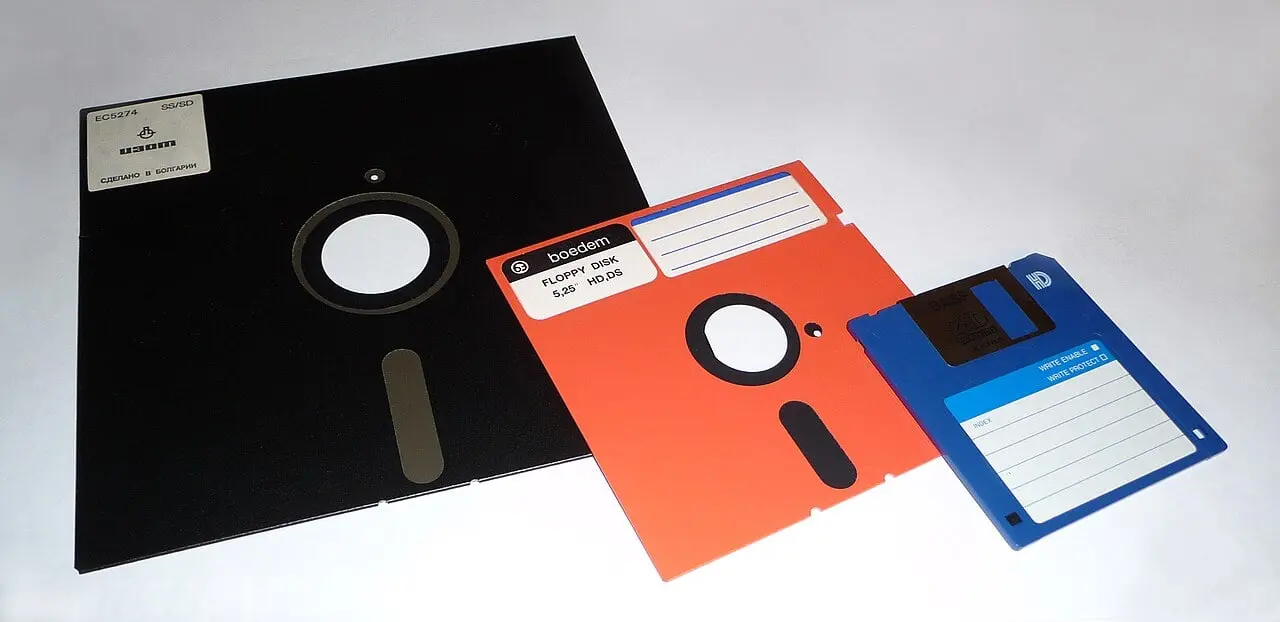
The floppy disk is a storage medium in which a flexible, magnetically coated disk stays inside an envelope-like jacket and is slotted into a drive to be read or written. The first product was the 23FD, a read-only 8-inch drive code-named Minnow that IBM shipped in 1971, holding 80 KB. The disks then shrank to 5.25 inches and to 3.5 inches and became the standard way to carry software and data between personal computers. In Japan, provisions in laws and regulations that specified floppy disks for government procedures survived until 2024.
| Year | Event |
|---|---|
| 1967 | Development begins at IBM in San Jose |
| 1971 | IBM ships the 8-inch 23FD |
| 1976 | Shugart Associates introduces the 5.25-inch format |
| 1980 | Sony announces the 3.5-inch micro floppy disk |
| 1987 | IBM adopts the 3.5-inch disk for the PS/2 |
| 2009 | Sony stops making 3.5-inch drives |
| March 2011 | Sony ends disk sales in Japan |
| June 2024 | Japan finishes revising 1,034 legal provisions that specified floppy disks |
"Minnow", built for the mainframe
According to the Computer History Museum (CHM), in 1967 Alan Shugart, then a product manager at IBM San Jose, assigned David L. Noble to develop an inexpensive way to load microcode into the controller of the IBM 3330. IBM's own account says the team considered magnetic tape before switching to a flexible Mylar disk with a magnetic coating that could be inserted through a slot into a drive. Because the disks got dirty easily, they were packed in slim envelopes lined with a dust-wiping material.
Warren L. Dalziel was the lead inventor of the drive, and Ralph Flores and Herbert Thompson designed the protective jacket. A survey report published by Japan's National Museum of Nature and Science says IBM announced the 23FD in 1970 and brought it to market the following year, 1971. CHM gives its capacity as 80 KB, about 3,000 punched cards. IBM began selling floppy drives in 1971 and received US patents for the drive and the disk in 1972. IBM quotes Dalziel's recollection: "I had no idea how important it would become and how widespread."
The same report says IBM followed with writable 8-inch disks, raising capacity to 250 KB (33FD) in 1972, 560 KB (43FD) in 1976 and 1.2 MB (53FD) in 1977. New drives could read and write older disks, and that backward compatibility became a requirement for the 5.25-inch and 3.5-inch generations as well.
The 5.25-inch disk and the personal computer
Shugart moved to Memorex and in 1973 founded Shugart Associates. According to CHM, Gary Kildall used the company's SA800 8-inch drive to develop CP/M. The 8-inch disk was too large and too costly for word processors and personal computers, so in 1976 Shugart Associates introduced a 5.25-inch disk and drive.
The floppy changed the personal computer. The Apple II started out storing programs on cassette tape, and the Disk II followed in 1978. The IBM PC was also sold in a configuration with two floppy drives. IBM credits the floppy with making an independent software industry possible, since companies could now put programs on disks and sell them by mail or in stores.
Sony's 3.5-inch disk
The National Museum of Nature and Science report says Sony announced a 3.5-inch micro floppy disk (MFD) and drive in 1980. Its author, Hidetoshi Kamoto, worked on planning and developing that drive at Sony. According to the report, Sony had no prior experience with floppy disks but produced the product within a year. The disk sat in a rigid plastic case and was praised for being easy to handle; HP adopted it for the 9121D/S in 1982, Apple for the Macintosh in 1984 and IBM for the PS/2 in 1987, making it the world standard. The report describes this as the first time a Japanese manufacturer's proposal became the global standard in data storage.
| Size | Introduced | Main capacities |
|---|---|---|
| 8-inch | 1971 (IBM) | 80 KB, rising to 1.2 MB by 1977 |
| 5.25-inch | 1976 (Shugart Associates) | IBM introduced a 1.2 MB high-density disk for the PC in 1984 |
| 3.5-inch | Announced 1980 (Sony) | Unformatted capacity of 437.5 KB, then 1 MB in 1983 and 2 MB in 1985 |
The 3.5-inch figures are from the National Museum of Nature and Science report; the 5.25-inch 1.2 MB is from IBM.
For the most widespread capacity, 1.44 MB, English Wikipedia says a group of 21 companies settled on a 3.5-inch design improved from Sony's, and that 1.44 MB drives first shipped in 1986.
From 5 billion a year to the save icon
IBM says more than 5 billion floppy disks were sold each year at the peak in the mid-1990s. The National Museum of Nature and Science report estimates that in the roughly four decades from 1971 to 2009, when Sony stopped making 3.5-inch drives, 1.97 billion drives and 49.24 billion disks were shipped. The 3.5-inch format accounted for 1.71 billion of the drives (86.8%) and 35.5 billion of the disks (72.1%).
As software grew, the floppy became a burden. IBM notes that the diskette version of Windows 95 came on 13 diskettes that had to be installed one after another. The 1998 iMac shipped without a floppy drive. IBM left the floppy business and others soon followed; by the mid-2000s, IBM writes, floppies had gone the way of the punched card. A floppy-shaped icon still marks the save button in a great deal of software.
Computerworld reported in April 2010 that Sony would end floppy disk sales in Japan by March 2011. The Japanese market the year before was about 12 million disks, 70% of them Sony's, and many of the remaining customers were education and research users with legacy equipment.
Out of Japan's rulebook, 2024
The floppy disk's name stayed in Japanese law for a long time. Working with other ministries, the Digital Agency had been revising what it calls analogue regulations, and at a press conference on 14 June 2024 Digital Minister Taro Kono said there had been 1,034 regulations concerning floppy disks and that all but one had been revised. The remaining one fell under Article 27 of the End-of-Life Vehicle Recycling Act, which the Ministry of the Environment administers.
At the same conference Kono said the effort had become an international talking point, partly because the BBC had reported it. At his 2 July press conference he later confirmed that the last provision had been completed on 28 June. Across the whole programme, 4,332 of the 6,364 regulations based on laws and ordinances, about 70%, had been revised by mid-June.
Fifty-three years after IBM's 8-inch disk, the floppy left Japan's administrative procedures too. For the optical disc that followed in video, see DVD; for hardware generally, the hardware timeline.
Questions this page answers
- When was the floppy disk invented, and by whom?
- Development began at IBM in San Jose in 1967, when product manager Alan Shugart assigned David L. Noble to lead it; Warren L. Dalziel was the lead inventor of the drive. The first product, the 8-inch 23FD, shipped in 1971.
- Who created the 3.5-inch floppy disk?
- Sony. According to a survey report from Japan's National Museum of Nature and Science, Sony announced the 3.5-inch micro floppy disk and drive in 1980. HP adopted it in 1982, Apple's Macintosh in 1984 and IBM's PS/2 in 1987, making it the world standard.
- How much data did a floppy disk hold?
- The first 8-inch 23FD held 80 KB, about 3,000 punched cards. IBM's 8-inch disks reached 1.2 MB by 1977. The most widespread type, the high-density 3.5-inch disk, held 1.44 MB.
- When did Japan's government stop requiring floppy disks?
- There were 1,034 provisions in laws and regulations that specified floppy disks. Digital Minister Taro Kono said on 14 June 2024 that all but one had been revised, and according to the Digital Agency the last one, under the Ministry of the Environment, was completed on 28 June.
Sources
Secondary1971: Floppy disk loads mainframe computer data — The Storage Engine, Computer History Museum
Shugart assigning Noble in 1967; the 23FD Minnow shipping in 1971 at 80 KB; Dalziel, Flores and Thompson; Shugart Associates founded 1973 and its 5.25-inch drive in 1976; CP/M on the SA800
PrimaryFloppy disk storage — IBM Heritage
Project Minnow, sales from 1971 and patents in 1972, more than 5 billion disks a year at the peak, 13 diskettes for Windows 95, Dalziel's recollection
Secondaryフロッピーディスクとドライブの技術とビジネス発展の系統化調査 — 嘉本秀年、国立科学博物館 技術の系統化調査報告
IBM's 1970 announcement and 1971 introduction, the growth of 8-inch capacity, Shugart's 5.25-inch in 1976, Sony's 3.5-inch announcement in 1980 and its adoption, and shipment estimates for 1971 to 2009. The author worked on the 3.5-inch drive at Sony
SecondarySony to halt floppy disk sales in 2011 — Martyn Williams, Computerworld, Apr 26, 2010
Sales to end by March 2011; Sony held 70% of a Japanese market of about 12 million disks the year before
Primary河野大臣記者会見(令和6年6月14日) — デジタル庁
All but one of 1,034 floppy-disk provisions revised; the remaining one under Article 27 of the End-of-Life Vehicle Recycling Act
Primary河野大臣記者会見(令和6年7月2日) — デジタル庁
Follow-up answer that the last provision was completed on 28 June
TertiaryFloppy disk — Wikipedia
Last updated: