T1#consumer#launch#japan
The Walkman — The Tape Player That Could Not Record
Metadata
- Date
- Decade
- 1970s
- Tier
- T1
- Sources
- 04
- Connections
- 00
- Tags
- #consumer#launch#japan
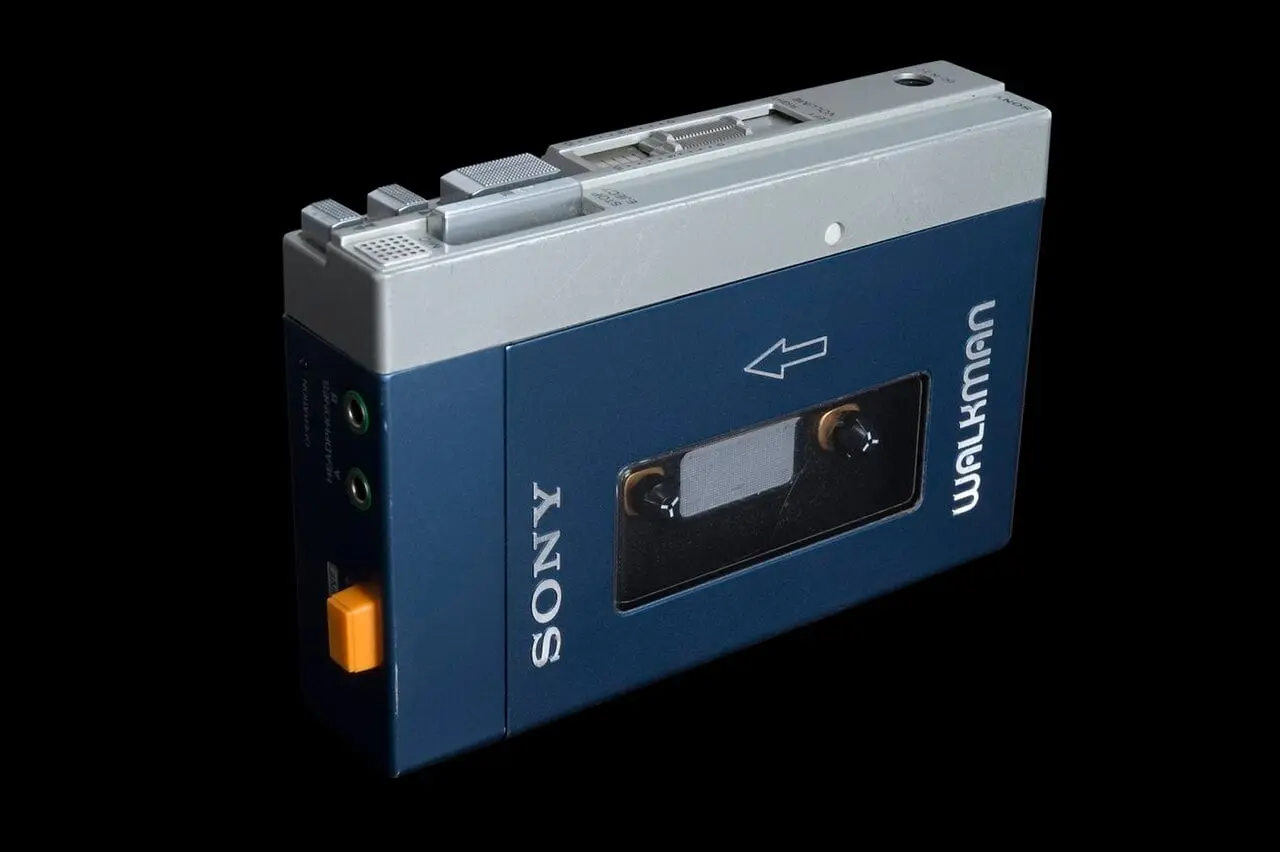
The first Walkman, the TPS-L2 stereo cassette player, went on sale in Japan on 1 July 1979 at 33,000 yen. Sony had announced it on 22 June. It was a playback-only machine listened to through headphones, and it could not record. Released over objections that a tape player without recording would never sell, it created the habit of taking music out of the house and listening to it on the move.
| Item | Detail |
|---|---|
| Model | TPS-L2 |
| Announced | 22 June 1979 |
| On sale | 1 July 1979 (Japan) |
| Price | 33,000 yen |
| First production run | 30,000 units |
| Design | Headphone playback only, with two headphone jacks |
Dates, price and first run are from Sony's corporate history; the headphone jacks are from AV Watch.
Ibuka's request and the Pressman mechanism
According to Sony's corporate history, "Sony History", it began with a request from Masaru Ibuka, then honorary chairman: could someone put a stereo circuit into a small tape recorder, even if it only played back? The tape recorder division built a modified unit in response, and Akio Morita took it up.
In February 1979 Morita gathered young engineers, planners and advertising and design staff at headquarters and told them that recording was unnecessary; sold as a playback-only machine with headphones, it would sell. The target was young people who wanted music all day, the launch was to come before the summer holidays, and the price was to be close to the Pressman's, under 40,000 yen.
Convinced that a first model prone to breaking down would discredit the concept itself, the division reused the mechanism of the Pressman, a cassette recorder that had already been produced in 500,000 units. The name Walkman, the history says, was thought up by young staff, partly because Superman was popular at the time and partly because the base model was the Pressman.
The team was settling on a price of around 35,000 yen when Morita said that this was Sony's 33rd anniversary year and the price should be 33,000 yen. Morita also set the first production run at 30,000 units. The history calls that a bold number, noting that even the best-selling tape recorder of the time sold 15,000 a month.
A slow July, a sold-out August
For the 22 June announcement, Sony took journalists by bus from the Sony Building in Ginza to Yoyogi Park, handed them Walkmans and played the product presentation through the headphones, while young people wearing Walkmans rode past on roller skates and a tandem bicycle.
Even so, newspapers gave it little space, and only about 3,000 sold in July. Advertising and domestic sales staff rode the Yamanote Line wearing Walkmans and let passers-by listen in the pedestrian-only streets of Shinjuku and Ginza on Sundays. According to the history, the first run of 30,000 sold out by the end of August, after which production could not keep up and stores ran out of stock for six months.
From "Soundabout" to "Walkman"
Overseas sales were to start about half a year after Japan, but Sony's overseas sales companies disliked "Walkman", a Japanese coinage from English words. According to the history, the product was named Soundabout in the United States, Stowaway in the United Kingdom and Freestyle in Australia. English Wikipedia gives June 1980 as the month the TPS-L2 went on sale in the US.
When Morita visited Europe, however, people kept asking him for a "Walkman": foreigners had been buying them in Japan and taking the name home with them. Morita unified the name worldwide. According to the history, the word entered France's Petit Larousse in 1981 and the Oxford English Dictionary in 1986.
From cassette to DAT, MiniDisc and memory
Sony's history records cumulative Walkman production passing 50 million in June 1989, ten years after the first model, reaching 100 million within 13 years and 150 million in fiscal 1995. More than 300 models had appeared by the 15th-anniversary model.
The name outlived the medium. According to AV Watch, a DAT Walkman arrived in 1990 and an MD Walkman in 1992, and in 1999 the NW-MS7 used Memory Stick. English Wikipedia notes that CD models were first sold as the Discman and later rebranded CD Walkman. The line of portable music players also leads on to Apple's iPod of 2001.
The cassette Walkman ended in 2010. AV Watch reported on 22 October that year that Sony was ending production and sales of cassette Walkmans in Japan: the five models then in the range had already finished production and would be sold until stores ran out, while models for overseas markets would continue. Cassette Walkmans had sold 220 million units worldwide, and all types including digital ones about 400 million as of the end of March 2010.
A trace in the headphone jack
A machine designed only for headphones also left a mark on connectors. The three-conductor 3.5 mm stereo mini plug spread widely with the Walkman, and how that jack was finally removed from the iPhone 7 in 2016 is told in another article.
For hardware generally, see the hardware timeline.
Questions this page answers
- When did the Walkman first go on sale?
- The first model, the TPS-L2, was announced on 22 June 1979 and went on sale in Japan on 1 July at 33,000 yen. According to Sony's history, overseas sales began about half a year after Japan.
- Why did the first Walkman cost 33,000 yen?
- According to Sony's history, the team was settling on about 35,000 yen when Akio Morita pointed out that it was Sony's 33rd anniversary year and set the price at 33,000 yen.
- When did Sony stop making cassette Walkmans?
- According to AV Watch on 22 October 2010, Sony ended production and sales of cassette Walkmans in Japan while continuing models for overseas markets. Cassette Walkmans had sold 220 million units worldwide.
Sources
Primary第6章 理屈をこねる前にやってみよう <ウォークマン> — ソニーグループ「Sony History」(archived Nov 4, 2025)
Ibuka's request and the reused Pressman mechanism, the origin of the name, the 30,000 first run, the 22 June announcement and 1 July release, about 3,000 sold in July, the August sell-out, the overseas names and their unification, dictionary entries, cumulative production
Primary第5章 コンパクトカセットの世界普及 — ソニーグループ「Sony History」(archived Nov 17, 2025)
Morita's February 1979 meeting, the before-summer-holiday target and price goal, and 33,000 yen for the 33rd anniversary
Secondaryソニー、カセット型ウォークマンの生産・販売終了 — AV Watch, 2010年10月22日
End of domestic production and sales with overseas models continuing; two headphone jacks; DAT in 1990, MD in 1992 and the NW-MS7 in 1999; 220 million cassette units; about 400 million of all types (end of March 2010)
TertiaryWalkman — Wikipedia
Last updated: