T1
CP/M — The Standard OS for 8-bit Micros
Metadata
- Date
- Decade
- 1970s
- Tier
- T1
- Timelines
- A History of Operating Systems
- Sources
- 06
- Connections
- 03
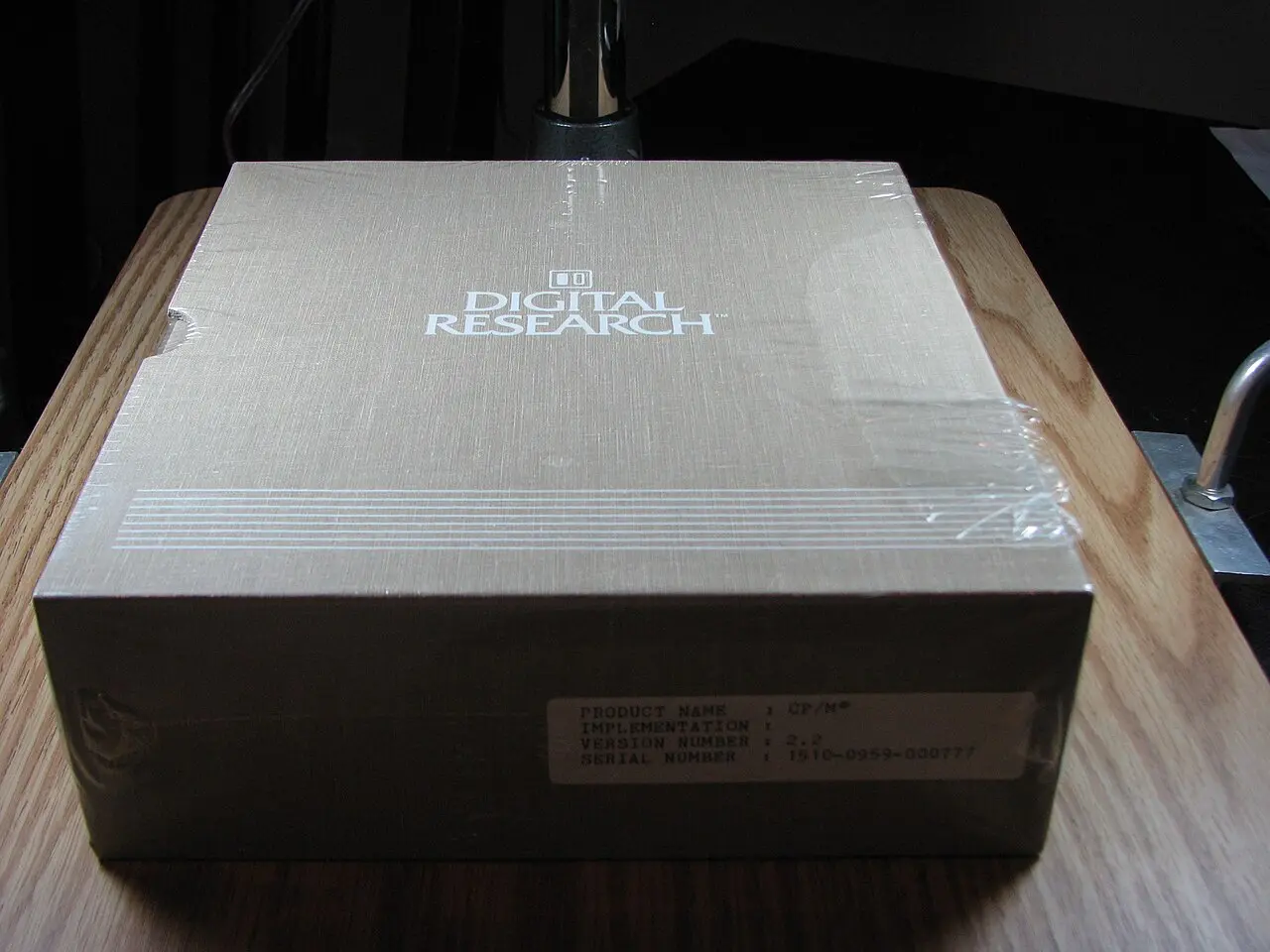
CP/M — Control Program for Microcomputers — is the disk operating system that Gary Kildall wrote for Intel's 8-bit microprocessors, and which became the common operating system of the 8-bit microcomputer market. The date "1974" refers to its first working prototype, not to a product on sale: the IEEE Milestone dedicated in 2014 states that Kildall demonstrated the first working prototype of CP/M in Pacific Grove, California, in 1974, and the Computer History Museum places the first successful boot from diskette in the autumn of that year. The first licence was sold in 1975, and the Computer History Museum dates its full configuration as a commercial operating system to 1976 — the year Kildall and his wife Dorothy McEwen founded the company that became Digital Research. Sources therefore differ less than they seem: 1974 is the prototype, 1975 the first sale, 1976 the commercial product.
| Year | Step | Source |
|---|---|---|
| 1972 | Kildall develops PL/M, the systems language CP/M was first written in, for Intel | CHM |
| 1974 | First working prototype demonstrated in Pacific Grove; boots from diskette in the autumn | IEEE Milestone; CHM |
| 1975 | First commercial licences, including Omron of America and Lawrence Livermore Laboratories | CHM |
| 1976 | Configured as a commercial OS; separate BIOS evolves; Intergalactic Digital Research founded | CHM |
| September 1981 | More than 250,000 CP/M licences sold | Wikipedia |
| 1982 | Digital Research's annualised sales exceed US$20 million | CHM |
| 2014 | IEEE Milestone plaque dedicated in Pacific Grove (25 April) | IEEE |
1972–74: a part-time Intel contractor at the Naval Postgraduate School
In the early 1970s Kildall taught computer science at the Naval Postgraduate School (NPS) and worked part-time for Intel, whose 4004 had begun the microprocessor era. For Intel he developed PL/M, a high-level systems programming language, in 1972. The tools he wrote for Intel's chips still depended on slow paper tape, and in 1974, according to the Computer History Museum, he wrote a program that let microprocessor designers replace it with a floppy disk.
The hardware was the hard part. Connecting an 8-inch floppy drive to a microcomputer needed a controller, and Kildall turned to John Torode, a college friend then teaching at UC Berkeley. In the account David Laws gives for the Computer History Museum, drawing on Kildall's memoir, the two finally got it working late one autumn afternoon in 1974 in the backyard workshop of Kildall's home in Pacific Grove: CP/M loaded from paper tape onto the diskette, booted from the diskette, and came up with its prompt, an asterisk. (Laws names the drive as a Memorex unit; other accounts, including Wikipedia's, say Shugart. The detail is one of several that vary between tellings.)
1975–76: from program to product
CP/M was not an Intel product: the Computer History Museum notes that Kildall was free to exploit the program on his own. He sold the first licence in 1975; early contracts went to Omron of America and to Lawrence Livermore Laboratories, where CP/M was used to monitor programs.
What turned CP/M into a standard was a design decision made as it spread. Each microcomputer of the period had different disk and console hardware. As the system was adapted for new machines, the hardware-dependent code was gathered into a separate Basic Input/Output System — the BIOS. To move CP/M to a new computer, a manufacturer rewrote only the BIOS; the rest of the operating system, and every program written for it, stayed the same. The IEEE citation names the BIOS alongside the operating system as Kildall's invention. That separation let the same application software run across very different machines; Digital Research said in 1982 that CP/M had been licensed for more than 450 types of computer systems.
In 1976 Kildall and Dorothy McEwen established Intergalactic Digital Research to pursue the commercial opportunity, shortening the name to Digital Research Inc. (DRI) when they could. One of the first big deals came through Glenn Ewing, a former NPS student, who brought DRI a licence for the disk systems of the microcomputer maker IMSAI; the CHM's account of the early source code puts the fee at a one-time US$25,000. By the CHM's account, CP/M "became accepted as a standard" and was offered by most early personal computer vendors, including Altair, Amstrad, Kaypro and Osborne.
1980: IBM, Microsoft and the meeting that failed
The story most often told about CP/M is the one in which it lost the IBM PC. The usual telling — that IBM came first to Kildall and was snubbed — has the order wrong. In the Computer History Museum's account, an IBM procurement team visited Microsoft to license its BASIC interpreter, and Bill Gates, who knew Kildall, referred them to DRI for an operating system.
At DRI the IBM team met in the morning with Dorothy McEwen and the company's attorney, Gerry Davis, to settle a non-disclosure agreement; Kildall, who had flown his own aircraft to Oakland to see a customer, returned in the afternoon as scheduled for the technical discussion. The CHM account puts the breakdown down to money: IBM wanted to buy CP/M outright, while DRI wanted a per-copy royalty to protect its existing business. Other tellings stress the non-disclosure agreement or the schedule; the participants' accounts do not agree.
Gates then bought an operating system from Seattle Computer Products that had been written to emulate the look and feel of CP/M, licensed it to IBM on a one-time, non-exclusive basis as PC DOS, and kept the right to license it to others as MS-DOS. Digital Research's 16-bit CP/M-86 was also offered for the PC, but price settled the contest: IBM, which announced the PC on 12 August 1981, listed PC DOS at US$40 against US$240 for CP/M-86, and most customers chose the cheaper option.
What CP/M left behind
DOS took more from CP/M than its market. Wikipedia notes that MS-DOS inherited CP/M conventions such as drive letters and the 8.3 file-name format, which Windows carried on. The Computer History Museum later released early CP/M source code from Digital Research for study, and the IEEE plaque stands outside DRI's former headquarters on Lighthouse Avenue in Pacific Grove.
CP/M's place among other systems is on the operating-systems timeline; the machines it ran on include contemporaries of the Apple II.
Questions this page answers
- When was CP/M created?
- The first working prototype dates from 1974: the IEEE Milestone places it in Pacific Grove that year, and the Computer History Museum puts the first boot from diskette in the autumn. The first licence was sold in 1975, and the commercial OS was complete in 1976.
- Did IBM go to Digital Research first for the IBM PC's operating system?
- No. IBM's procurement team first visited Microsoft to license BASIC, and Bill Gates referred them to Digital Research for an operating system.
- Why did PC DOS win over CP/M-86 on the IBM PC?
- Price settled it. IBM listed PC DOS at US$40 against US$240 for CP/M-86, and most customers chose the cheaper option.
- What was CP/M's BIOS?
- The layer that isolated each machine's disk and console hardware. Porting CP/M meant rewriting only the BIOS, while the rest of the OS and its applications ran unchanged. The IEEE plaque names the BIOS as Kildall's invention.
Sources
The plaque citation for the first working prototype in Pacific Grove in 1974 and the BIOS; dedicated 25 April 2014
The first boot in autumn 1974, Torode, the first sale in 1975, Intergalactic Digital Research, the IBM meeting, and $40 versus $240
PL/M (1972), Omron and Lawrence Livermore in 1975, the 1976 commercial OS and BIOS, IMSAI's US$25,000, and 1982 sales
TertiaryCP/M — Wikipedia
250,000 licences by September 1981, 450 system types in 1982, the Shugart drive, and drive letters and 8.3 names
TertiaryGary Kildall — Wikipedia
Last updated: