T1#market#standard
The Birth of MS-DOS — PC DOS 1.0 and the IBM PC
Metadata
- Date
- Decade
- 1980s
- Tier
- T1
- Timelines
- A General History of Information Technology · A History of Operating Systems · A History of Microsoft
- Sources
- 05
- Connections
- 03
- Tags
- #market#standard
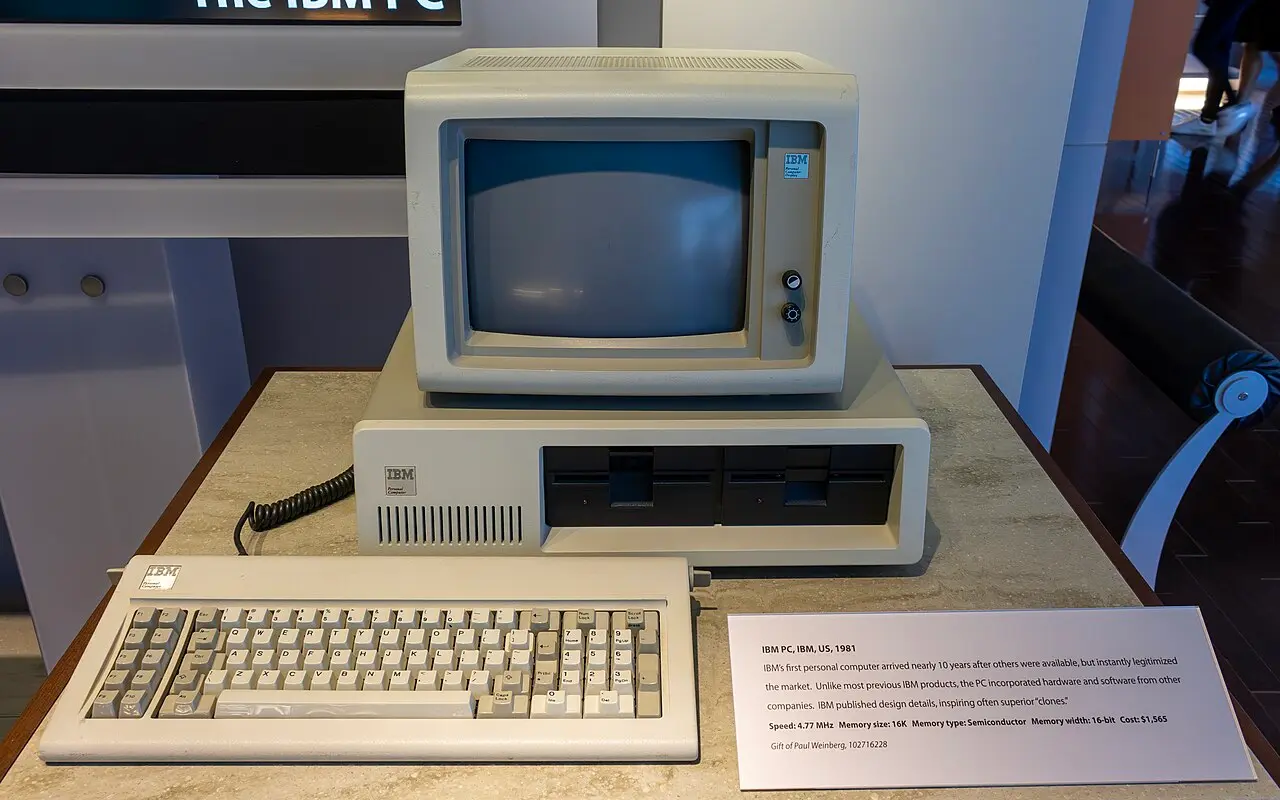
MS-DOS first appeared in August 1981, as the operating system of the IBM Personal Computer, which IBM announced on 12 August. On IBM's machine it was called PC DOS 1.0; Microsoft licensed the same software to other computer makers under its own name, MS-DOS. It was not written from scratch at Microsoft. It began as 86-DOS — also known as QDOS — written by Tim Paterson at Seattle Computer Products, which Microsoft first licensed and then bought outright.
An Operating System Microsoft Did Not Have
When IBM was building its personal computer, it chose to support operating systems it did not write itself. The Computer History Museum's account of the period, written by Len Shustek when the museum published the early DOS source code in 2014, lists three: Digital Research's CP/M-86, the Pascal-based UCSD p-System, and the favoured option, PC DOS, commissioned from Microsoft. IBM's own announcement says the same in its own words: "IBM, in conjunction with Microsoft, Inc., has adapted an advanced disk operating system", alongside contracts with Digital Research and SofTech Microsystems for the other two.
There was a problem. When Microsoft signed its contract with IBM in November 1980, according to the museum, it had no such operating system.
86-DOS: $25,000, then $50,000
Paterson had written 86-DOS for Seattle Computer Products' 8086-based computer kit, because the 16-bit version of CP/M was late. Microsoft licensed it in December 1980 for a flat fee of $25,000. By the next summer, the museum writes, Microsoft had recognised the importance of owning it and being able to license it to companies making IBM PC clones, and bought all rights for another $50,000. Wikipedia's account places that purchase in July 1981, a month before the PC was announced.
Paterson himself left Seattle Computer Products to work for Microsoft in 1981 and spent the following months working closely with IBM's engineers in Boca Raton, Florida. Version 1.0 of PC DOS was complete in July 1981.
Seattle Computer Products later sued, claiming that Microsoft had concealed its relationship with IBM in order to buy the system cheaply. The museum records that the case was settled out of court for almost $1 million.
The Clause That Mattered
The decisive term was who owned the result. Microsoft kept the rights to the operating system and licensed it to other manufacturers as MS-DOS. Each manufacturer built its own version, combining Microsoft's kernel with input/output drivers for its hardware — which is why early MS-DOS existed in many OEM variants until clones converged on IBM-compatible hardware.
This was the point of buying 86-DOS outright: the museum says Microsoft wanted to own it precisely so that it could license it to the companies making IBM PC clones. Every compatible machine from another manufacturer was a potential MS-DOS licence. The machine itself is covered in the IBM PC; the company in Microsoft; its co-founder in Bill Gates.
Similar to CP/M, but Not Copied
86-DOS deliberately resembled CP/M, the dominant operating system for 8-bit microcomputers. The museum describes Paterson's system as using similar commands and some of the same programming interfaces, while having a different internal implementation and different file storage formats. Gary Kildall of Digital Research considered it an infringement of CP/M, confronted both Gates and IBM, and was advised by his lawyer not to sue. He then licensed CP/M-86 to IBM — and, in an account the museum quotes, was astounded that IBM charged $240 a copy for CP/M and only $40 for DOS. DOS became the dominant system on the IBM PC.
Paterson denied copying. Decades later the museum cites Bob Zeidman, a software intellectual-property expert, who examined the code of QDOS, CP/M and PC DOS and concluded that QDOS was not copied from CP/M.
What Version 1.0 Did
Early DOS was small. The museum describes it as basically a file manager and a simple program loader, with typed commands and text responses — no graphics, no mouse. DOS 1.0 used about 12 KB of memory and supported only floppy disks. Version 1.1, in May 1982, added double-sided 320 KB floppy drives.
The first major revision was 2.0, built by a Microsoft team that included co-founder Paul Allen. It added hierarchical subdirectories and hard-disk support, grew to about 28 KB, and shipped in March 1983 with the IBM PC XT as PC DOS 2.0 and to other manufacturers as MS-DOS 2.0.
Fifteen Years as the Foundation
In the museum's assessment, for fifteen years DOS was the bedrock on which thousands of applications, running on millions of IBM PCs and clones, depended. Microsoft kept enhancing it until the late 1990s, by which time, the museum notes, Windows and other operating systems with graphical user interfaces had taken over (see Windows 95). Wikipedia lists the final MS-DOS release as version 8.0, part of Windows Me, in September 2000.
The early code survives. The museum released the source of versions 1.1 and 2.0 for non-commercial use in March 2014, and Microsoft later republished the 1.25 and 2.0 code, and the 4.00 source developed jointly with IBM, on GitHub under the MIT License.
More on the period is on the operating systems timeline.
Questions this page answers
- When was MS-DOS released?
- The first version was the operating system of the IBM PC, announced on 12 August 1981; IBM called it PC DOS 1.0, and Microsoft licensed the same software to other makers as MS-DOS. Version 2.0, with hard-disk support, came with the IBM PC XT in March 1983.
- Who created MS-DOS?
- Tim Paterson of Seattle Computer Products wrote 86-DOS, on which it was based. Microsoft licensed it in December 1980 for $25,000, bought all rights the next summer for another $50,000, and Paterson himself moved to Microsoft in 1981 to work on the IBM PC version.
- What is the difference between MS-DOS and PC DOS?
- They are the same Microsoft DOS. PC DOS was the version IBM sold with its own PCs; MS-DOS was the name under which Microsoft licensed it to other computer makers, each of which added input/output code for its own hardware.
Sources
From $1,565; dealer sales 'beginning this fall'; an 'advanced disk operating system' adapted with Microsoft; CP/M-86 and UCSD p-System also contracted
SecondaryShustek, L. J. — Microsoft MS-DOS early source code, Computer History Museum blog (25 March 2014)
November 1980 IBM contract; $25,000 licence in December 1980; all rights for another $50,000 the next summer; PC-DOS 1.0 complete July 1981; 2.0 with the PC-XT in March 1983; SCP settlement of almost $1M; fifteen years as the bedrock
Tertiary86-DOS — Wikipedia
TertiaryMS-DOS — Wikipedia
Last updated: