T1#standard#consumer
DVD — The Disc Whose Format War Ended Before Launch
Metadata
- Date
- Decade
- 1990s
- Tier
- T1
- Sources
- 12
- Connections
- 01
- Tags
- #standard#consumer
DVD players went on sale first in Japan, in November 1996. On 27 September 1996 Toshiba announced that its first DVD player, the SD-3000, would go on sale on 1 November at 77,000 yen, and Toshiba says it sold the SD-3000 in November 1996 as the world's first home DVD player. In the United States, players arrived about four and a half months later, in March 1997, and at first only in seven cities, including Los Angeles and New York. Japan was in the first wave, and according to the DVD FAQ it was the first market where players appeared.
The other half of the DVD story is that its format war was over more than a year before launch. A camp led by Sony and Philips and another led by Toshiba and Time Warner had proposed different formats, but they merged into one during 1995, so the split was avoided before any product reached the shelves.
Two formats: MMCD and SD
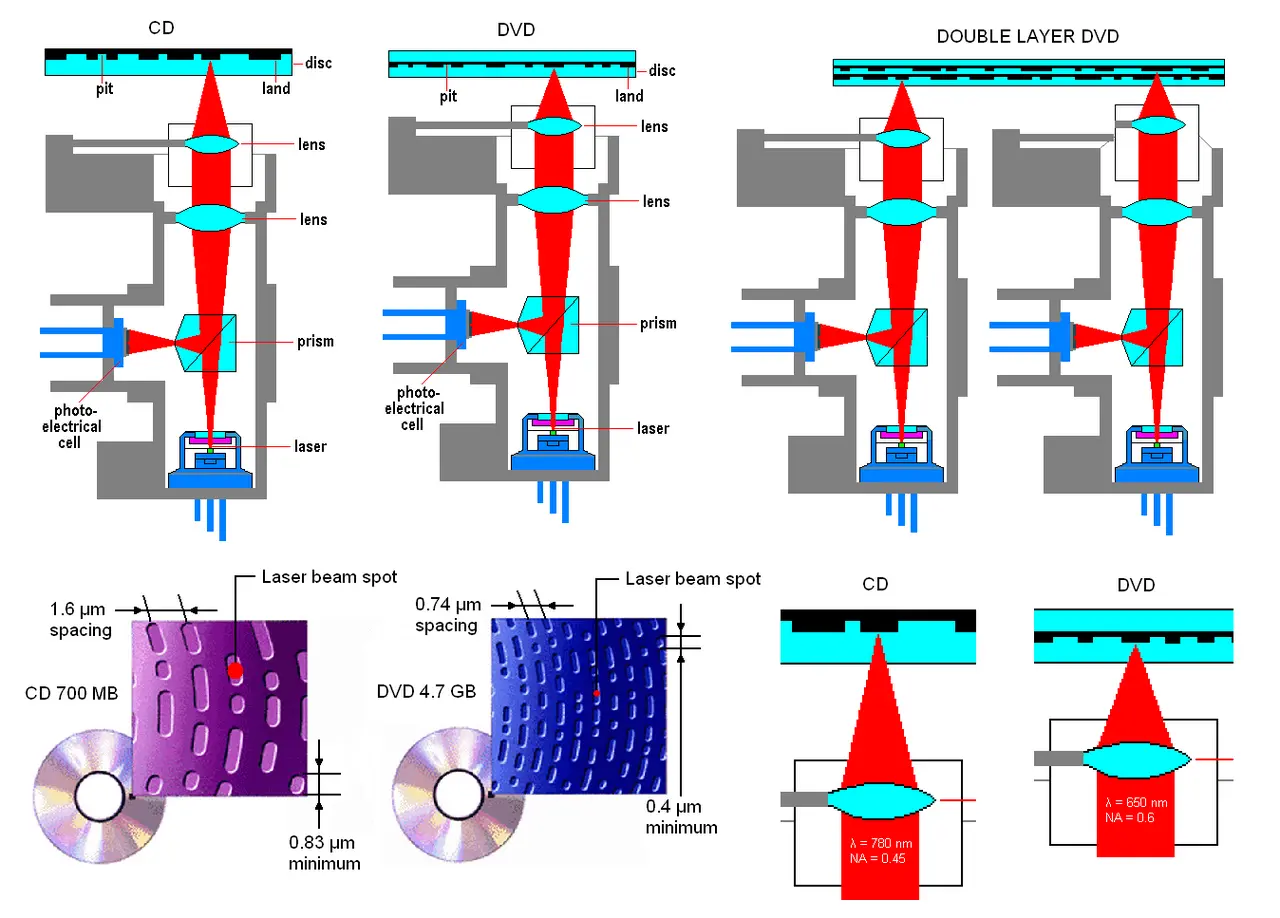
Fitting a feature film on a 12 cm disc the size of a CD required both a denser disc and MPEG-2 video compression. According to Stewart Wolpin's history of DVD, on the Hollywood side Warner Home Video president Warren Lieberfarb wanted a next-generation video disc and teamed up with Toshiba. In September 1994 an advisory committee of film studios that Lieberfarb had formed set out its requirements: at least 135 minutes of playing time, room for three to five languages, multiple subtitles, multiple aspect ratios, Dolby Digital multichannel sound and a parental lockout.
| MMCD | SD (Super Density) | |
|---|---|---|
| Lead companies | Sony, Philips | Toshiba, Time Warner, Matsushita, Hitachi, Pioneer and others |
| Announced | 16 December 1994 | 24 January 1995 (as the SD Alliance) |
| Disc structure | Single 1.2 mm disc, 3.75 GB | Two 0.6 mm discs bonded together, 5 GB per layer |
| Modulation | EFM+, an extension of the CD scheme | A more efficient but more experimental scheme |
Values as given by Wolpin.
The computer industry steps in
The deciding voice came from the computer industry. According to Wolpin, a Technical Working Group (TWG) chaired by IBM's Alan Bell, growing out of a group that included Apple, Compaq and Microsoft, examined both formats, published requirements in May 1995 that included compatibility with personal computers, and pressed for a single format. In late July Bell let it be known privately that IBM was ready to endorse SD, and Sony agreed to compromise on condition that its EFM+ modulation be used.
Sony and Philips announced their concession at a press conference at the IFA show in Berlin on 24 August 1995. After internal debate, the SD camp announced on 15 September that it accepted the compromise, and the final unified specification was announced at Comdex on 13 November.
According to the DVD Forum, the body promoting the unified format was founded in 1995 as the DVD Consortium by ten companies: Hitachi, Matsushita, Mitsubishi Electric, Pioneer, Philips, Sony, Thomson, Time Warner, Toshiba and JVC. It began operating as the DVD Forum on 7 August 1997.
November 1996: launch in Japan
The SD-3000 played DVD-Video and audio CDs and had a Dolby AC-3 decoder, S-video output and component (Y/Cr/Cb) output. According to a Newsbytes report at the time, Toshiba was the third major Japanese electronics maker to announce players, and it had also begun sample shipments of the SD-M1002 DVD-ROM drive for computers. A 4.7 GB disc held several times more data than a CD-ROM, and the drive could still read existing CD-ROMs.
In 2020 the SD-3000 and Toshiba's TC81201F, a single-chip MPEG-2 decoder made for DVD, were registered by Japan's National Museum of Nature and Science as important historical materials of science and technology, a list nicknamed Future Technology Heritage. The same year the museum also registered the DVD-A300 that Matsushita (now Panasonic) released in 1996. Toshiba calls the SD-3000, and Panasonic calls the DVD-A300, the first home DVD player, so neither company's word alone settles which came first.
The DVD FAQ records a Toshiba forecast that 100,000 to 150,000 DVD-Video players would sell in Japan from 1 November to the end of 1996.
March 1997: launch in the United States
| Region | Launch | Notes |
|---|---|---|
| Japan | November 1996 | Toshiba SD-3000 announced for 1 November at 77,000 yen |
| United States | March 1997 | Seven cities only; official start 19 March, titles in stores 24 March, players in stock 26 March |
According to Bill Hunt of The Digital Bits, the first US test markets were Los Angeles, San Francisco, Chicago, Dallas, New York, Seattle and Washington, and Warner launched with 25 titles. The DVD FAQ says distribution was limited to those seven major cities for the first six months, and that the first players in 1997 cost $1,000 and up.
What kept the Japanese and US markets apart were region codes. According to the DVD FAQ, the US and Canada are Region 1, while Japan shares Region 2 with Europe and other areas, so discs from one region are generally not meant to play on players from another.
The name, and what came next
DVD began as the initials of "digital video disc"; some of its creators later proposed "digital versatile disc" to reflect uses beyond video. According to the DVD FAQ, the DVD Forum as a whole never officially adopted either, so the official answer is that the letters stand for nothing.
The DVD Forum's primer says a DVD can store over two hours of video on one layer, and a double-sided, dual-layer DVD-Video disc holds 17 GB in total. Recordable formats followed: DVD-R, DVD-RAM and DVD-RW.
Game consoles gave the format a big push. PlayStation 2, released in Japan on 4 March 2000, could play DVD-Video, and when Japan's National Museum of Nature and Science registered it as Future Technology Heritage in 2024, it credited the console with spreading DVD because it cost less than typical DVD players of the time. Microsoft's Xbox the following year also carried a DVD drive.
Other hardware milestones of the period are on the hardware timeline.
Questions this page answers
- When did DVD players first go on sale?
- Japan came first, in November 1996. On 27 September Toshiba announced that its SD-3000 would go on sale on 1 November at 77,000 yen, and Toshiba says it sold the SD-3000 in November 1996 as the world's first home DVD player. Sales in the United States began in March 1997.
- When was DVD released in the United States?
- In March 1997. For roughly the first six months it was limited to seven cities: Los Angeles, San Francisco, Chicago, Dallas, New York, Seattle and Washington. According to The Digital Bits, 19 March was the official start, titles reached stores on 24 March and players arrived on 26 March.
- How was the DVD format war settled?
- Sony and Philips's MMCD faced the SD format of Toshiba, Time Warner and others until the computer industry, led by IBM, pushed for a single standard. Sony and Philips announced their concession on 24 August 1995 and the SD camp accepted on 15 September. The compromise was based on SD but adopted the EFM+ modulation from the Sony side.
- What does DVD stand for?
- It began as the initials of 'digital video disc', and some of its creators later proposed 'digital versatile disc'. According to the DVD FAQ, the DVD Forum as a whole never officially adopted either, so the official answer is that it stands for nothing.
Sources
The SD-3000 due on 1 November at 77,000 yen; Toshiba the third big Japanese maker to announce players; sample shipments of the SD-M1002 DVD-ROM drive; 4.7 GB
Primary【東芝】1996年に発売した世界初の家庭用DVDプレーヤとDVD用MPEG-2デコーダLSIが国立科学博物館の「未来技術遺産」に登録 — 東芝, 2020年9月15日
Sale of the SD-3000 in November 1996, Toshiba's role in standardisation, and the TC81201F MPEG-2 decoder LSI
PrimaryMission (Ten Founding Companies) — DVD Forum (archived Dec 21, 2001)
Founded in 1995 as the DVD Consortium by ten companies, with the list of founders
PrimaryForum FAQ — DVD Forum (archived Mar 2, 2009)
The DVD Forum commenced on 7 August 1997
SecondaryThe History of DVD — Stewart Wolpin, Sep 24, 2015 (originally written for DVD Etc., 2007)
The MMCD release (16 Dec 1994) and the SD Alliance's reply (24 Jan 1995), the studios' requirements, IBM's Alan Bell as mediator, the 15 September announcement and the final specification on 13 November
SecondaryDVD Frequently Asked Questions (and Answers) — Jim Taylor, DVD Demystified
Japan in November 1996, the US in March 1997 (seven major cities for the first six months), region codes, the name DVD, and Toshiba's sales forecast
The US start (19 March), the seven test markets, titles on 24 March and players on 26 March, and Warner's initial 25 titles
TertiaryDVD — Wikipedia
Last updated: