T1#research
The Xerox Alto — The Machine That Was Never Sold
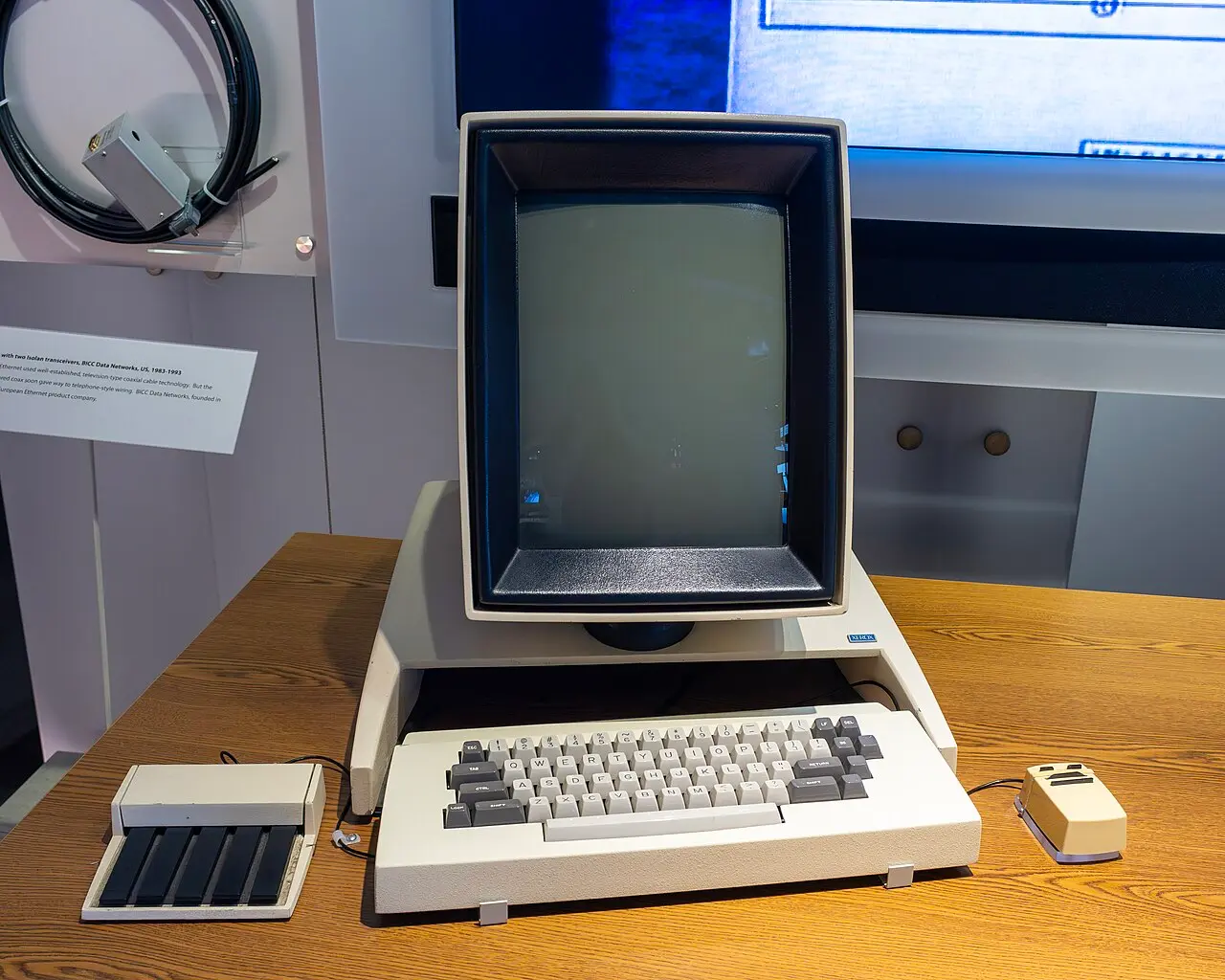
Metadata
- Date
- Decade
- 1970s
- Tier
- T1
- Timelines
- A General History of Information Technology · A History of Operating Systems · A History of Semiconductors and Hardware
- Sources
- 07
- Connections
- 04
- Tags
- #research
On 19 December 1972 an inter-office memorandum went round the Computer Science Laboratory at Xerox PARC. It was from Butler Lampson, and its subject line was "Why Alto". It argued for building 10 to 30 copies of a personal computer that Chuck Thacker and others had designed, at a cost of about $10,500 each — or about $9,700 if a 2.5-megabyte disk were used. The first reason given was that Alan Kay needed fifteen or twenty "interim Dynabooks" for his education research.
The machine was designed in early 1973 and the first one ran that March. Its design report, written six years later as Xerox PARC CSL-79-11, defines it plainly: a small computer system designed in early 1973 as an experiment in personal computing.
Fifteen Megabits a Second, for One User
The standard configuration listed in that report reads strangely today, because nothing about it is strange any more.
| Component | Specification |
|---|---|
| Display | 875-line raster scan, 30 frames/second. 808 visible scan lines, 608 picture elements per line. Oriented with its long dimension vertical, almost exactly the area of a sheet of paper |
| Input | Keyboard, a three-button mouse, and a five-finger chord keyset |
| Storage | 2.5 MB removable cartridge disk (Diablo Model 31) |
| Network | An Ethernet interface, a 3 Mbit/second communication facility |
| Processor | Microprogrammed, running emulators for several instruction sets |
| Memory | 64K 16-bit words, expandable to 256K words |
Refreshing that display alone consumed an average of 15 megabits per second of memory bandwidth. Spending that on a single user, in 1973, was itself the experiment.
The economic argument is the interesting part of Lampson's memo. He was not claiming the Alto would be cheap in absolute terms — $10,500 a machine was serious money in 1972. He was claiming that for most of what people in the laboratory actually did, an Alto would deliver better performance to its user than a share of a time-shared PDP-10, while relieving the load on the shared machine. That is the whole argument for personal computing, made in a procurement memo, five years before anyone could buy such a thing.
A Screen That Looked Like Paper
What ran on the Alto is what made the hardware mean something. Bravo, its document system, let a writer edit a page whose typefaces, spacing and page breaks on screen were the ones that came out of the printer — the idea later labelled WYSIWYG. Smalltalk, grown in Alan Kay's group, presented object orientation not as a language specification but as a live environment, and went out into the world in 1980 as Smalltalk-80. Draw, printing services to a laser printer, electronic mail, networked multiplayer games: each of these required the Alto and Ethernet together.
What "Not a Product" Means
The Alto was never sold as a product. That is a statement about its design brief, not about its failure. Lampson's memo asked for enough machines to keep a laboratory supplied, not for a production run. The count kept climbing anyway. The 1979 report records that there were then "nearly a thousand Altos in regular use by computer science researchers, engineers, and secretaries." The Computer History Museum notes that machines also went out to universities, the White House, the US House of Representatives and the Atlantic Richfield Company as an early marketing test. Ken Shirriff, who has restored one, puts total production at roughly 2,000.
Xerox turned the lineage into a product in April 1981, as the Xerox 8010 Star Information System — the first commercial machine built around a desktop metaphor of icons and folders. It was introduced at US$16,595.
December 1979: Apple Comes to PARC
This is the part of the story that changes shape every time it is retold. Here is what holds up.
- Apple groups visited PARC twice in 1979. Steve Jobs was on the December visit; the earlier one was arranged by Jef Raskin.
- Xerox's venture arm had invested in Apple around that time, and the visits happened under that relationship. Reported figures for the share arrangement vary between accounts.
- What Apple saw were demonstrations of the Alto and of Smalltalk. One of the people giving them was Larry Tesler, who later joined Apple.
And plenty did not transfer. The Alto's mouse had three buttons; the Macintosh shipped with one. The desktop of icons and folders belongs to the Star of 1981, not to the Alto. The menu bar pinned to the top of the screen, drag-and-drop, and the trash can are Apple's own. Stanford's Making the Macintosh project points out that the Lisa and Macintosh projects were already committed to bitmapped screens and direct interaction, that PARC published and demonstrated its work widely, and that turning a laboratory prototype into a machine an ordinary buyer can afford is a distinct and difficult act of invention. "PARC invented it and Apple productised it" is careless at both ends: it drops Douglas Engelbart's work at SRI from the first half, and it treats the second half as though it were transcription.
Eleven Years Before the Macintosh
Chuck Thacker received the ACM A.M. Turing Award in 2009, cited for the Alto among other work; Butler Lampson had received it in 1992, and the two shared the 1984 ACM Software System Award for the Alto with Robert Taylor. In 2023 Xerox donated PARC to the non-profit research institute SRI International. The thing the Macintosh delivered for $2,495 in 1984 had been running eleven years earlier on a desk, on a machine nobody intended to sell.
Sources
TertiaryXerox Alto — Wikipedia
Last updated: