PERSON
Steve Jobs
Co-founder of Apple. With Steve Wozniak and Ronald Wayne he founded Apple Computer in 1976 and stood at the centre of the product lineage that ran from the Apple II through the Macintosh, iMac, iPod, iPhone and iPad. He left Apple in 1985, ran NeXT and Pixar, and returned in 1997 when Apple bought NeXT. He resigned as CEO on 24 August 2011 and died on 5 October 2011, aged 56.
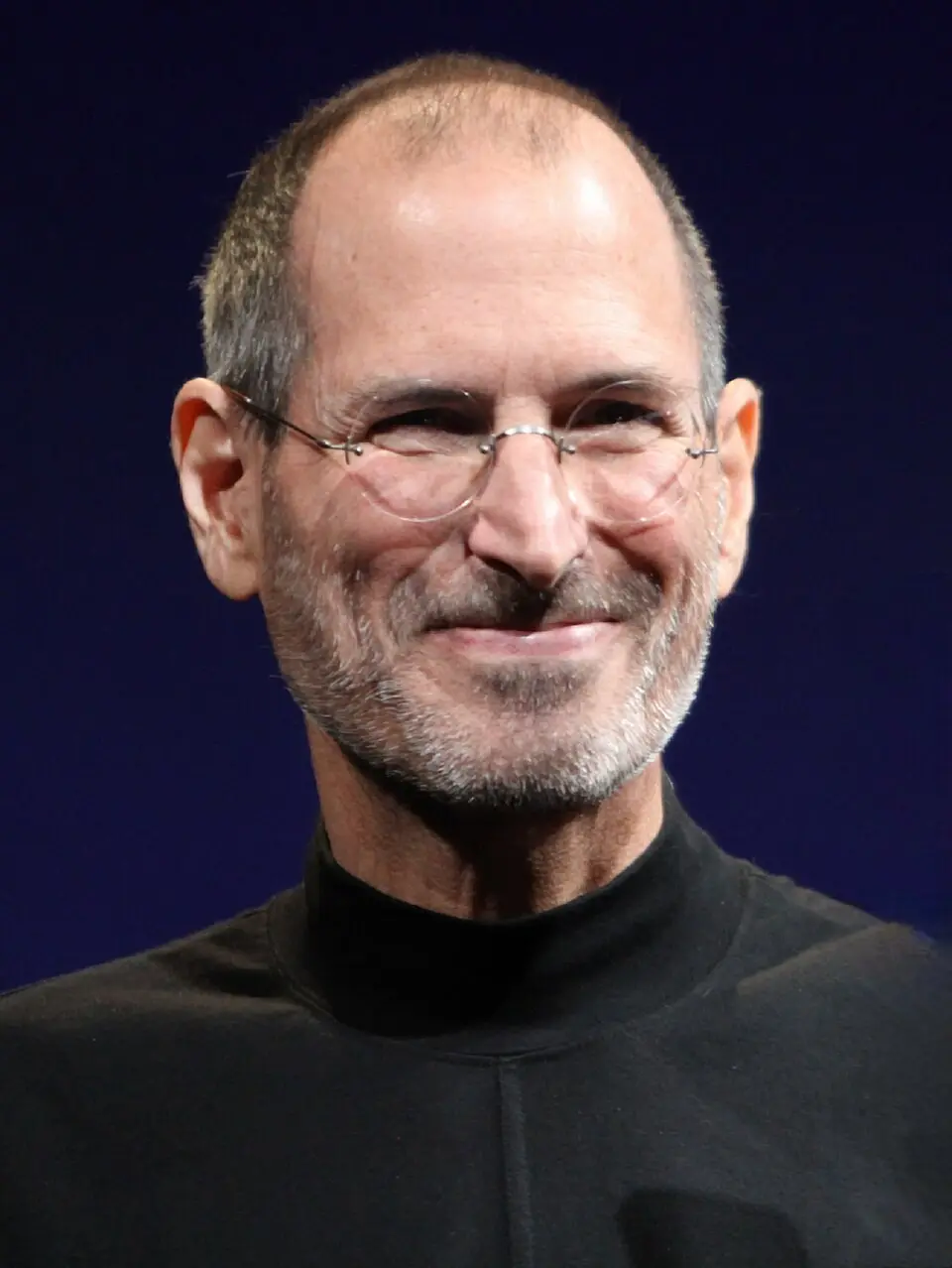
Profile
- Born
- 1955
- Died
- 2011
- Span
- 56 years
- Appearances
- 14
- Name
- ENSteve JobsJAスティーブ・ジョブズ
Steven Paul Jobs (24 February 1955 — 5 October 2011) was a co-founder of Apple and one of the rare executives to have shaped four distinct consumer markets — the personal computer, digital music, the smartphone, and the tablet — from the same chair. Together with Steve Wozniak and Ronald Wayne he founded Apple Computer in 1976 and stood at the centre of the product lineage that ran from the Macintosh (1984) to the original iPhone (2007) and the App Store (2008).
His career splits neatly in two: the founding years at Apple from 1976 to 1985, and the return years from 1997 to 2011. The twelve-year gap between them, spent running NeXT and Pixar, served as the runway for the second act.
Origins and the founding of Apple
Jobs was born in San Francisco in 1955 to a Syrian graduate-student father and an American mother, and was placed for adoption with Paul and Clara Jobs of Mountain View, California — soon to be the heart of Silicon Valley. He enrolled at Reed College in 1972 and, in his own account, dropped out after the first six months but "stayed around as a drop-in for another 18 months or so", sitting in on the courses that interested him. One was a calligraphy course. In his 2005 Stanford commencement address he told the story himself: "10 years later, when we were designing the first Macintosh computer, it all came back to me. And we designed it all into the Mac." The moral he drew from it was about hindsight: "you can't connect the dots looking forward; you can only connect them looking backward. So you have to trust that the dots will somehow connect in your future."
In 1974 Jobs took a technician job at Atari, where he was asked to design the circuit board for the arcade video game Breakout. He sub-contracted most of the work to his friend Steve Wozniak. On 1 April 1976 the two of them, with Ronald Wayne, founded the Apple Computer Company. The Apple I shipped that year; the Apple II in 1977 rode — and largely made — the first wave of personal computing.
Apple's December 1980 IPO made the 25-year-old Jobs worth more than $200 million. In January 1984 the original Macintosh launch, heralded by the Super Bowl "1984" commercial, put a $2,495 all-in-one machine with a graphical interface and a 3.5-inch floppy drive in front of the American public.
The exile: NeXT and Pixar
Jobs lost an internal power struggle in 1985. The conflict with CEO John Sculley — the former PepsiCo president whom Jobs had himself recruited — became unresolvable; the board stripped Jobs of operational authority and he resigned that September, aged thirty.
Within months he founded NeXT, Inc. and built the NeXT Cube workstation (1988) along with the NeXTSTEP operating system. NeXT never sold in volume, but NeXTSTEP earned its place in computing history when Tim Berners-Lee used a NeXT machine at CERN to write the first implementation of the World Wide Web (1989 proposal).
In parallel, on 3 February 1986 Jobs bought the Lucasfilm computer graphics division from George Lucas — $5 million of his own money for the technology rights, and a further $5 million of capital into the new company — and spun it out as Pixar. Toy Story (1995) was a runaway hit, and Pixar's IPO on 29 November 1995 was the largest of that year. Disney agreed to buy Pixar for about $7.4 billion in January 2006; when the all-stock deal closed that May, Jobs's 49.65% of Pixar converted into roughly 7% of Disney, making him its largest individual shareholder and a board member.
The return and the road to the iPhone
On 20 December 1996 Apple, unable to ship a credible next-generation OS, announced its intention to buy NeXT Software "in a friendly acquisition for $400 million". The deal closed in February 1997; Jobs returned with it and took over as interim CEO ("iCEO") that September.
The turnaround was executed at remarkable speed. Jobs cut the product matrix to four quadrants — desktop / portable × consumer / professional — and shipped the iMac G3 in 1998, Mac OS X (the NeXTSTEP lineage) in 2001, the iPod that October, and the iTunes Music Store in 2003.
Then, on 9 January 2007, at Macworld Expo in San Francisco, Jobs unveiled the original iPhone. Eighteen months later the App Store turned it into a platform. The iPad followed in 2010.
Management style and criticism
Two things ran in parallel inside Jobs's working method: an intense "reality distortion field" — the gift of insisting the impossible was imminent until it was — and an aggressive style of personnel management. Colleagues' accounts, repeatedly recorded by journalists, describe public humiliations and the casual appropriation of other people's ideas. Walter Isaacson's authorised biography Steve Jobs (2011), produced with Jobs's cooperation, documents that side without softening it.
Recurring critiques of his stewardship include (1) labour conditions in Apple's supply chain, especially the suicides and overtime issues at Foxconn's Chinese plants; (2) the stock-option backdating scandal investigated by the SEC from 2006, in which Apple executives were charged but Jobs himself was not; and (3) a pronounced indifference to organised philanthropy — Jobs shuttered Apple's existing charitable programmes after his return.
Illness and death
In October 2003 Jobs was diagnosed with a pancreatic neuroendocrine tumour (pNET), a rare cancer with a comparatively good prognosis. Doctors recommended surgery; Jobs spent roughly nine months on diet and alternative therapies before agreeing to an operation in July 2004. Isaacson, who interviewed him at length, reported that Jobs came to regret the delay. Jobs's own explanation, as Isaacson recorded it: "I really didn't want them to open up my body, so I tried to see if a few other things would work."
A liver transplant in 2009 bought him a renewed period of activity, but the disease progressed. On 24 August 2011 he wrote to the Apple board: "I have always said if there ever came a day when I could no longer meet my duties and expectations as Apple's CEO, I would be the first to let you know. Unfortunately, that day has come." Tim Cook took over. Jobs died on 5 October 2011, aged 56; the official cause of death was respiratory arrest secondary to a metastatic pancreatic neuroendocrine tumour.
Legacy
The Apple Jobs left behind became the first US company to reach a $1-trillion market value, in August 2018, and the first company anywhere to touch $3 trillion, on 3 January 2022. More than a decade after his death, in 2026, the iPhone, iPad, and Mac still carry the shape of his second tenure. Bold architectural pivots such as the Apple Silicon M1 transition (2020) — moving from PowerPC to Intel to in-house ARM designs — are direct extensions of his vertical-integration instinct.
He remains a divisive figure as an organisation builder, but the underlying record — turning computers into mass-market consumer products, and mass-market consumer products into objects of desire — was demonstrated twice through the two Apples he built.
Appearances
- The Apple II — A Finished Machine With Colour and Slots
- VisiCalc — The Spreadsheet That Gave People a Reason to Buy a PC
- Smalltalk-80 — The Canonical Object-Oriented Language
- The Macintosh — The GUI Goes Mainstream
- The First iMac — An All-in-One That Dropped the Floppy for USB and the Internet
- Mac OS X 10.0 Released
- The First iPod — 1,000 Songs in Your Pocket
- The First MacBook Pro — The First Mac Notebook on Intel
- The Original iPhone Goes on Sale
- MacBook Air — The 'World's Thinnest Notebook' Without an Optical Drive
- The App Store Opens
- The First iPad — and the Two-Month Wait Outside the US
- iPhone 4 — Retina Display and 'Antennagate'
- iPhone 4S and Siri — The First iPhone with a Voice Assistant
Questions this page answers
- Who was Steve Jobs?
- A co-founder of Apple, born in San Francisco on 24 February 1955. His time at Apple came in two spells, 1976 to 1985 and 1997 to 2011, and he ran NeXT and Pixar in between.
- Why did Steve Jobs leave Apple in 1985?
- He lost a power struggle with CEO John Sculley, whom he had recruited himself, and the board stripped him of operational authority. He resigned in September 1985, aged thirty.
- When did Steve Jobs return to Apple?
- Apple announced it would buy NeXT on 20 December 1996; Jobs came back when the deal closed in February 1997 and became interim CEO that September.
- When did Steve Jobs die?
- On 5 October 2011, aged 56; he had resigned as CEO on 24 August that year. The official cause was respiratory arrest secondary to a metastatic pancreatic neuroendocrine tumour.
Sources
TertiarySteve Jobs — Wikipedia
Last updated: