PERSON
Douglas Engelbart
Known as the inventor of the mouse, though his own subject was always the augmentation of human intellect. Born in Portland, Oregon in 1925; served two years in the Philippines as a US Navy radar technician during the Second World War, where he encountered Vannevar Bush's essay. He joined the Stanford Research Institute in 1957 and set out his framework in the 1962 report Augmenting Human Intellect: A Conceptual Framework. At the Augmentation Research Center, founded around 1963, he built NLS, and on 9 December 1968 in San Francisco demonstrated the mouse, on-screen windows, hypertext links and shared-screen collaboration in a single session. ARC became the second host on the ARPANET in 1969 and ran its Network Information Center. ACM Turing Award 1997; US National Medal of Technology 2000. He died in 2013.
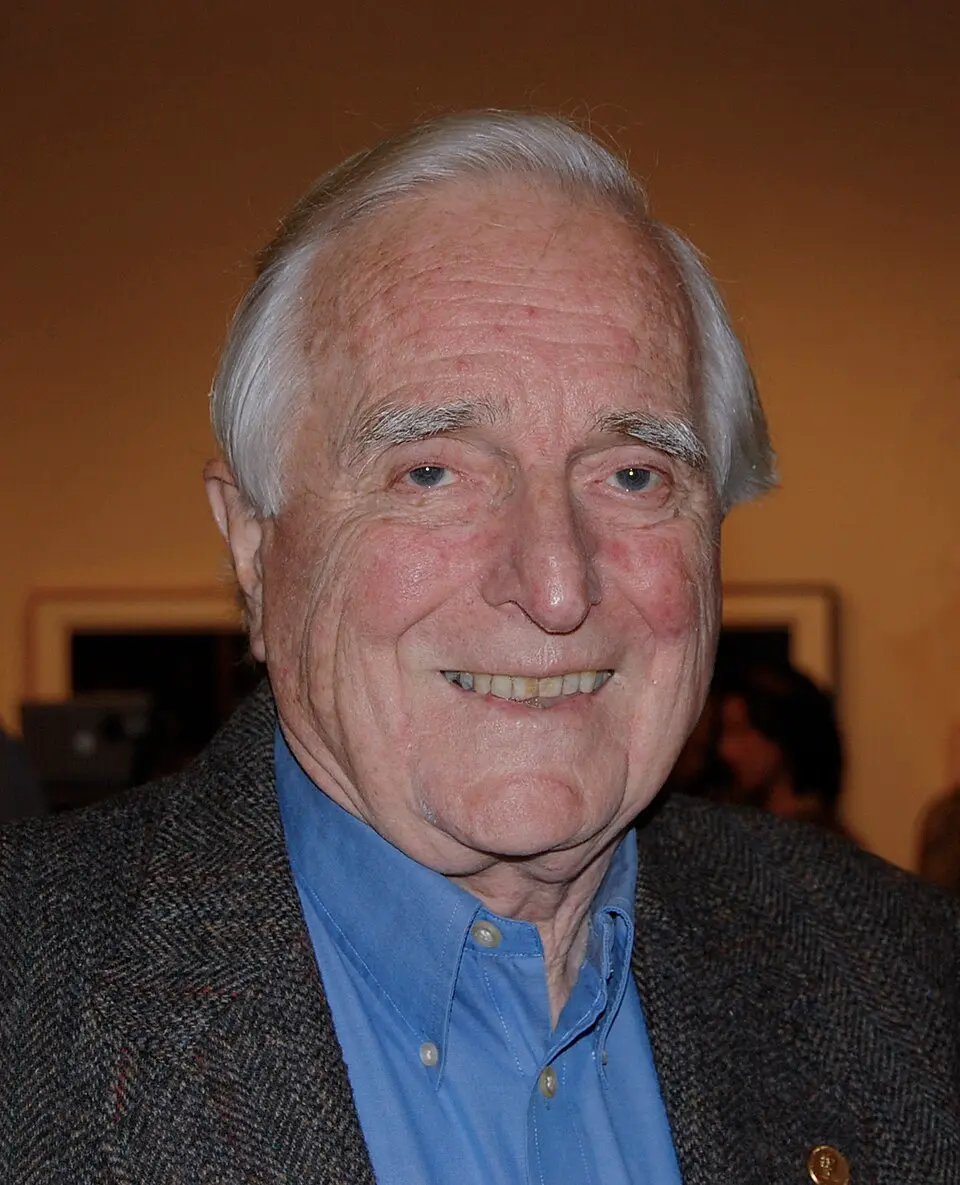
Profile
- Born
- 1925
- Died
- 2013
- Span
- 88 years
- Appearances
- 01
- Name
- ENDouglas EngelbartJAダグラス・エンゲルバート
Douglas Carl Engelbart (30 January 1925, Portland, Oregon – 2 July 2013, Atherton, California) is usually filed under "inventor of the mouse". Followed in order, his life looks different: the mouse is one component picked up halfway along a much longer road. At twenty-five he set himself a single career goal — to raise humanity's capacity to cope with complex, urgent problems — and then went back to school for it, endured years when nobody would pay for it, built a laboratory around it, lost the laboratory, and spent his last decades arguing for it from a small non-profit. This page covers that road. The 1968 public demonstration and the engineer who actually built the first mouse each have their own pages.
1945: A Red Cross Library on Leyte
He finished Franklin High School in Portland in 1942 and went on to Oregon State. Midway through, from 1944 to 1946, he served in the Navy, where he was trained as a radar technician. On the day his troop ship pulled away from the San Francisco waterfront, the public-address system announced that Japan had surrendered. The ship sailed on regardless; thirty-eight days later the men were put ashore at the southern end of Samar, and after a wait of some weeks were moved west to Leyte to be reshipped.
At that temporary camp there was a Red Cross library in a thatched hut on stilts, and nobody else in it. There he read Vannevar Bush's "As We May Think". He believed he had seen it in Life; when his interviewer pointed out that The Atlantic had published it in the late summer of 1945, he doubted a magazine could have reached the Philippines by early September. Either way, he recalled four decades later that the idea of helping people work and think in that fashion had thrilled him. He spent most of the following year at the communications centre of the Philippine Sea Frontier, the Navy headquarters for the region, and came home roughly a year after he had left.
He was careful not to overstate it. He described himself at that point as still "the naive drifter". Bush's essay did not set his course; it was one of several pieces that slotted into his framework when he came to write it, years later.
December 1950: The Morning Commute After an Engagement
After his BS in electrical engineering in 1948 he joined the NACA's Ames laboratory as an electrical engineer in a service group: installing and maintaining wind-tunnel control systems and paging systems, and building one-off electronics for the researchers. He later judged it a job nobody with real ambition to create something would choose. It was at Ames that he met Ballard Fish, whom he would marry.
The turning point came the morning after their engagement. Driving to work, he realised that getting married and living happily ever after had been his last remaining goal, and that beyond it there was nothing. He was twenty-five; he dated it to the tenth or eleventh of December 1950. That evening he set about choosing professional goals deliberately, with two conditions: do the maximum good for mankind, and earn enough to live reasonably well.
Weighing possible causes, he kept returning to side effects — campaigns that defeated malaria only for the population to outgrow land that was already eroding. The world's problems, he concluded, were growing more complex while the time available to solve them was shrinking. The product of complexity and urgency had outrun what human institutions could handle. If one could improve people's capability to deal with that, it would be a basic contribution.
Within about an hour, he said, he could picture himself at a large CRT screen, manipulating new kinds of symbols and driving the computer with levers, knobs and buttons. Both the knowledge that electronics could draw any symbol on a screen and the feel of cranking a tracer around a display came from his Navy radar training. Within hours more he could see colleagues in other rooms, at similar stations tied to the same machine, sharing and collaborating. He did not yet know how a computer worked. He only knew that if it could calculate, it could do this.
He married on 5 May 1951 and shortly afterwards left Ames for graduate school.
Berkeley, and Three Closed Doors
Stanford and Berkeley both accepted him. Berkeley won because Paul Morton was already running a Navy-sponsored project there to build a computer with a magnetic-drum memory and vacuum tubes; Stanford, as he put it, had never heard of such a thing. He took an MS in 1953 and a PhD in 1955 (he himself thought it might have been 1956), with a dissertation titled "A Study of High-Frequency Gas-Conduction Electronics in Digital Computers" — an attempt to use gas-discharge devices as bistable elements. Along the way he sat in on symbolic logic in the philosophy department.
He stayed on for about a year as an acting assistant professor and, with three partners, formed a small company, Digital Techniques, to turn the gas-discharge work into products, backed by the Hale brothers. As transistor prices fell, the backers wanted an outside opinion, and Engelbart himself suggested the Stanford Research Institute. SRI's team reported that solid-state devices would doom the venture. In 1957 the backers withdrew, generously leaving the partners the equipment.
Around this time he tried three doors. The first was Hewlett-Packard. He had worked out terms with research director Barney Oliver, but on the drive home he stopped at a phone booth in Redwood City to check one assumption: HP would be moving into digital technology, wouldn't it? Oliver's reply: "Not a chance." Engelbart withdrew on the spot. The second was Stanford University, where he offered to teach computer design; the dean wrote back that Stanford was a small school pursuing excellence in academic disciplines, that computers were a service activity, and that there were no plans to bring them into the engineering curriculum. The third door was SRI — the same institute that had just written off his company.
A Magnetics Engineer at SRI
He joined SRI in 1957 and began under Hewitt Crane, working on magnetic devices — in particular shift registers built from multi-aperture magnetic cores — and collected a number of patents in that field. Augmenting the human intellect remained a private interest that no one had asked him to pursue.
Around 1959 he got to know Newell, Shaw and Simon. They were preparing a proposal to the Defense Department for a very large, very fast machine dedicated to LISP processing for artificial intelligence, and, knowing his hardware background, they invited him to lead its development. Their premise was that such a machine would be smart enough to make most other kinds of human–computer interaction unnecessary. He did not accept the premise: however smart the machine became, the human side of the work would not go away. He turned the offer down. It is perhaps the first place where the split between artificial intelligence and intelligence augmentation shows up as one man's career decision.
The same year, 1959, brought his first outside money for augmentation, from the Air Force Office of Scientific Research, through Harold Wooster's small information-sciences programme. By Engelbart's account it covered about half of what the work needed and paid no overhead. There was nothing to build with; the work was thinking.
What the 1962 Report Actually Proposed
The thinking became an SRI summary report dated October 1962: Augmenting Human Intellect: A Conceptual Framework (AFOSR-3223, contract AF 49(638)-1024). It is not an equipment specification. It is a theoretical case for a research programme.
It opens with a definition: "By 'augmenting human intellect' we mean increasing the capability of a man to approach a complex problem situation, to gain comprehension to suit his particular needs, and to derive solutions to problems." The intended beneficiaries are diplomats, executives, scientists, attorneys and designers, and the target is an integrated way of working rather than isolated tricks.
People, the report argues, are already augmented. It names four classes of augmentation means — artefacts, language, methodology, and the training needed to use the other three — and treats the trained human plus those means as one system, the "H-LAM/T system (Human using Language, Artifacts, Methodology, in which he is Trained)". The thing to improve is that whole system, not the machine in isolation; a change in any one component opens possibilities for change throughout a hierarchy of capabilities built on top of it.
It sketches four stages of intellectual evolution: concept manipulation, symbol manipulation, manual external symbol manipulation, and — the stage computers would introduce — automated external symbol manipulation. To probe the claim that the means of manipulating symbols shapes language and thought (an extension of Whorf's hypothesis), Engelbart ran the experiment in reverse: "We fastened a pencil to a brick and experimented," timing writing with the brick-pencil against an ordinary pencil and a typewriter, and asking how a civilisation would have developed if that were the best scribing tool it had.
The report then imagines a demonstration by a skilled user called Joe, who works at two near-horizontal screens like a draughtsman, one hand on a chorded keyset and the other holding a light pen. In 1962 the imagined pointing device was still the light pen.
The research recommendations contain the seed of what Engelbart would later call bootstrapping. The first people to augment, the report says, should be computer programmers — partly because the researchers building the system are themselves programmers wrestling with complex intellectual problems. As the report puts it, "they are developing better tools for a class to which they themselves belong." Feeding results straight back into the researchers' own work creates what it calls a regenerative, positive-feedback effect. It even advises building "a quick and rough scaffolding" rather than a carefully engineered structure, so as to climb up and look around sooner.
1963: Standing at ARPA's Door
ARPA's Information Processing Techniques Office opened in January 1963 under J. C. R. Licklider. Engelbart remembered it plainly: "I was standing at the door with this 1962 report and a proposal." Money followed that year.
The start was rough. Licklider's first condition was that Engelbart's group program a large machine at System Development Corporation in Santa Monica, which was being converted to time-sharing. It ran in time-sharing mode only a couple of hours a day and crashed constantly — the opposite of a laboratory using its own tools every day to improve them. The group eventually bought a Control Data CDC 160-A for over $100,000 and used it as a terminal over a phone line with modems.
Inside SRI his position was precarious. His managers, Roy Amara and Jerry Noe, regarded him as too far out. When an ARPA-funded project arrived, they installed John Wensley as project leader and proposed moving Engelbart to a new title and to proposal writing, and even limited his speaking up in meetings. He considered leaving for MIT. He later recalled Wensley insisting that users type out a command such as "DELETE WORD;" in full, rejecting his argument that on an interactive screen two keystrokes would do.
The rescue came by telephone from Robert Taylor, a psychologist at NASA headquarters who had been looking for money on Engelbart's behalf. Taylor attached a condition to funding he was sending to NASA's Langley Research Center, so that part of it would come to SRI. In Engelbart's recollection Taylor said, "It's only $80,000 but it's a start." Together with Licklider's support it was enough for a stand-alone computer with a display — though with no disk and, for a while, no magnetic tape, so work was saved to punched paper tape. The laboratory was first called the Augmented Human Intellect Research Center, later shortened to the Augmentation Research Center (ARC).
The Mouse and the 1968 Demo, in Brief
Two products of ARC are famous enough to have their own pages on this site.
- The mouse was Engelbart's idea from around 1961, turned into a working prototype in 1964 by Bill English, who also ran the comparison tests of pointing devices. The patent, US 3,541,541, was granted in 1970.
- The public demonstration of 9 December 1968 put ARC's NLS (oN-Line System) in front of the Fall Joint Computer Conference for ninety minutes; what was shown and how it was wired up is covered on the 1968 demonstration page.
What matters here is where they sit in his arc. The mouse did not exist when the 1962 report was written; it was chosen later, after measurement, from several candidate devices. And the 1968 demonstration was, in effect, Joe's imaginary working session from 1962 made real six years on.
The Second ARPANET Node and the NIC
In 1969 SRI became the second site on the ARPANET after UCLA, with ARC's computer as the host. When UCLA sent the first host-to-host message that October, the receiving machine was ARC's.
ARC also took on the job of collecting and serving the network's information. According to the finding aid for the SRI ARC/NIC records at the Computer History Museum, ARC began in May 1967 to gather and catalogue documents from prospective ARPANET sites, preparing a proposal to run a network information centre via NLS. A charter was outlined that November, the concept was specified in late 1969, and in 1970 the first Network Information Center on the ARPANET began operating at SRI, with a master catalogue maintained as a subsystem of NLS.
At first the NIC was part of Engelbart's ARPA contract, and users had to log in to the ARC machine and learn NLS to use it. As the network grew the host was overwhelmed, and the services migrated to network servers reachable by FTP, e-mail and WHOIS. In 1973 the NIC was spun off as a separate project with Elizabeth Feinler as principal investigator. It went on to create the generic top-level domain names, but that later history belongs to others.
The 1970s: The Laboratory Comes Apart
ARC's peak was short. From about 1970 key researchers began to leave, many for the new Xerox PARC. Wikipedia's account attributes this partly to frustration and partly to a difference of vision: Engelbart saw the future in collaborative, networked, time-shared computing, while the younger programmers were drawn to personal computers. The disagreement was ideological as well as technical.
From 1972 several key ARC staff took part in Erhard Seminars Training (EST), and Engelbart served for years on the board of its corporation; the controversy around EST and other social experiments is said to have damaged morale. Funding shrank too: the 1969 Mansfield Amendment barred military funding of research without a direct military purpose, and with the winding down of the Vietnam War and the Apollo programme, ARPA and NASA support eroded through the early 1970s. SRI's management, unhappy with how he ran the centre, placed what remained of ARC under the artificial-intelligence researcher Bertram Raphael.
Tymshare, McDonnell Douglas and Bootstrap
In 1977 SRI sold NLS to the time-sharing company Tymshare. Engelbart and many of the NLS staff moved with it, and the system was renamed Augment. The NIC, by then a separate project funded by the Defense Communications Agency, stayed at SRI. Tymshare sold Augment as a commercial service through its office-automation division and made Engelbart a senior scientist, but operational priorities crowded out his research.
In 1984 Tymshare was acquired by McDonnell Douglas. The knowledge-management demands of an aerospace programme's life cycle were exactly the kind of problem he cared about, and executives expressed interest, yet never committed funds or people at the scale needed. Sources disagree on when he left: some say 1986, others 1989.
With his daughter Christina Engelbart he then founded the Bootstrap Institute; sources give 1988 or 1989. The National Inventors Hall of Fame describes its purpose as promoting "the development of collective IQ through worldwide computer networks". From 1989 to 2000 it ran three-day and half-day management seminars at Stanford University, and by the early 1990s seminar graduates had formed the non-profit Bootstrap Alliance. In the mid-1990s DARPA funded a modern interface to Augment, Visual AugTerm; in 2005 a National Science Foundation grant supported HyperScope, an open-source browser component that reproduced Augment's viewing and linking. The organisation later became the Doug Engelbart Institute, with Christina Engelbart as executive director.
The principle from 1962 — augment the augmenters first — had been widened into a method for organisations at large: improve the way people improve their own work, and the gains compound.
The 1990s: Recognition Catches Up
The years when research money was hardest to find were also the years the honours arrived.
| Year | Honour | Basis |
|---|---|---|
| 1997 | Lemelson–MIT Prize | $500,000 |
| 1997 | ACM A.M. Turing Award | "For an inspiring vision of the future of interactive computing and the invention of key technologies to help realize this vision." |
| 1998 | National Inventors Hall of Fame | The computer mouse (US 3,541,541) |
| Dec 2000 | US National Medal of Technology | Creating the foundations of personal computing — real-time interaction on CRT displays with the mouse, hypertext linking, text editing, online journals, shared-screen teleconferencing and remote collaboration; presented by President Clinton |
| 2001 | BCS Lovelace Medal | |
| 2005 | Computer History Museum Fellow | Advancing the study of human–computer interaction, developing the mouse, and applying computers to improve organisational efficiency |
2013: Atherton
He was diagnosed with Alzheimer's disease in 2007. Ballard, his first wife, had died in 1997; in 2008 he married Karen O'Leary Engelbart. He died of kidney failure at his home in Atherton on the night of 2 July 2013, aged 88, survived by his wife and the four children of his first marriage — Gerda, Diana, Christina and Norman.
The goal he set on that December commute in 1950 was to raise humanity's capability to handle complex, urgent problems. The mouse and on-screen windows were parts built on the way there, and the parts reached every desk. The goal itself remains where he left it: in the name of the institute he founded and in the pages of the 1962 report.
Appearances
Sources
SecondaryA Lifetime Pursuit — Doug Engelbart Institute
Career, ARC, Tymshare and awards
SecondaryFirsts: The Mouse — Doug Engelbart Institute
The idea in 1961, Bill English's prototype in autumn 1964, and the patent
TertiaryDouglas Engelbart — Wikipedia
Navy and the Leyte library, Ames, the December 1950 decision, Berkeley, Digital Techniques, HP and Stanford, the RAND offer
Joining SRI, AFOSR from 1959, Licklider at ARPA in 1963, SDC and the CDC 160-A, internal conflict, Robert Taylor's $80,000 from NASA
The AHIRC name, NIC preparation from 1967 to operation in 1970, the 1973 spin-off, the 1977 sale to Tymshare
SecondaryDouglas Engelbart, inventor of computer mouse, dies at 88 — Bangor Daily News, 5 July 2013
Cause of death (kidney failure), survivors, death of his first wife Ballard in 1997
Last updated: