T1#consumer#market
The Apple II — A Finished Machine With Colour and Slots
Metadata
- Date
- Decade
- 1970s
- Tier
- T1
- Sources
- 11
- Connections
- 04
- Tags
- #consumer#market
From 15 to 17 April 1977, the first West Coast Computer Faire ran at the San Francisco Civic Auditorium and Brooks Hall, organised by Jim Warren and Bob Reiling. It was the first large gathering to present microcomputing to the general public at a moment when the hobby still mostly meant buying a board and soldering it yourself. What Apple showed there was the Apple II. Commodore was in the same hall with the PET.
Shown Is Not Shipped
The Apple II's chronology tends to collapse into a single date. It should not.
| Date | What happened |
|---|---|
| 15–17 April 1977 | Shown at the first West Coast Computer Faire — a demonstration of finish as much as of function |
| 10 June 1977 | Shipped, per the Computer History Museum's record |
| January 1978 | Disk II demonstrated at CES; shipped later that year |
| 17 October 1979 | VisiCalc for the Apple II reached stores |
The price was US$1,298 with 4 KB of memory; a fully populated 48 KB machine was $2,638.
Eight Slots and No Visible Screws
Against its contemporaries, the Apple II's distinguishing property was not raw capability. It was that you never had to open it.
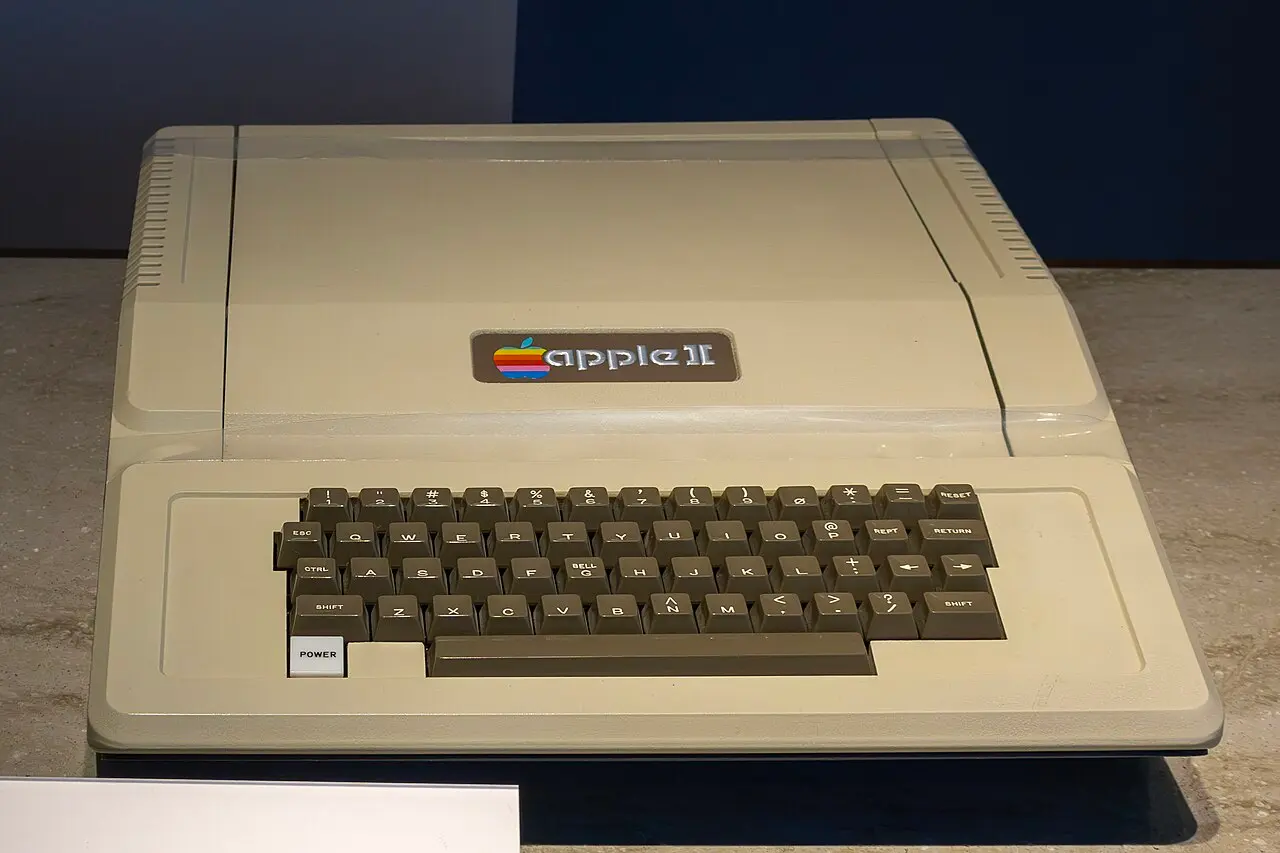
- A plastic case. Steve Jobs wanted moulded plastic rather than sheet metal or wood. The job went to Jerry Manock, an industrial designer who had recently gone freelance from Hewlett-Packard, and who produced a beige ABS enclosure in the weeks before the Faire. No screws are visible from outside.
- Colour. The MOS 6502 runs at 1.023 MHz for a reason: that is exactly two-sevenths of the NTSC colour subcarrier frequency. Steve Wozniak had built Breakout for Atari in hardware and wanted to rewrite it in software. So colour went in first; then a speaker, because the game needed sound; then a minimal paddle circuit. The feature list accreted from what the game required rather than from a specification.
- BASIC in ROM. Switch it on and BASIC is there. Wozniak wrote Integer BASIC without an assembler, working the instructions out on paper and hand-converting them to machine code.
- Eight expansion slots. As Apple II History records it, Jobs thought two would do — a printer and perhaps a modem. Wozniak, from his time at Hewlett-Packard, held out for eight on the argument that users would always find something to put in a spare slot. It made the machine dearer to build.
That last decision compounded. The PET and the TRS-80 were both awkward to expand beyond the memory they shipped with; an Apple II took a card. The third-party peripheral market that grew up around the machine existed because those eight slots did.
Getting Off Cassette Tape
At launch, mass storage meant a cassette recorder: slow, and prone to failing at the worst moment. Over the Christmas holidays of 1977, Wozniak and Randy Wigginton built a floppy disk controller. The Computer History Museum's account notes that Wozniak did it with eight integrated circuits, achieving in programmed logic what other controllers accomplished in dedicated hardware. It was demonstrated at CES in January 1978 and shipped that year as the Disk II.
The software to drive it was bought in. The contract CHM has published shows Apple engaging Shepardson Microsystems on 10 April 1978 for $13,000; Paul Laughton wrote the code, and DOS 3.1 shipped that June.
VisiCalc — A Reason for a Company to Buy One
What moved the Apple II from hobby to office was not an Apple product. On 17 October 1979, VisiCalc reached stores — written by Dan Bricklin and Bob Frankston at Software Arts, published by Personal Software (later VisiCorp), and priced under $100.
A spreadsheet gave a reason to touch a computer to people who had never had one: accountants, financial planners, anyone whose work was a grid of numbers with formulas between them. Change one figure and everything downstream recomputes. The "what if" iteration that had been impractical by hand now took seconds. VisiCalc sold more than 700,000 copies over six years. The decisive fact is that for a period it ran only on the Apple II. Businesses bought the spreadsheet and took the computer as its accessory.
About the "1977 Trinity"
The Apple II, the Commodore PET and the TRS-80 are now habitually grouped as the "1977 trinity". The label is usually credited to Byte magazine, but the originating article has not been located in the archives. It is best treated as a retrospective framing rather than a contemporary one.
Which of the three came first depends entirely on whether you mean announced or delivered.
| Machine | Announced | Shipped |
|---|---|---|
| Commodore PET 2001 | January 1977, prototype shown at Winter CES | First hundred units October 1977; general availability December |
| Apple II | April 1977, West Coast Computer Faire | 10 June 1977 |
| TRS-80 Model I | 3 August 1977, New York press conference | First units delivered November 1977 |
The PET was announced first; the Apple II reached buyers first. On volume, though, the TRS-80 led — Radio Shack's chain of stores was of a different order from Apple's dealer network, and by one analysis it outsold the Apple II by a factor of five until 1982. When TIME surveyed the personal computer market in 1981, the company it put at the head of the list was Tandy, not Apple. "First" changes owner depending on which measure you pick.
Sixteen Years Beside the Macintosh
The Apple II line ran for sixteen years. By the time the IIGS was discontinued in December 1992 and the IIe in November 1993, somewhere between five and six million machines in the series had shipped. Apple kept selling it long after the Macintosh arrived in 1984, for the education market and for customers with software they were not going to abandon — the company's first experience of running an old line and a new one side by side.
Questions this page answers
- When was the Apple II released?
- It was shown at the first West Coast Computer Faire, 15-17 April 1977, and shipped on 10 June 1977 at US$1,298 with 4 KB of memory. Sources disagree because those two dates are routinely conflated.
- Why did the Apple II have colour and sound?
- Because Steve Wozniak wanted to write Breakout in software rather than in hardware. Colour and sound entered the design from that motivation.
Sources
Last updated: