PERSON
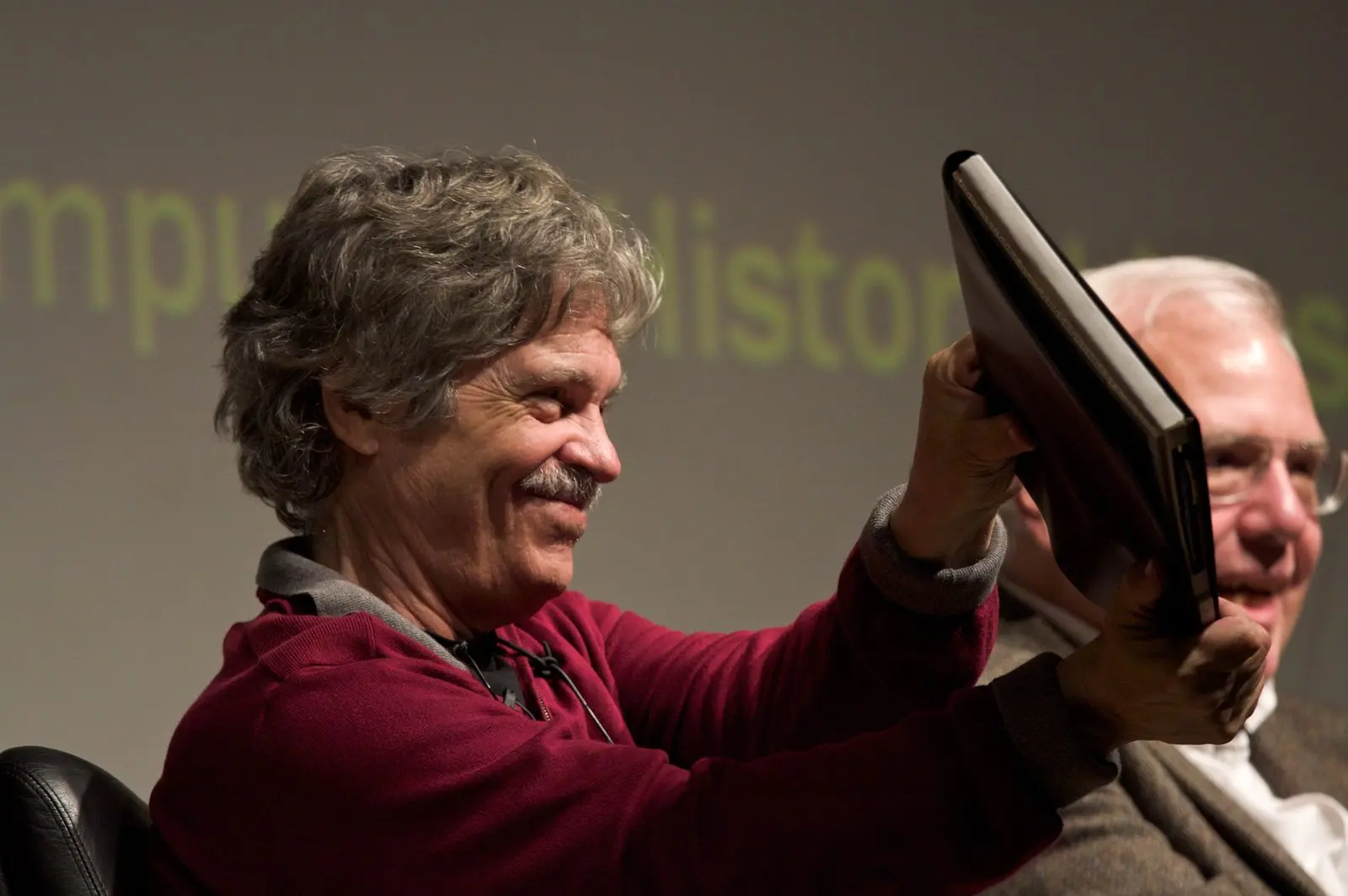
Alan Kay
Led the development of Smalltalk at Xerox PARC and articulated much of object-oriented programming as a discipline. His 1972 paper proposed the Dynabook, a personal computer no larger than a notebook and under four pounds, which prefigured later laptops and tablets. ACM Turing Award 2003; Kyoto Prize and Draper Prize 2004. Known for the line, 'The best way to predict the future is to invent it.'
Profile
- Born
- 1940
- Status
- Living
- Span
- 1940–
- Appearances
- 02
- Name
- ENAlan KayJAアラン・ケイ
Alan Curtis Kay (b. 17 May 1940) is the American computer scientist who, in the 1970s at Xerox PARC, led the development of Smalltalk and articulated object-oriented programming as a discipline. In the same period he set out the Dynabook — a personal computer no larger than a notebook and under four pounds, meant for children — anticipating laptops and tablets by decades. ACM Turing Award, 2003. He is widely known for the line, "The best way to predict the future is to invent it."
Reading at three, 150 books before school
Kay was born on 17 May 1940 in Springfield, Massachusetts. His father was a physiologist who designed arm and leg prostheses; his mother was a musician and an artist. He could read at three and had got through some 150 books before he started school. The family later moved to New York City, where he attended Brooklyn Technical High School. He worked for a time as a professional jazz guitarist and has played all his life.
He started college but left before graduating to join the US Air Force, where an aptitude test made him an IBM 1401 programmer; he worked on several machines, including the Burroughs B500. It was there, by his own account, that he learned a program can be written with procedures that do not know how the data is represented — an idea that fed directly into object-oriented programming. After the Air Force he returned to the University of Colorado and took a bachelor's degree in mathematics and molecular biology in 1966. At the University of Utah he took a master's in 1968 and a PhD in computer science in 1969, encountering computer graphics under Ivan Sutherland and David Evans and designing, with Edward Cheadle, a small machine for engineers called FLEX. His doctoral dissertation was The Reactive Engine.
Running the Learning Research Group at PARC
Xerox PARC and Smalltalk (1971-early 1980s)
In 1971 Kay joined Xerox PARC (Palo Alto Research Center), founded the year before, and was given the Learning Research Group to run. Together with Robert Taylor, Butler Lampson, Charles Thacker, Dan Ingalls, Adele Goldberg and the rest of PARC's first cohort, he helped invent most of the prototype of modern personal computing in one building over one decade.
Smalltalk was first implemented by Dan Ingalls in 1971-72 and matured through Smalltalk-76 into Smalltalk-80, whose specification four outside companies were invited to review in 1980. The form of object orientation Smalltalk embodied was not the static "set of classes with methods" later inherited by C++ (Bjarne Stroustrup, 1985) and Java (1995), but a far more biological metaphor: a network of small, independent computers passing messages to each other. Kay's own definition, given in a July 2003 email to Stefan Ram, is narrow: "OOP to me means only messaging, local retention and protection and hiding of state-process, and extreme late-binding of all things. It can be done in Smalltalk and in LISP." He had made the same point to the Squeak mailing list on 10 October 1998, and regretted his own vocabulary while doing it: "I'm sorry that I long ago coined the term 'objects' for this topic because it gets many people to focus on the lesser idea. The big idea is 'messaging'."
The Xerox Alto (1973) — bitmap display, mouse, WYSIWYG editing, Ethernet and Smalltalk in one machine — stands as the first practical networked personal computer. The visit by Steve Jobs and the Apple team in 1979, and the cascade of borrowings into the Lisa and Macintosh GUI designs, started there.
The Dynabook (1968-1972)
The idea began at Utah as a cardboard mock-up of a tablet with a flat screen and a stylus, and became public in the 1972 paper "A Personal Computer for Children of All Ages." The paper's own specification: "The size should be no larger than a notebook; weight less than 4lbs.; the visual display should be able to present at least 4000 printing quality characters with contrast ratios approaching that of a book; dynamic graphics of reasonable quality should be possible." Storage was to be "removable local file storage of at least one million characters (about 500 ordinary book pages) traded off against several hours of audio (voice/music) files." The point of it was that its owner could "maintain and edit his own files of text and programs when and where he chooses."
The Dynabook was never built as such, but practically every laptop and tablet that has followed — ThinkPad, iBook, iPad, Surface — has been an asymptotic approach to that 1972 description. Kay assessed the iPad coldly in a 2013 interview: "much of the iPad UI is very poor in a myriad of ways." His deeper objection was about distribution rather than interface — Apple "does not allow children to download an Etoy made by another child somewhere in the world," which "could not be farther from the original intentions of the entire ARPA-IPTO/PARC community in the '60s and '70s."
Career
- 1981-1984 — Chief Scientist, Atari.
- 1984-1997 — Apple Fellow (Advanced Technology Group).
- 1997-2001 — Disney Fellow at Walt Disney Imagineering.
- 2001- — Founder and President, Viewpoints Research Institute.
- 2002-2005 — Senior Fellow, Hewlett-Packard.
- Teaching and visiting appointments at UCLA, Kyoto University, MIT and New York University.
Etoys, Squeak and STEPS (1996-2012)
Squeak, an open-source modern Smalltalk, was built by Kay's research team while he was at Apple, and development continued after the team moved to Disney in 1997. Etoys, an authoring environment for children, sits on top of it. Together they supplied the software environment of the One Laptop Per Child XO laptop in 2007.
From November 2006 to October 2012, with just over $5.33 million from the US National Science Foundation (award IIS-0639876), Kay led the STEPS project at Viewpoints Research Institute. The question was how many lines of code the personal computing experience — operating system, applications and supporting software — intrinsically is. Kay laid out the options from two billion lines down to two thousand and wrote: "suppose it might be only 20,000 lines of code in a new kind of programming system and architecture – this is a modest 400-page book, not the tiny 'constitution in the pocket', but not a multivolume encyclopedia or a library of 1000 books (20 million lines of code)." The work produced OMeta, Nile, Frank and a stack of domain-specific languages, reported annually as Steps Toward the Reinvention of Programming. The 20,000-line figure was the framing of the question, not a declared result, and no commercial successor came out of it.
Awards and honours
- 1987 — ACM Software System Award for Smalltalk, with Adele Goldberg and Dan Ingalls.
- 1999 — Fellow of the Computer History Museum.
- 2001 — Berlin University of the Arts Award for Interdisciplinary Art and Science; J-D Warnier Prix d'Informatique; NEC Computer & Communications Prize.
- 2003 — ACM Turing Award, "For pioneering many of the ideas at the root of contemporary object-oriented programming languages, leading the team that developed Smalltalk, and for fundamental contributions to personal computing."
- 2004 — Kyoto Prize.
- 2004 — Charles Stark Draper Prize, jointly with Butler Lampson, Robert Taylor and Charles Thacker.
- 2008 — ACM Fellow.
He is also a Fellow of the American Academy of Arts and Sciences, the National Academy of Engineering and the Royal Society of Arts.
A language for children, and for adults through it
Kay has led the Viewpoints Research Institute on the long-standing question of "a small, powerful language and environment for children — that adults can also learn through." VPRI is reported to have wound down its operations in 2018, but he continues to carry the title: the SPLASH 2024 conference listed him as "president of the Viewpoints Research Institute, and an adjunct professor of computer science at the University of California, Los Angeles."
He still speaks. On 21 February 2024 he gave a talk at UCLA's CS Connection Lab built around the question of whether an institution like Xerox PARC could be created today, and the ARPA funding doctrine behind it — fund people rather than projects, prefer problem-finding to problem-solving. SPLASH 2024 ran an "Interview with Alan Kay." His recurring theme is the impoverishment of present-day computing education: its reduction to vocational training, and the abandonment of the computer as a tool for thinking.
Four axes: the GUI, objects, the PC, and children
Kay's influence is most easily measured along four axes: the graphical user interface, object orientation, the ideal of the personal computer, and "programming for children." On the GUI and personal computer, Jobs's 1979 visit to PARC fed into the Lisa and Macintosh, and from there into Microsoft Windows and the modern GUI lineage. On object orientation, Smalltalk's genes are thinly and widely distributed through C++, Objective-C, Java, Ruby and Python, although the message-centric reading Kay cared about is best preserved in the Erlang/OTP and Actor-model tradition.
In educational programming he is the spiritual grandparent of the line that runs from Logo and Smalltalk through Scratch, Etoys, Snap! and Microsoft MakeCode; in 2026 his 1972 paper is still cited in arguments about primary-school computing.
"The best way to predict the future is to invent it" is recorded by the ACM as his credo. Half a century later, alongside the laptop, the tablet, the GUI and object orientation, the sentence too has become one of the things he invented.
Appearances
Sources
TertiaryAlan Kay — Wikipedia
Last updated: