T1#research#standard#market
The Ethernet Memo — One Cable Through the Building
Metadata
- Date
- Decade
- 1970s
- Tier
- T1
- Sources
- 08
- Connections
- 02
- Tags
- #research#standard#market
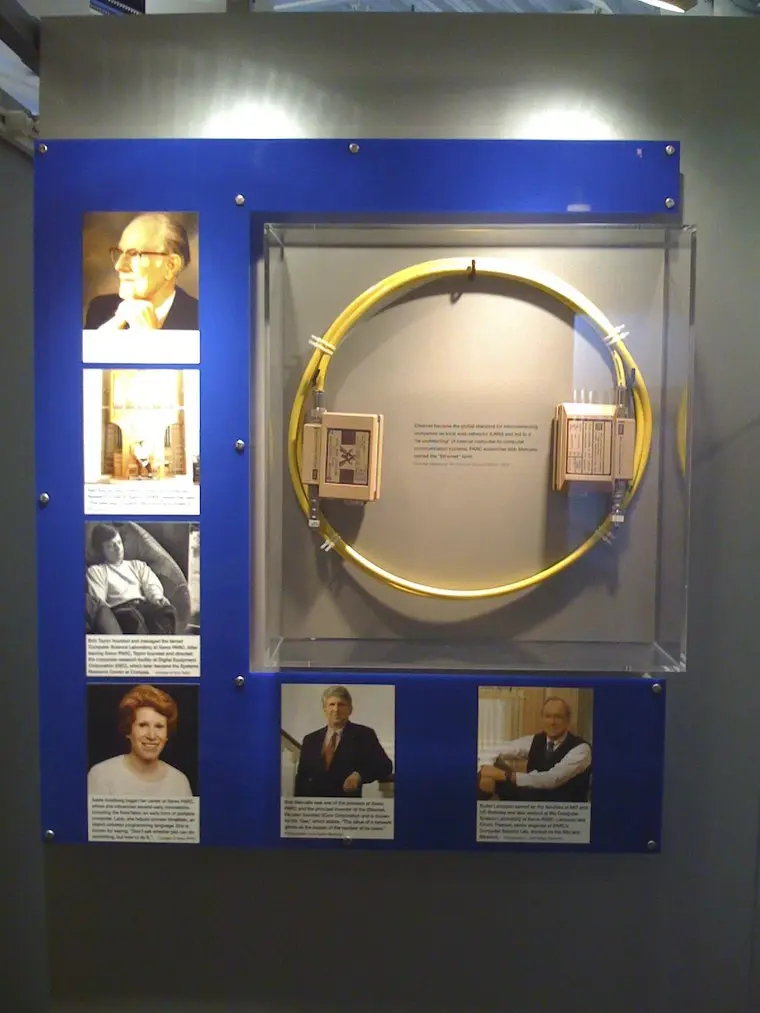
On 22 May 1973, Robert Metcalfe circulated a memorandum inside Xerox PARC describing a broadcast network for connecting Altos within a building. The Computer History Museum records that Metcalfe called the document "Ether Acquisition" and that it was heavy with handwritten annotations and hand-drawn diagrams. Until then he had been calling the idea the ALTO ALOHA Network. The memo proposed a new name: the Ether network.
What It Took From ALOHA
The ALOHA in that old name was not a flourish. The University of Hawaii's ALOHA System linked computers across the islands by radio packet, and it worked on a principle that looked reckless by the standards of contemporary communications engineering: transmit when you have something to say, and if two transmissions collide, wait a random interval and try again. Metcalfe examined and refined the model of that scheme in his Harvard doctoral work.
Ethernet moved the idea off the radio and onto coaxial cable, and added two things. Listen before transmitting, to hear whether the channel is busy — carrier sense. Keep listening while transmitting, and abort the moment a collision is detected — collision detection. Then choose the retransmission delay at random from an interval whose mean doubles after each successive collision: binary exponential backoff. There is no switch in the middle and no master station passing a token. Arbitration is statistical and it happens at each contending station.
Why "Ether"
The 1976 paper states the derivation outright: Ethernet is named for the historical luminiferous ether through which electromagnetic radiation was once alleged to propagate. A concept nineteenth-century physics had discarded. This was not irony but a statement of design intent. The shared medium is passive, holds no control, and simply exists. And that the medium happened to be coaxial cable was not meant to be essential — when Ethernet later migrated to twisted pair, to fibre, and eventually to the air, the name turned out to have been chosen well.
Four Things That Are Not the Same Thing
Ethernet gets misdated because four separate events all get called its birth.
| Date | What happened | What it was |
|---|---|---|
| 22 May 1973 | Metcalfe's memo | A proposal, internal to Xerox. Not a specification |
| July 1976 | Metcalfe and David Boggs, Communications of the ACM 19(7), 395–404 | A published design with measurements, based on an operating network of 100 nodes along a kilometre of coaxial cable. Up to 256 stations, 3 Mbit/s |
| 30 September 1980 | DEC, Intel and Xerox, Version 1.0 (the "Blue Book") | An industry specification. 10 Mbit/s, maximum station separation 2.5 km, maximum 1,024 stations |
| Approved 23 June 1983, published 31 December 1985 | IEEE 802.3 | A formal standard: the CSMA/CD access method and physical layer |
The speeds do not line up either. The Alto's Ethernet interface is described in the 1979 Alto design report as a 3 Mbit/second communication facility; ACM's account of Metcalfe's Turing Award gives the actual figure as 2.94 Mbit/s, an awkward number because it was derived from the Alto's own clock. Ten megabits first appears in the 1980 DIX specification. And that specification's own preface calls its predecessor the "Experimental Ethernet", designed and implemented by Xerox in 1975 — the distance from memo to running network is measured in years, not weeks.
One Laser Printer, Hundreds of Altos
It helps to remember what problem PARC had. It had hundreds of Altos, and a laser printer far too expensive to give each researcher one, and file servers, and the beginnings of electronic mail. None of that is worth anything unless the machines can reach each other, and the wide-area techniques of the day — the ARPANET's leased lines and interface message processors — were absurd for a set of machines standing in the same building. Ethernet was designed for the case where the medium is short, cheap, and shared, and where nobody is willing to pay for a switch.
Xerox filed for a patent on the work in 1975, with Metcalfe, Boggs, Thacker and Lampson named, and it was granted in 1977. That patent is why the DIX arrangement of 1980 mattered so much: it was Xerox deciding to license rather than to hold.
Becoming a Standard
Metcalfe left Xerox in June 1979 and founded 3Com. What he did next was not to sell an invention but to build agreement among competitors. The DIX consortium put a technology Xerox had held alone into a jointly published specification, and that document was carried into the IEEE 802 committee and became 802.3.
The sequence mattered. IBM was pushing Token Ring at the same moment, and a token bus scheme had its own constituency. IEEE 802 declined to pick a winner and issued three parallel standards — 802.3, 802.4 and 802.5. What settled the question was not the committee but volume: cheap interface cards, and a vast installed base of IBM PC compatibles to plug them into.
Metcalfe received the 2022 ACM A.M. Turing Award, cited for the invention, standardization, and commercialization of Ethernet. The citation itself makes the point that inventing it was not sufficient.
The Frame Format Outlived the Cable
When TCP/IP became the common language of the internet, the thing actually carrying the frames underneath was, more often than not, Ethernet. The single fat coaxial cable with everyone hanging off it gave way to hubs, then switches, then full duplex, at which point collision detection stopped being necessary at all. The frame format and the 48-bit MAC address survived anyway, from the 1980 Blue Book through to IEEE 802.3df-2024 at 800 Gb/s. The division of labour — ARPANET and its descendants for distance, Ethernet inside the building — has held for half a century.
Questions this page answers
- When did Ethernet become a standard?
- With the DEC-Intel-Xerox specification of 30 September 1980 at 10 Mbit/s, and then IEEE 802.3, approved on 23 June 1983 and published on 31 December 1985. The memo of 22 May 1973 was a proposal, not a standard.
- Where does the name Ethernet come from?
- From the luminiferous aether of nineteenth-century physics, the medium once thought to carry light.
Sources
TertiaryEthernet — Wikipedia
Last updated: