PERSON
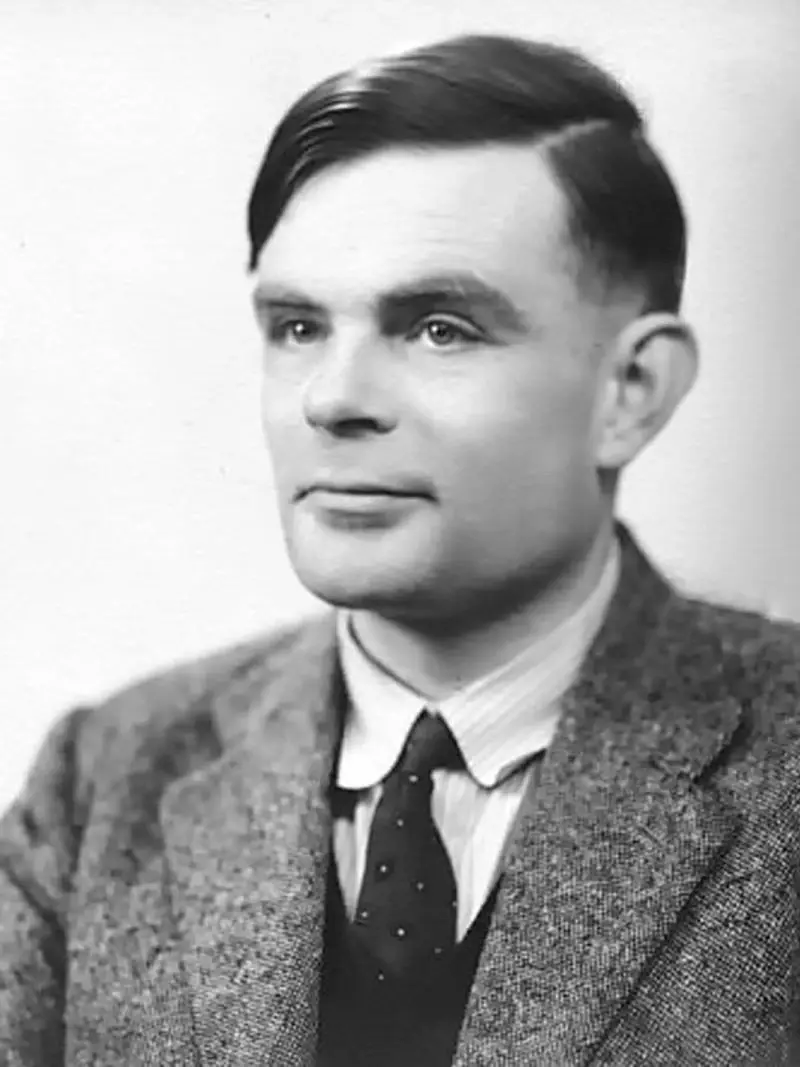
Alan Turing
The mathematician who founded the theory of computability. His 1936 paper "On Computable Numbers, with an Application to the Entscheidungsproblem" defined the abstract machine later named after him and answered Hilbert's decision problem in the negative. He worked on Enigma at Bletchley Park during the Second World War, designed the ACE at the National Physical Laboratory afterwards, and joined the University of Manchester in 1948. His 1950 paper "Computing Machinery and Intelligence" proposed the imitation game, now called the Turing test. Convicted in 1952 under the laws then criminalising homosexual acts, he died in 1954 at forty-one; a royal pardon followed in 2013.
Profile
- Born
- 1912
- Died
- 1954
- Span
- 42 years
- Appearances
- 01
- Name
- ENAlan TuringJAアラン・チューリング
Alan Mathison Turing (23 June 1912 – 7 June 1954) gave a mathematical definition to the act of computing. He settled what machines could and could not do at a time when no such machine existed.
The 1936 paper
Born in Paddington, London, Turing read mathematics at King's College, Cambridge, and was elected a Fellow of the college in 1935. The following year, at twenty-four, he wrote "On Computable Numbers, with an Application to the Entscheidungsproblem". The London Mathematical Society received it on 28 May 1936, it was read on 12 November, and it appeared in the Society's Proceedings, series 2, volume 42, pages 230–265.
The paper introduces a device with an unbounded tape, reading and writing symbols on it while moving between a finite number of states. Turing simply called it a computing machine. The abstraction made it possible to define rigorously what it means for a number to be obtainable by a finite procedure — and then to prove that no general procedure exists for deciding whether an arbitrary such machine ever halts. That is a negative answer to David Hilbert's Entscheidungsproblem.
The same paper describes a universal machine: one that takes the description of another machine as input and imitates its behaviour. The idea that a program is data to be fed to a machine was set down years before any machine existed to receive it.
Bletchley Park
From September 1939 Turing worked full time for the Government Code and Cypher School at Bletchley Park, on the German Enigma. The Bombe, which he designed with W. G. Welchman, mechanised the search for Enigma keys, and he became the leading scientific figure on the naval problem, with particular responsibility for U-boat traffic. He was appointed OBE in 1945. The work stayed classified long past his lifetime; none of it was public when he died.
ACE, and Manchester
After the war Turing designed an electronic computer, the Automatic Computing Engine, for the National Physical Laboratory. Drawn up between late 1945 and early 1946, the proposal is a remarkably concrete document — circuit designs, hardware specifications, specimen programs in machine code, even a cost estimate — and in it he cites von Neumann's EDVAC draft. The full ACE was never built as designed; a reduced Pilot ACE ran in 1950.
In 1948 Max Newman brought him to the University of Manchester. Of the three demonstration programs known to have run on the Baby, one — a long-division routine — was Turing's.
The imitation game
In October 1950 Mind published "Computing Machinery and Intelligence". It opens by proposing to consider the question "Can machines think?" — and then immediately refuses to answer it by inspecting what the words normally mean, since that route ends in a Gallup poll. Turing replaces the question with another: whether a judge, communicating only in text, can tell a machine from a person. He called it the imitation game. It is now called the Turing test.
Conviction, death, and after
In February 1952 Turing was arrested over a relationship with a man and convicted of gross indecency. To avoid prison he accepted injections of oestrogen. The conviction also disqualified him from further secret cryptological work. He died at his home in Wilmslow, Cheshire, on 7 June 1954, aged forty-one. The full circumstances cannot now be established; the coroner's inquest returned suicide.
In 2009 the then Prime Minister, Gordon Brown, issued a public apology for his treatment. On 24 December 2013 a posthumous pardon was granted under the Royal Prerogative of Mercy. And on 23 June 2021 — his birthday — the Bank of England issued a £50 note bearing his portrait, with the Pilot ACE and mathematical formulae on the reverse.
Appearances
Sources
Last updated: