T1#market#research
Intel 4004 — The First Commercially Available Microprocessor
Metadata
- Date
- Decade
- 1970s
- Tier
- T1
- Sources
- 08
- Connections
- 01
- Tags
- #market#research
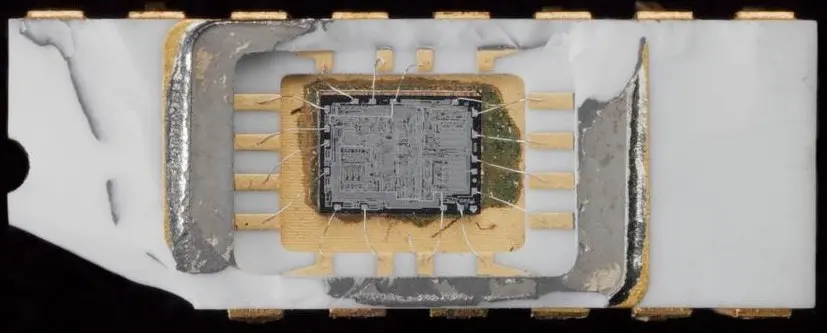
The first microprocessor sold as a component — a complete central processing unit on one chip that any engineer could order — was the Intel 4004. Intel announced it to the general market with an advertisement in Electronic News on 15 November 1971. The chip itself had been working since early that year, and the first product built around it, Busicom's 141-PF printing calculator, went on sale in October 1971. "First microprocessor" needs that qualifier: there were earlier processors built from a few large-scale integrated chips, and the 4004 was the first to reach the open market as a single-chip part.
A Calculator Order From Japan
The 4004 began as custom work. In 1969, according to Intel's own history, the Nippon Calculating Machine Corporation — maker of Busicom calculators — asked Intel to design twelve custom chips for a new printing calculator, the 141-PF. Intel was then a young company, founded the year before by Robert Noyce and Gordon Moore, and its main business was memory.
Ted Hoff and Stan Mazor at Intel proposed something different: rather than a dozen special-purpose chips, a small set of general chips, one of which would be a programmable processor. The Computer History Museum credits Hoff and Mazor with conceiving the 4004 as a member of the MCS-4 chip set, which also included ROM, RAM and input/output expansion chips.
Faggin, Shima and Silicon-Gate MOS
Turning the concept into silicon fell to Federico Faggin, who joined Intel in 1970 after developing silicon-gate MOS technology at Fairchild. Masatoshi Shima, a Busicom engineer, worked alongside him. The museum describes Faggin applying his silicon-gate experience, assisted by Shima, to squeeze the 4004's 2,300 transistors into a low-cost 16-pin package. (The museum's "This Day in History" page gives 2,250; this article uses the Silicon Engine figure.)
On his own site, Faggin recounts receiving the first 4004 wafers one evening in January 1971 and testing them alone in the lab until about 3 a.m., when all the critical functions turned out to work. He also signed the design: his initials, F.F., are etched on the chip.
According to the IPSJ Computer Museum of the Information Processing Society of Japan, the 4004 was completed in March 1971, and Busicom began selling the 141-PF, the first product to carry it, in October 1971.
What the Chip Could Do
The 4004 was a 4-bit processor, suited to the decimal digits a calculator handles. Intel's datasheet lists 46 instructions, P-channel silicon-gate MOS construction, and a 10.8-microsecond instruction cycle; a one-word instruction took eight clock periods, a two-word instruction sixteen. That timing works out to roughly 92,000 single-cycle instructions per second.
It was not a computer by itself. A working system needed the other MCS-4 chips for program storage, data memory and input/output. What was new was that the processor — the part that fetched and executed instructions — had become one standard component.
Buying Back the Rights
The decision that turned a calculator part into a product was commercial. Busicom held exclusive rights to the design. Intel's history page says that in May 1971, at the urging of the design team, Noyce bought back the rights to the chip for everything but calculators by returning Busicom's $60,000 investment in its development. Faggin, for his part, describes campaigning inside Intel to make the 4004 available to the general market after showing that it could be used for more than calculators.
That made the November advertisement possible. The Computer History Museum records it as the first advertisement for a microprocessor. Busicom itself did not last: Intel notes that it went bankrupt in 1974.
How "First" Should Be Stated
The museum's account of the period is careful about precedents. In 1969 Lee Boysel at Four-Phase Systems created the AL-1, an 8-bit CPU slice; in 1970 Steve Geller and Ray Holt of Garrett AiResearch designed the MP944 chip set, six metal-gate chips for the F-14A fighter's Central Air Data Computer. Both put processor functions into MOS large-scale integration before the 4004, but neither was a single-chip CPU sold to the public. The defensible claim for the 4004 is therefore "the first single-chip CPU sold as a component", not "the first processor on silicon".
The 8008 Was a Separate Line
The 8-bit 8008, announced in 1972, is often described as the 4004's successor. The museum's account presents it differently: it was designed for Computer Terminal Corporation (later Datapoint), with Hal Feeney doing the design under Faggin's supervision, in parallel with the 4004 rather than after it. The museum adds that second-generation 8-bit processors in 1974, Intel's 8080 and Motorola's 6800, established widespread acceptance of the microprocessor concept.
Further Reading
The four designers — Faggin, Hoff, Mazor and Shima — later wrote a joint history of the chip in IEEE Micro (1996). For the company, see Intel; for the forecast of chip density that the 4004 helped confirm, see Moore's Law. The rest of the story is on the hardware timeline.
Questions this page answers
- What was the first microprocessor?
- The first single-chip CPU sold as a component was the Intel 4004 of 1971. Earlier efforts put a CPU on a few LSI chips: Four-Phase Systems' AL1 of 1969 combined registers and an arithmetic unit but needed an external control unit, and Garrett AiResearch's MP944 of 1970 was a six-chip set for the F-14 fighter.
- When was the Intel 4004 released?
- It was completed in March 1971 and first reached buyers inside Busicom's 141-PF calculator, on sale from October 1971. Intel announced it to the general market on 15 November 1971 with an advertisement in Electronic News.
- Who designed the Intel 4004?
- Ted Hoff and Stan Mazor of Intel conceived it, Federico Faggin designed the silicon-gate circuitry and layout, and Masatoshi Shima of Busicom worked with him. The Computer History Museum names all four as its designers.
- How powerful was the Intel 4004?
- It was a 4-bit chip of about 2,300 transistors (another Computer History Museum page gives 2,250). Its instruction cycle was 10.8 μs, which works out to about 92,000 single-cycle instructions per second.
Sources
DOI confirmed via Crossref to resolve to this paper by the four designers
PrimaryIntel 4004 Single Chip 4-Bit P-Channel Microprocessor — Intel datasheet (archived)
10.8 μs instruction cycle; one-word instructions take 8 clock periods; 46 instructions; P-channel silicon-gate MOS
Hoff and Mazor conceived it; Faggin assisted by Shima; 2,300 transistors; 16-pin package; AL-1 (1969) and MP944 (1970, six chips); 8008 for CTC, designed by Hal Feeney
PrimaryAnnouncing a New Era of Integrated Electronics — Intel
In May 1971 Noyce bought back rights for everything but calculators by returning Busicom's $60,000; Busicom went bankrupt in 1974
SecondaryBusicom 141-PF — IPSJ Computer Museum (Information Processing Society of Japan)
4004 completed March 1971; 141-PF on sale October 1971; Intel's public sales from November 1971
PrimaryThe Intel 4004 Microprocessor and the Silicon Gate Technology — Federico Faggin's site
Faggin's account of the first working 4004 wafers in January 1971, and the F.F. initials on the chip
TertiaryIntel 4004 — Wikipedia
Last updated: