T1#research#military
Engelbart's Demo — Ninety Minutes of Interactive Computing
Metadata
- Date
- Decade
- 1960s
- Tier
- T1
- Timelines
- A General History of Information Technology · A History of the Internet and the Web · A History of Operating Systems
- Sources
- 06
- Connections
- 02
- Tags
- #research#military
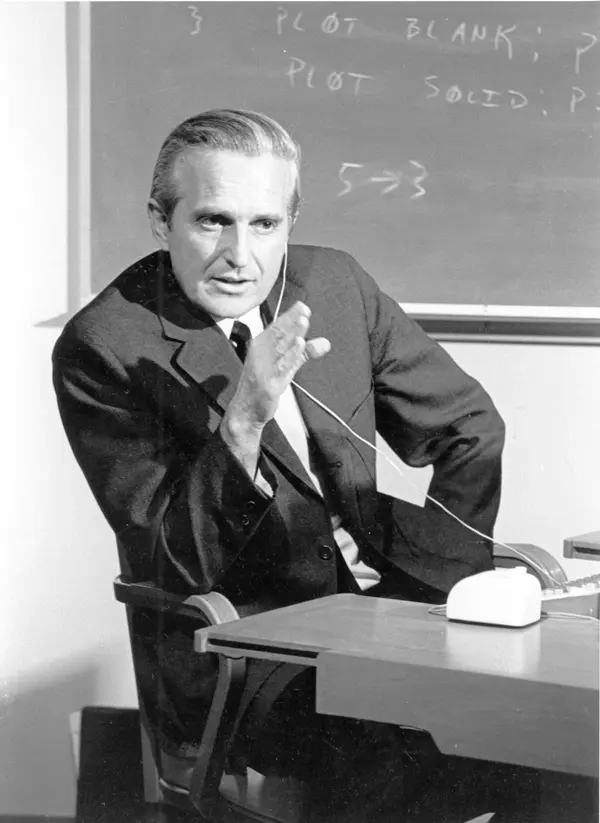
San Francisco Civic Auditorium, 9 December 1968. As one session of the Fall Joint Computer Conference, which ran from 9 to 11 December, Douglas Engelbart of the Stanford Research Institute took a seat on stage. The paper was "A Research Center for Augmenting Human Intellect", written with William K. English and printed in the AFIPS conference proceedings, volume 33, pages 395–410.
He did not read it. For roughly ninety minutes he showed a running system instead.
What Was on the Screen
Approximately the agenda of the next twenty-five years:
- The mouse — a box for pointing at a place on the screen. Engelbart's console carried a mouse, a keyboard, and a five-key chord keyset for the left hand.
- Windows on a single display, with control over how much of a document you saw and at what granularity.
- Following links within and between documents — the operation later called hypertext.
- Structured editing — treating prose as a hierarchy that could be collapsed, expanded and rearranged.
- Collaboration — sharing a screen with a colleague thirty miles away, talking and seeing each other, editing the same document.
Individual pieces had antecedents. The significance of the ninety minutes is that they were shown as one working system, at once.
The Wiring
None of it was recorded, and there was no computer in the hall.
Engelbart was operating NLS — the oN-Line System — on an SDS 940 at SRI in Menlo Park. The 1968 paper describes that machine as having 65K of 24-bit core and serving twelve CRT workstations simultaneously, with ten research staff working at consoles in their offices as a matter of routine.
Keyboard and mouse traffic went south over a leased telephone circuit through home-built 1200-baud modems. Video came back north over microwave links and was thrown onto a large screen by an Eidophor projector — a device the size of a small car that modulated an oil film and bounced light off it. The faces of colleagues at SRI, among them Bill Paxton and Jeff Rulifson, arrived by a second microwave path and appeared as a window in the corner of the same screen.
Bill English was co-author of the paper and the principal engineer who made the demonstration happen. He was also the man who, in the autumn of 1964, had built the first mouse prototype to Engelbart's design: perpendicular wheels set into a hollowed-out wooden block with a button on top. The patent — US 3,541,541, "X-Y position indicator for a display system", filed 21 June 1967 and granted 17 November 1970 — names Engelbart as inventor and Stanford Research Institute as assignee.
It is worth stressing that the mouse was not a hunch that happened to catch on. ARC ran comparative experiments on pointing devices — joystick, light pen, a knee-operated control, the mouse — and the mouse came out ahead on both speed and error rate. It was measured against the alternatives and then selected. The console Engelbart sat at that afternoon also carried a five-key chord keyset for the left hand, worked in concert with the mouse. That half of the input design never left the laboratory.
Who Paid
The 1968 paper names its sponsors plainly: the Advanced Research Projects Agency; NASA, under contract NAS1-7897; and the Rome Air Development Center, under F30602-68-C-0286. Cold War defence money, spent on document editing and collaborative work.
The intellectual starting point sits six years earlier, in Engelbart's SRI report Augmenting Human Intellect: A Conceptual Framework (AFOSR-3223, October 1962), which argued for designing computers as amplifiers of human thought rather than as calculators. The demo was that framework, executing.
The Name Came Later
Nobody in the room called it "The Mother of All Demos". The usual account traces the phrase to Steven Levy's 1994 book Insanely Great, in which a passing line about Engelbart's demonstration used it; Andries van Dam, who had been in the 1968 audience, repeated it in 1995 while introducing Engelbart at the Vannevar Bush Symposium at MIT, and it stuck. The attribution is not settled, and it does not need to be to make the useful point: constructions of the form "the mother of all —" entered common English around the 1991 Gulf War, so the label cannot be contemporary. It records what the industry decided to call the event a quarter of a century afterwards, not what the audience called it that afternoon.
Even the size of that audience is unfixed. The Doug Engelbart Institute puts it at about 2,000; Wikipedia at about 1,000. The accounts agree that the hall was full to standing room, and that the session ended in a standing ovation.
From the Second ARPANET Node to PARC
The following year, SRI's Augmentation Research Center became the second node on the ARPANET. When UCLA sent the first host-to-host message on 29 October 1969, the machine at the other end was this same SDS 940, and ARC went on to run the network's Network Information Center. The interactive workstation and the network that linked such workstations came out of the same laboratory.
Through the 1970s ARC people moved to Xerox PARC, where the ideas became the Alto and Smalltalk, and from there — by way of the Macintosh — reached ordinary desks. Engelbart's own NLS never became a product of consequence. What he was demonstrating was not a product but a way of working in which a person and a machine are engaged together, and most of it took about fifty years to become unremarkable. The part he cared about most, the shared screen and the collaborating group, was the last to arrive.
Sources
SecondaryFirsts: The Demo — Doug Engelbart Institute
The venue, the session title and the composition of the team
TertiaryThe Mother of All Demos — Wikipedia
The link setup, the Eidophor projector, and the debate over where the name came from
Last updated: