T1#consumer
The Macintosh — The GUI Goes Mainstream
Metadata
- Date
- Decade
- 1980s
- Tier
- T1
- Sources
- 06
- Connections
- 02
- Tags
- #consumer
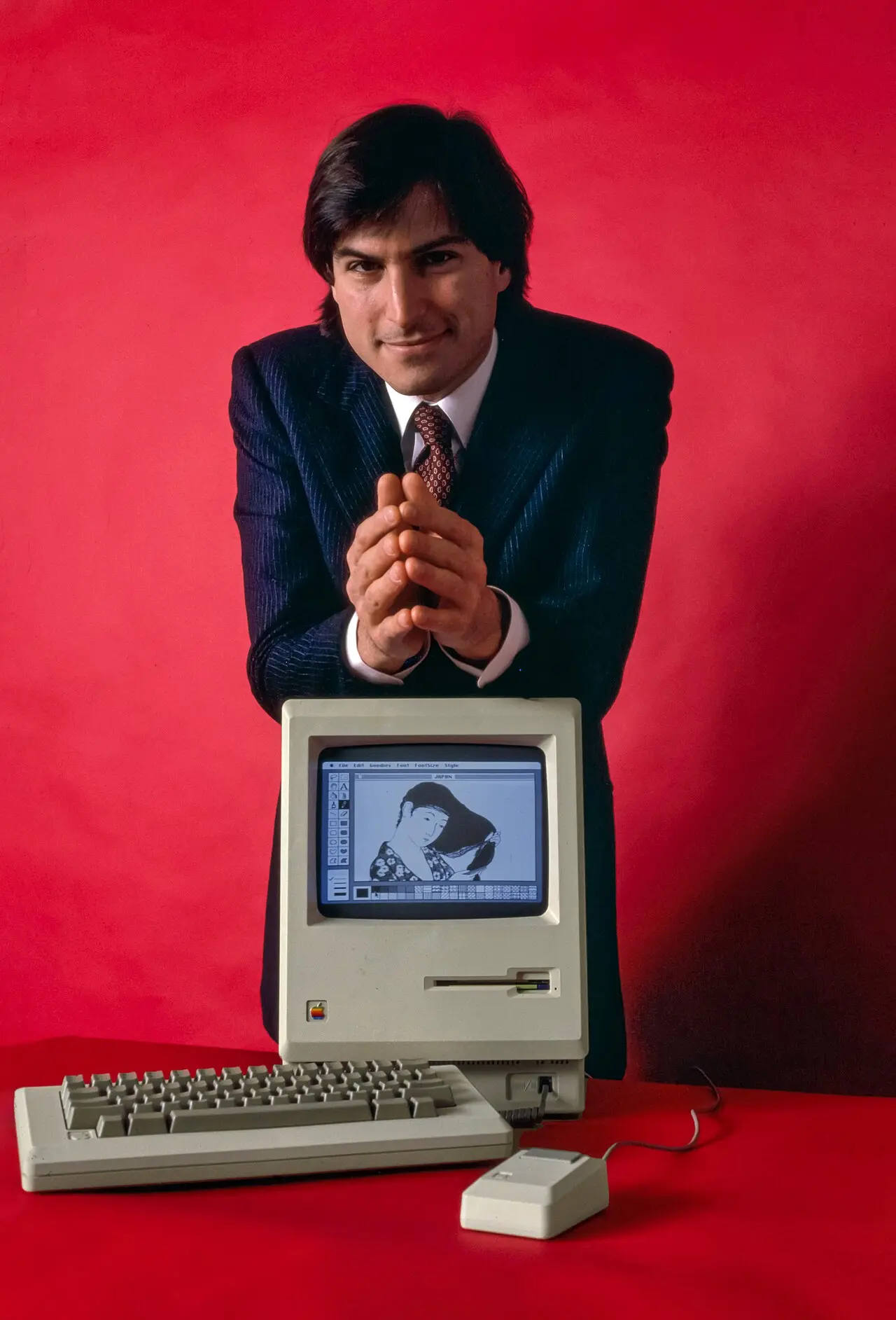
The original Macintosh, the model later called the Macintosh 128K, was introduced by Steve Jobs on stage at Apple's annual shareholders' meeting on 24 January 1984 and went on sale in the United States the same day, at US$2,495. It was not the first personal computer operated by pointing at icons and menus with a mouse. It was the one that brought that way of working down to a price individuals could pay, and sold it as a computer for ordinary people.
Introduced at a Shareholders' Meeting
The Macintosh was not unveiled at a trade show or a press conference but as part of the agenda of Apple's annual shareholders' meeting. The recording preserved at the Internet Archive opens with a welcome from John Sculley, Apple's president and CEO, and his report on the company.
In it Sculley said that on the previous Sunday 43 million Americans had seen a new Apple television commercial, the one declaring that 1984 would not be like George Orwell's 1984. After a speech asking the room whether IBM would come to dominate the whole industry, the commercial was played, and Jobs took the stage. He named two milestone products in the industry's history, the Apple II in 1977 and the IBM PC in 1981, and called the Macintosh the third. He announced the price, $2,495, and said the machine could be seen that day at more than 1,500 dealers in America.
The Specifications Jobs Listed
| Item | Detail |
|---|---|
| CPU | Motorola 68000, the same processor as the Lisa (about 8 MHz) |
| Memory | 64 KB ROM + 128 KB RAM (presented as 192 KB in total) |
| In ROM | The operating system, the graphics foundation and the entire user interface |
| Storage | 3.5-inch floppy disk, over 400 KB on one side |
| Display | 9-inch black-and-white bitmap screen (512 × 342 pixels) |
| I/O | Two serial ports; four-voice sound and speech built in |
| Size | One third the size and weight of an IBM PC (Jobs's description) |
Jobs said the screen had more than twice as many dots as any current-generation personal computer. He also introduced a family of peripherals: the ImageWriter printer, an external disk drive, a modem, a numeric keypad and a carrying case.
Then a Macintosh taken out of a bag drove the images on the hall's big screen and introduced itself in a synthesised voice, with a joke about being easier to lift than an IBM mainframe. The moment is still the scene most often replayed from the launch.
The Markets Apple Aimed At
Jobs described two primary markets. The first was the 25 million knowledge workers behind desks, particularly in small and medium-sized businesses. The second was college students, more than 11 million in the United States alone, whom he called the knowledge workers of tomorrow. The telephone, he said, had been the first desktop appliance; the Macintosh could be the second. The advertising copy that runs at the start of the recording and recurs throughout is "The computer for the rest of us."
"1984," Two Days Earlier
Two days before the introduction, during the broadcast of Super Bowl XVIII on 22 January 1984, Apple ran the commercial "1984." It was made by the agency Chiat/Day and directed by Ridley Scott, whose Blade Runner had come out a year and a half earlier. A grey crowd listens to Big Brother on a giant screen; a woman in colour runs in and hurls a hammer that shatters it. The closing card announces that on 24 January Apple Computer will introduce Macintosh.
By having Sculley tie the commercial to Orwell, and by playing it after a speech about IBM's dominance, Apple presented the Macintosh to its own shareholders as the alternative to IBM.
The Lisa, Introduced the Same Day
It is less often remembered that the same meeting also introduced a new Lisa line-up. The Lisa, announced a year earlier on 19 January 1983 at US$9,995, had been Apple's first GUI computer.
| Model | Configuration | Price |
|---|---|---|
| Macintosh | 3.5-inch floppy | $2,495 |
| Lisa 2 | 512 KB RAM, 3.5-inch floppy | $3,495 |
| Lisa 2/5 | 5 MB external hard disk | $4,495 |
| Lisa 2/10 | 10 MB internal hard disk | $5,495 |
Jobs said all the new Lisas were compatible with Macintosh software and presented the four as a family of 32-bit products. The Computer History Museum, however, describes the Macintosh as "Apple's second attempt at a GUI-based personal computer, following the failure of the Lisa." It was the Macintosh that survived. For the lineage before the Lisa, the Xerox Alto at PARC and its relationship to Apple, see the Xerox Alto article.
The 128 KB Constraint
The launch went well, but the original machine's 128 KB of RAM soon became a constraint. Beyond the small memory, rewriting applications for the GUI was time-consuming work, and many software developers are reported to have held back. In September 1984 Apple released the Macintosh 512K, with four times the RAM.
Meanwhile, according to the Computer History Museum, graphic designers, artists and educators adopted the Macintosh quickly. The bitmap screen and the mouse first paid off in the work of people who dealt in pictures rather than text.
The Link to Windows
During the same presentation Jobs said the Lisa had set the technical direction for the industry and that imitations were already appearing, naming VisiCorp's VisiOn, MS Windows and a rumoured IBM windowing package. MS Windows actually shipped in November 1985, with tiled windows that could not overlap (Windows 1.0), about one year and ten months after the Macintosh went on sale.
Questions this page answers
- When was the first Macintosh released?
- On 24 January 1984. Steve Jobs introduced it at Apple's annual shareholders' meeting and said it could be seen that day at more than 1,500 dealers in America. That was the US launch; the model is now usually called the Macintosh 128K.
- What did the original Macintosh cost, and what were its specs?
- US$2,495. It had a Motorola 68000 at about 8 MHz, 128 KB of RAM, 64 KB of ROM, a 9-inch monochrome screen at 512 × 342 pixels, and a 3.5-inch floppy drive holding 400 KB per disk.
- Was the Macintosh the first computer with a GUI?
- No. The GUI was researched on the Xerox Alto at PARC in the 1970s, and commercial machines such as the Xerox Star (1981) and Apple's own Lisa (1983) came first. The Macintosh brought it down to a US$2,495 price.
- When did the "1984" commercial air?
- During the broadcast of Super Bowl XVIII on 22 January 1984, two days before the introduction. It was directed by Ridley Scott for the agency Chiat/Day.
Sources
TertiaryApple Lisa — Wikipedia
Tertiary1984 (advertisement) — Wikipedia
TertiaryMacintosh 128K — Wikipedia
Last updated: