T1#market#enterprise
IBM 305 RAMAC — The First Commercial Hard Disk Drive
Metadata
- Date
- Decade
- 1950s
- Tier
- T1
- Timelines
- A General History of Information Technology · A History of Semiconductors and Hardware · A History of Databases
- Sources
- 06
- Connections
- 01
- Tags
- #market#enterprise
On 14 September 1956 IBM held a press conference to announce the IBM 305 RAMAC — Random Access Method of Accounting and Control. At the centre of the system sat the IBM 350 disk storage unit, the first commercial hard disk drive.
Four dates, not one
Accounts of RAMAC blur four separate events. Separated out:
| Date | What happened |
|---|---|
| June 1956 | An engineering prototype (305-A) ships to Zellerbach Paper Company, San Francisco |
| 4 September 1956 | IBM announces internally |
| 13 September 1956 | The first unit ships |
| 14 September 1956 | Public announcement at a press conference |
| November 1957 | Production shipments begin, to United Airlines in Denver |
The reason so many sources date the announcement to 13 September is that the first shipment and the press conference fell a day apart. The RAMAC restoration project also records that the machines going out from June 1956 were test prototypes, later recalled and scrapped, not production units.
What tape could not do
Commercial data processing in 1956 ran on punched cards and magnetic tape. Both are sequential. To read the balance of customer 48213 you wind the reel until you get there. The work therefore shaped itself into batches: accumulate a day of transactions, sort them overnight, then run the master file from the beginning and update it. A question of the form "what is the stock level right now" had no structural answer.
That is what RAMAC changed. By IBM's own account, retrieving information through a computer before RAMAC took hours or even days; the 350 reached any record in about 0.6 seconds on average. The operative word is any — the time did not depend on which record you wanted. Numbers that had previously been knowable only after the close became numbers you could look up. The design motive was real-time accounting, which is what the "AC" in the acronym is still recording.
Inside the machine
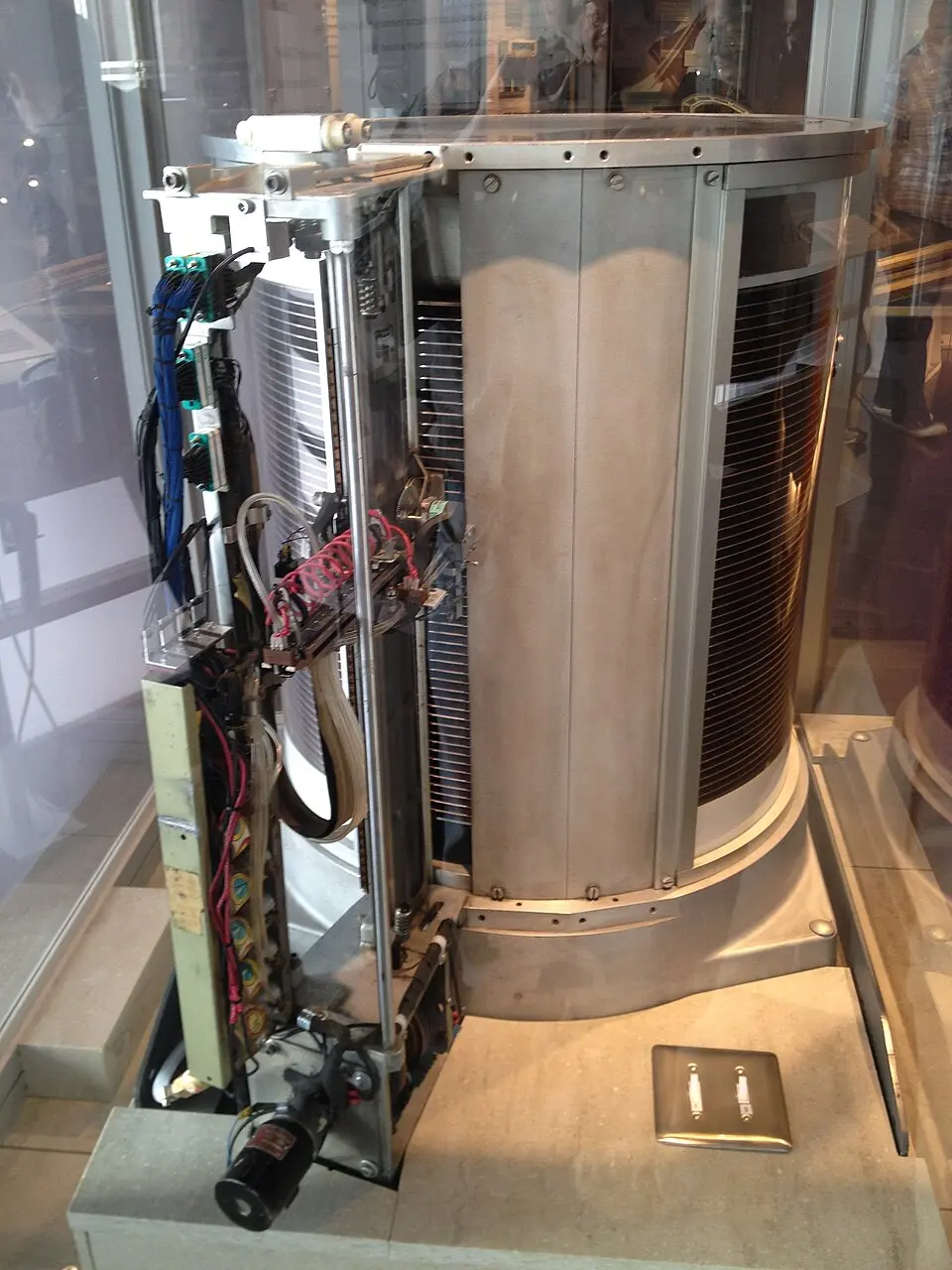
The team Reynold B. Johnson led at IBM's San Jose laboratory tried rods, strips, tapes and flat plates before settling on aluminium disks coated with iron-oxide paint. Spun fast, a single disk warped, so they glued disks together in pairs for stiffness. The head could not touch the surface without destroying data, so they floated it on a jet of compressed air. One disk did not hold enough, so they stacked them — a design IBM's own history says sceptical executives called the "baloney slicer".
The main specifications:
- A stack of 24-inch (610 mm) disks presenting 100 recording surfaces in use. Sources give the disk count as either fifty or fifty-two
- 100 tracks per surface, 1,200 rpm, transfer rate 8,800 characters per second
- Average time to locate a record about 600 milliseconds
- About one ton, plus a separate air compressor
The last obstacle was getting a pair of heads to an arbitrary position immediately. Johnson's account, in IBM's records: "That was our goal: to go from any track, which was 6 inches in on a disk, out, down 2 feet to the bottom, and in 6 inches — in half a second." And: "We achieved something like 800 milliseconds, and that's where the product came out."
Converting "five million characters" honestly
The documented capacity of the 350 is five million characters. Turning that into megabytes gives different answers depending on the arithmetic you accept.
- Six data bits per character: 5,000,000 × 6 = 30 million bits = 3.75 MB (decimal; about 3.6 MiB)
- Counting the parity bit as well, seven bits per character: about 4.4 MB
- Counting one character as one byte: 5 MB
"The first hard disk held 5 MB" comes from the third of these. IBM's current heritage article says five megabytes in one paragraph, "5 million binary decimal encoded characters at 7 bits per character" in another, and "5 to 10 megabytes" in a third. The RAMAC restoration project treats 3.75 MB — six-bit characters converted to eight-bit bytes — as correct and files 5 MB under myths.
This article treats "five million characters" as the primary figure, because that is the number the sources agree on. The unit conversion is an interpretation, not a measurement.
Price and reach
The 305 system leased for US$3,200 a month. Rental was IBM's standard commercial arrangement at the time, which put the machine on a customer's books as an operating expense rather than a capital purchase — not a trivial factor in how quickly computers spread through American business.
Early customers included 3M, New York University, Norfolk Naval Shipyard, Pfizer and United Airlines. RAMAC was demonstrated in the US pavilion at the 1958 Brussels World's Fair, and handled scoring at the 1960 Winter Olympics in Squaw Valley. More than a thousand 305 systems were built; the 350 was formally withdrawn in 1969.
US Patent 3,503,060, "Direct access magnetic disc storage device", by William A. Goddard and John J. Lynott and granted on 24 March 1970 out of the RAMAC programme, is generally treated as the fundamental disk-drive patent.
Every Record the Same Distance Away
For the next seventy years, storage design inherited RAMAC's shape: spinning platters, a head flying above the surface. Solid-state drives displaced that shape in the 2010s. But what was displaced was the implementation. The premise RAMAC introduced — every item of data is the same distance away — underlies every system running today.
IBM writes that RAMAC paved the way for the invention of the relational database. For Codd's relational model to arrive in 1970, someone had to build a store that could reach anywhere, fourteen years earlier.
Sources
PrimaryRAMAC — IBM Heritage, IBM
TertiaryIBM 305 RAMAC — Wikipedia
Last updated: