T1#standard#military
COBOL Specification Adopted
Metadata
- Date
- Decade
- 1950s
- Tier
- T1
- Timelines
- A History of Programming Languages
- Sources
- 07
- Connections
- 02
- Tags
- #standard#military
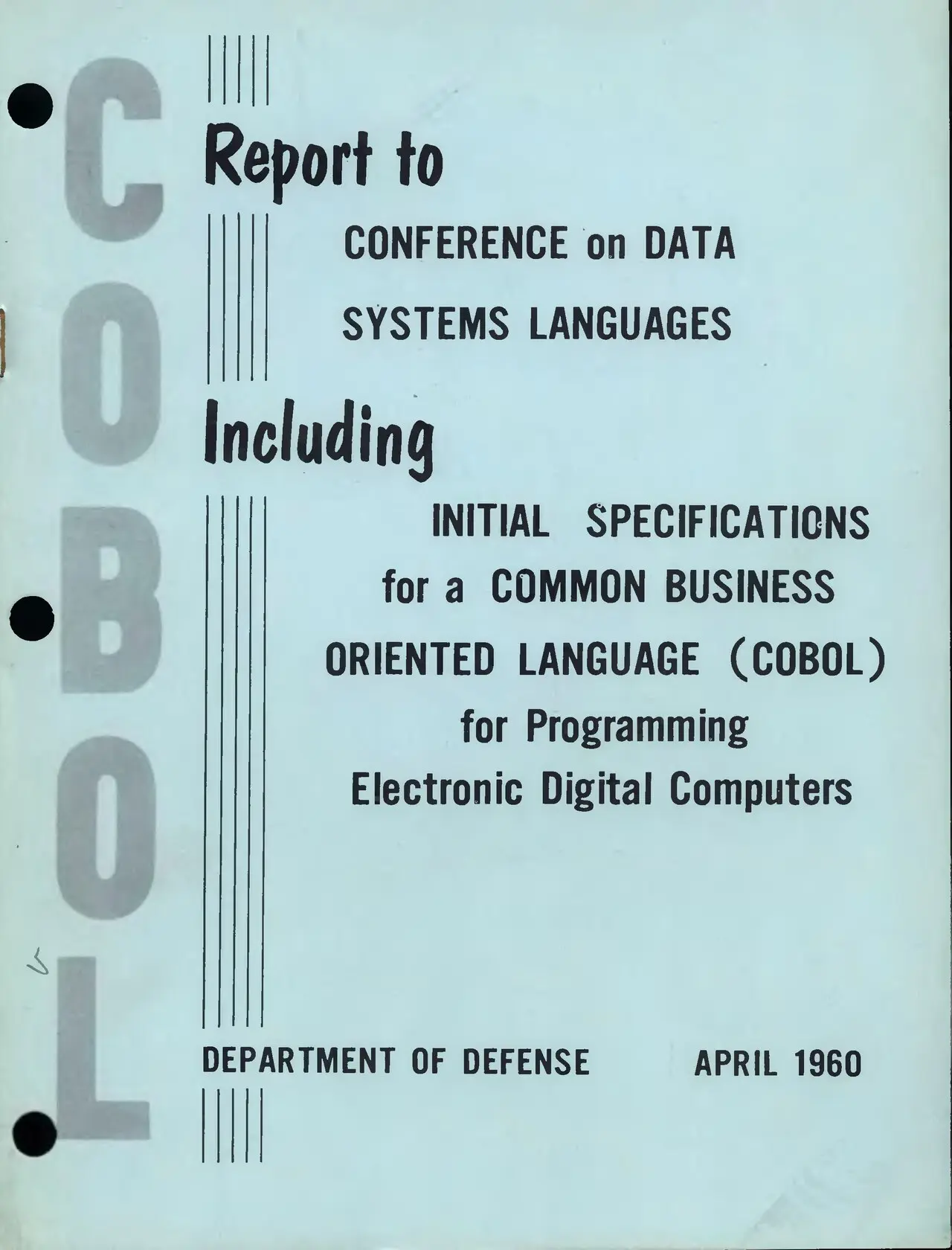
COBOL — the COmmon Business Oriented Language — is a programming language created so that business data processing such as payroll, inventory and accounting could be written in English-like statements, independent of any make of computer. Its starting point was a meeting at the US Department of Defense, in the Pentagon, on 28–29 May 1959. A Short Range Committee of six computer manufacturers and three government agencies wrote the specification; the final edited report went to the Executive Committee on 17 December 1959, was accepted on 7–8 January 1960, and was published by the Department of Defense in April 1960. The body that grew out of that meeting is CODASYL, the Conference on Data Systems Languages.
Ask who created COBOL and the answer is often Grace Hopper. The 1960 specification itself, and the testimony of Jean Sammet, who helped design the language, give a more complicated picture. This article follows those seven months, relying mainly on the specification.
| Date | What happened |
|---|---|
| 28–29 May 1959 | Pentagon meeting; near-unanimous agreement that a common business language is desirable and feasible |
| 23 June 1959 | First meeting of the Short Range Committee |
| August 1959 | Two full-committee sessions prepare a report to the Executive Committee |
| September 1959 | Report submitted; the committee is authorised to finish the work by December |
| 18 September – 7 November 1959 | Meetings complete the language; the name COBOL is adopted |
| Week of 16–20 November 1959 | The Short Range Committee approves COBOL |
| 17 December 1959 | Final editing done; report distributed to the Executive Committee |
| 7–8 January 1960 | Executive Committee accepts the report |
| April 1960 | The Department of Defense publishes the specification |
The Pentagon meeting
According to the specification's introduction, the May 1959 meeting was called to consider "both the desirability and the feasibility" of a common language for programming electronic computers in business-type data processing. Users, government installations, computer manufacturers and other interested parties attended, and there was almost unanimous agreement on both counts. The meeting set up three committees on different time scales: short range, intermediate range and long range.
The motives the introduction gives are practical. Users with computers from different manufacturers needed to move a data processing system from one type of machine to another. Management requirements kept changing, so systems needed constant revision. Many users had to produce large numbers of programs quickly, often with inexperienced programmers. A common business language, "independent of any make or model of computer, open-ended and stated in English", would do much to solve these problems.
The Short Range Committee
The Short Range Committee consisted of six manufacturers and three government representatives, and held its first meeting on 23 June 1959. The specification lists the organisations that took part in its work at one time or another.
| Type | Organisations |
|---|---|
| Computer manufacturers | Burroughs (ElectroData Division), IBM, Minneapolis-Honeywell (Datamatic Division), RCA, Sperry Rand (Remington Rand Division), Sylvania Electric Products |
| Government | US Air Force Air Materiel Command, the National Bureau of Standards, the Navy's David Taylor Model Basin |
| Other | Computer Science Corporation |
The committee first split into four working groups: data description, procedural statements, application survey, and usage and experience. Its September report admitted that it "contained rough spots and needed additions", and asked for time until December to complete and polish the system.
Much of the core language was worked out by a six-person subcommittee. According to the obituary of one of them, Jean Sammet of Sylvania, distributed by the New York Times service, the six designed much of the language in two weeks of nearly round-the-clock work at the Sherry-Netherland Hotel in Manhattan, and their proposal, presented in November 1959, was accepted with few changes. The Computer History Museum holds a "COBOL" tombstone dated 1960, an 82-pound object donated by the Defense Department's Charles Phillips; it is said to have been sent to him by a committee member frustrated with the pace of the work.
Three divisions and English
The specification divided every COBOL program into three parts. Describing a business problem, it reasoned, needs a set of procedures saying how data is to be manipulated and a description of the data itself; information about the computer is also unavoidable. These became three divisions, listed in decreasing order of compatibility among computers.
| Division | What it holds | Machine dependence |
|---|---|---|
| PROCEDURE DIVISION | The steps of processing, written as English words, statements, sentences and paragraphs | Essentially independent |
| DATA DIVISION | File and record descriptions | Intermediate |
| ENVIRONMENT DIVISION | The computer and input-output equipment | Changes from machine to machine |
The report says COBOL lets users write their problem solutions "in the language most natural to him - namely English". It interpreted "Common" to mean source programs compatible among computers, while conceding that differences in size, peripherals and order structure made complete compatibility impossible. So the committee proposed "phasing", levels running from a minimum Basic COBOL to an ideal Extended COBOL, and listed features to be added as soon as possible, including table handling, report writing and sort-merge.
Three sources of ideas, and Grace Hopper
The attribution section says ideas and information were drawn from many sources, and names three in particular.
| Name | Developed by |
|---|---|
| FLOW-MATIC | Sperry Rand |
| Commercial Translator | IBM |
| AIMACO | Jointly by the Air Materiel Command and Sperry Rand |
FLOW-MATIC came out of the automatic-programming work at Remington Rand Univac led by Grace Hopper (its background is in Hopper's A-0 compiler). That is why her name is attached to COBOL, and why she is often called the mother of COBOL. But Hopper was not one of the six people who designed the language, a fact Sammet rarely failed to point out. "I yield to no one in my admiration for Grace," Sammet said. "But she was not the mother, creator or developer of Cobol."
Afterwards
The specification stressed that a source language must change continually to be effective, and the Executive Committee adopted arrangements for maintaining COBOL, with a Technical Committee and a Maintenance Committee, at its meeting of 12 February 1960. According to Wikipedia, on 6–7 December 1960 essentially the same COBOL program ran on both an RCA computer and a Remington Rand Univac, demonstrating that compatibility could be achieved; formal standardisation followed with the US standard X3.23 of August 1968 and later revisions.
In February 2022 Micro Focus announced the results of a survey it commissioned from the research firm Vanson Bourne, estimating more than 800 billion lines of COBOL running on production systems in daily use. More than 65 years after the specification, COBOL still runs core systems in finance and government.
COBOL's place among its contemporaries is on the programming-languages timeline; the scientific language that preceded it is FORTRAN, and IBM's part in the story is under IBM.
Questions this page answers
- When was COBOL created, and by whom?
- It was created by a Short Range Committee of six computer manufacturers and three government agencies, set up after a meeting at the Pentagon on 28–29 May 1959. The specification went to the Executive Committee on 17 December 1959, was accepted on 7–8 January 1960, and was published by the Department of Defense that April. The core design work was done by a six-person subcommittee that included Jean Sammet.
- Did Grace Hopper create COBOL?
- No. Hopper was not one of the six people who designed the language. One of them, Jean Sammet, said that while she greatly admired Hopper, Hopper was not the mother, creator or developer of COBOL. FLOW-MATIC, one of the three sources of ideas the specification names, was however built under Hopper's direction.
- What does COBOL stand for?
- COmmon Business Oriented Language. The name was adopted during the committee's meetings between September and November 1959.
- Is COBOL still in use?
- Yes. A 2022 survey by Vanson Bourne, commissioned by Micro Focus, estimated more than 800 billion lines of COBOL running on production systems in daily use.
Sources
The Pentagon meeting, the committee's composition and schedule, adoption of the name, the 17 December distribution, the January 1960 acceptance, the three sources of ideas, and the participating organisations
The six designers, the two weeks at the Sherry-Netherland Hotel, and Sammet's remark about Hopper
TertiaryCOBOL — Wikipedia
TertiaryGrace Hopper — Wikipedia
Last updated: