T1#apple#consumer#launch
The First iMac — An All-in-One That Dropped the Floppy for USB and the Internet
Metadata
- Date
- Decade
- 1990s
- Tier
- T1
- Sources
- 12
- Connections
- 02
- Tags
- #apple#consumer#launch
The original iMac was announced on 6 May 1998. US orders opened on 3 August, and it went on sale in stores across the US on Saturday 15 August 1998. Japan got it on Saturday 29 August, from 3 p.m., at 178,000 yen. The US price was $1,299, for the one and only configuration. Japan came two weeks after the US, but Apple's announcement had promised worldwide availability in August, and Japan made that August.
It was introduced by Steve Jobs, who had come back to Apple the year before and was serving as interim CEO. How he returned is told on his page; what became of the operating system Apple brought over from NeXT is in the Mac OS X article. The iMac was the first major new product Apple released under that leadership.
The dates
| Date | Event |
|---|---|
| 6 May 1998 | iMac announced: $1,299 in the US, worldwide availability in August |
| 3 August 1998 | US orders open |
| 10 August 1998 | Apple reports more than 150,000 orders in the first week |
| 15 August 1998 | On sale in US stores |
| 19 August 1998 | Apple Japan announces the Japanese launch: 178,000 yen on 29 August |
| 29 August 1998 | On sale in Japan |
| 14 October 1998 | Apple reports 278,000 shipped in the first six weeks |
What was in it, and what was not
Apple's announcement presented the iMac as a computer that was ready for the internet straight out of the box.
| Item | Original iMac (announcement and Japanese specification) |
|---|---|
| CPU | PowerPC G3 at 233 MHz, 512 KB backside cache |
| Display | 15-inch (13.8-inch viewable), up to 1024 × 768 |
| Memory | 32 MB SDRAM (up to 128 MB) |
| Storage | 4 GB IDE hard disk, 24x CD-ROM |
| Networking | 10/100Base-T Ethernet, a modem (33.6 Kbps in the announcement), infrared (IrDA) |
| Expansion | Two USB ports; USB keyboard and mouse |
| OS | Mac OS 8.1 |
| Size and weight | 380 × 440 × 395 mm (W × D × H), 17.3 kg |
| Price | $1,299 / 178,000 yen |
What was missing drew more attention. There was no floppy disk drive. The ADB and serial ports that earlier Macs had used for keyboards, mice and printers were gone as well, so every peripheral had to connect over USB, which was still new. AKIBA PC Hotline!, reporting from Akihabara, named USB and the missing floppy drive as defining features alongside the translucent case. Early reviews are described as finding it good for newcomers while regretting the loss of the older ports.
In the press release, Jobs said: "We designed iMac to deliver the things consumers care about most--the excitement of the Internet and the simplicity of the Mac." He added: "iMac is next year's computer for $1299; not last year's computer for $999."
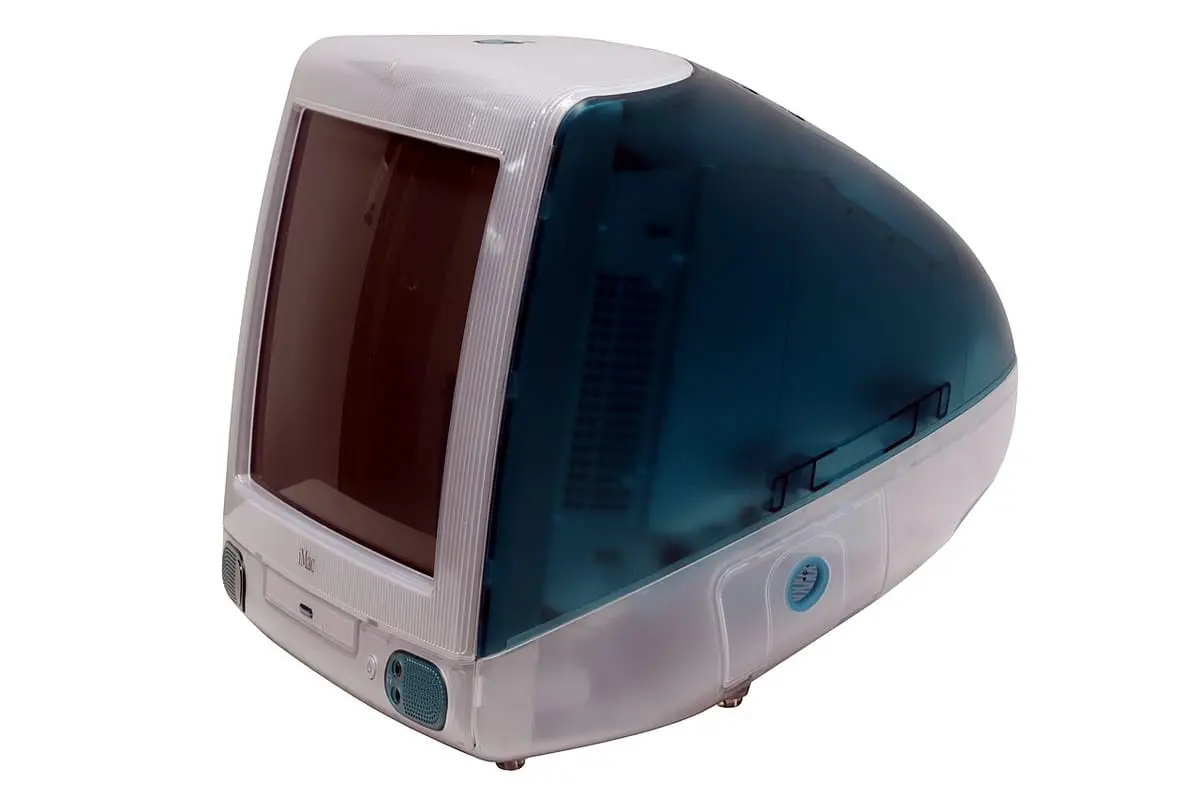
The case was white and translucent blue-green plastic, a colour called Bondi blue. The launch was held at the Flint Center at De Anza College, the same venue where Apple had introduced the Macintosh in 1984.
The US launch
Orders opened on 3 August, and on 10 August Apple said more than 150,000 had come in during the first week. According to PC Watch, Apple put $100 million into the iMac campaign, and some stores opened at midnight on the 15th to start selling. The Register reported that many dealers had sold out and were taking orders for delivery the following weekend and beyond.
The Japanese launch
Apple Japan announced the Japanese launch on 19 August: 178,000 yen, on sale nationwide from 3 p.m. on 29 August. According to PC Watch, the Japanese model was identical to the US one except for a JIS-layout keyboard, and it came with a version of Mac OS 8.1 for the iMac. Fewer stores than expected were to carry it, though, and there were doubts about whether supply would be enough. In Akihabara, one shop began taking orders for an imported English-language model at 258,000 yen including fees.
On launch day, Sofmap and T-Zone in Akihabara held countdowns at their storefronts. But the rain came and went, the turnout was slower than expected, and some shops still had same-day purchase tickets left after 2 p.m. Every shop sold the machine itself at the same 178,000 yen.
How many sold
On 14 October 1998 Apple announced it had shipped 278,000 iMacs in the first six weeks on sale, making it the fastest-selling Macintosh ever. That is a shipment figure, and Apple's own.
The same announcement carried the results of a telephone survey of US buyers (1,911 completed).
| Buyers (survey commissioned by Apple) | Share |
|---|---|
| Buying their first computer | 29.4% |
| Owners of Windows PCs | 12.5% |
| Existing Mac owners | 58.1% |
Jobs said the research showed the number one reason people were buying iMacs was fast and easy access to the internet. Nearly six in ten were existing Mac users; roughly four in ten were new customers.
Later iMacs
In January 1999 the line grew to five colours: blueberry, strawberry, tangerine, grape and lime. This translucent all-in-one series was sold until 2003, and the iMac name continued through later designs. On 10 January 2006 an iMac with an Intel Core Duo was among the first Macs to use Intel processors, and in 2021 an iMac arrived with Apple's own M1 (see Apple M1).
Where it sits
The original iMac gave up the floppy drive and the Mac's own legacy ports, moved peripherals to USB and sold itself on getting online. In Apple's own survey, that connection was the top reason people bought one. Three years later the same leadership would bring out the iPod. For other hardware milestones see the hardware timeline; for the company, Apple.
Questions this page answers
- When was the original iMac released?
- It was announced on 6 May 1998. US orders opened on 3 August and it went on sale in stores on Saturday 15 August. In Japan it went on sale nationwide at 3 p.m. on 29 August.
- How much did the original iMac cost?
- One configuration, $1,299 in the US and 178,000 yen in Japan. In the announcement Jobs called it next year's computer for $1,299, not last year's computer for $999.
- Did the original iMac have a floppy drive?
- No. It had a 4 GB hard disk and a 24x CD-ROM drive, and peripherals connected through two USB ports; the keyboard and mouse were USB too.
- Did the original iMac sell?
- On 14 October 1998 Apple said it had shipped 278,000 in the first six weeks, making it the fastest-selling Macintosh ever. In its buyer survey, 29.4 percent were first-time computer buyers and 12.5 percent owned Windows PCs.
Sources
PrimaryApple Unveils iMac — Apple Press Release, May 6, 1998 (Internet Archive)
Announcement, $1,299, 233 MHz G3, 15-inch display, 33.6 Kbps modem, two USB ports, IrDA, worldwide availability in August, Jobs's statements
Orders from 3 August, over 150,000 in the first week, in stores on Saturday 15 August
PrimaryiMac a Hit With First Time Computer Users — Apple Press Release, October 14, 1998 (Internet Archive)
278,000 in six weeks; the buyer survey of 1,911 responses
SecondaryiMac、米でいよいよ販売開始 — PC Watch, 1998年8月17日
The 15 August US launch, the $100 million campaign, dimensions and weight
SecondaryiMacは178,000円で29日国内発売 — PC Watch, 1998年8月19日
Japanese price and launch time; identical to the US model apart from the JIS keyboard
SecondaryiMacの直輸入版をデモするショップに人だかり — AKIBA PC Hotline!, 1998年8月22日号
USB adopted and the floppy drive removed; worries about Japanese supply
TertiaryiMac G3 — Wikipedia
No serial ports, ADB or floppy; the launch venue; the five colours of January 1999
Last updated: