T1#research#market
Moore's Law — Gordon Moore
Metadata
- Date
- Decade
- 1960s
- Tier
- T1
- Sources
- 05
- Connections
- 02
- Tags
- #research#market
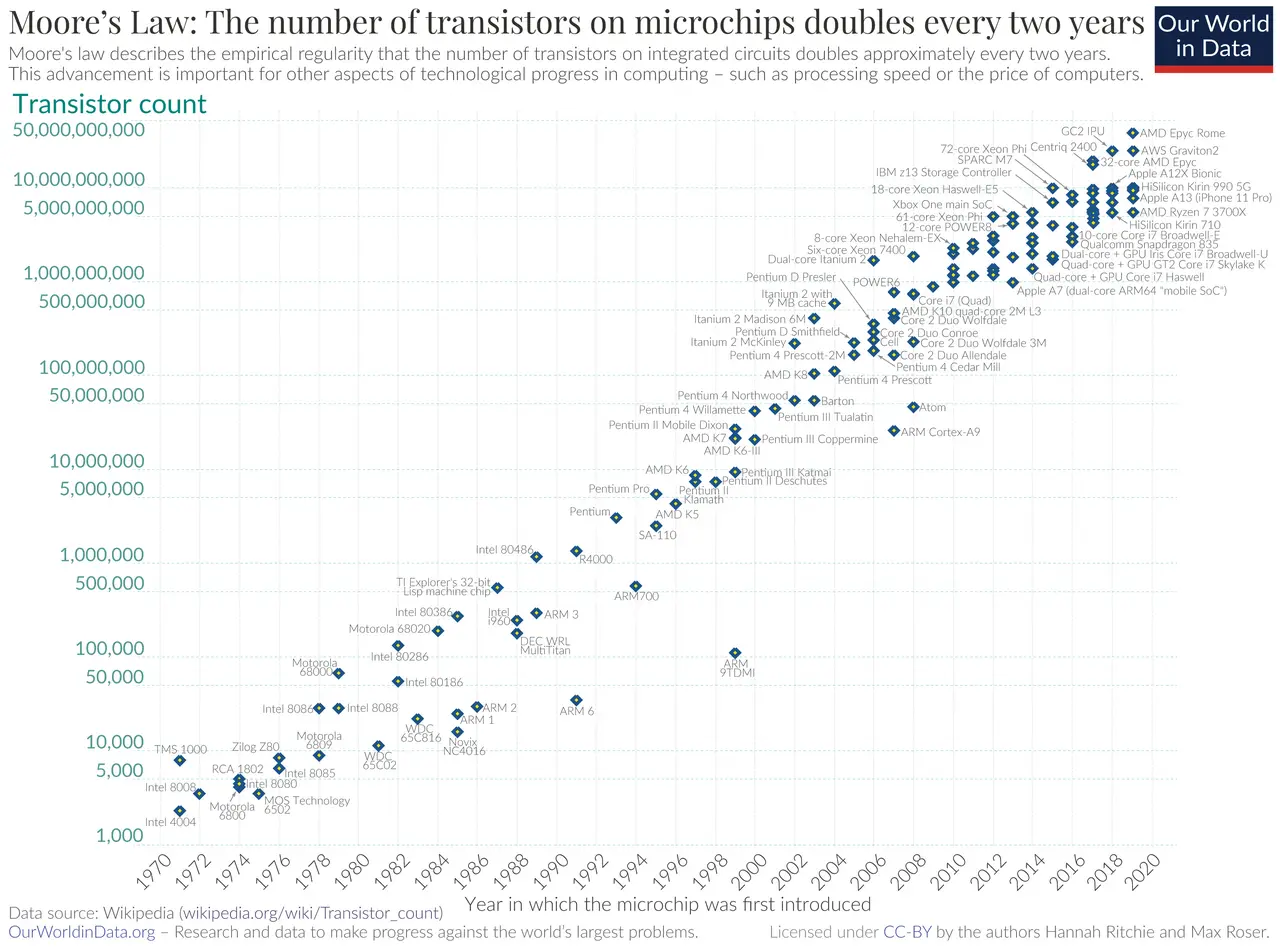
Moore's Law is the observation that the number of components on an integrated circuit doubles at a steady interval. It was first stated by Gordon Moore, then director of research and development at Fairchild Semiconductor, in an article titled "Cramming More Components onto Integrated Circuits" in the 19 April 1965 issue of Electronics. His interval was one year. The "every two years" quoted today is Moore's own revision of 1975, and the popular "every 18 months" is not his figure at all.
What the 1965 Article Actually Measured
The article is short, and its central claim is narrower than the slogan it became. Moore was not counting the largest chip anyone could make. He was looking at cost. For simple circuits, he wrote, the cost per component falls almost in inverse proportion to the number of components; but as more are added, falling yields start to push the cost back up. There is therefore a minimum cost per component at any given moment — and in 1965 it was reached at about 50 components per circuit. Looking five years ahead, he expected the minimum to move to about 1,000 components per circuit, and the manufacturing cost per component in 1970 to be only a tenth of what it was.
The trend he extrapolated was the position of that minimum. In his words, "the complexity for minimum component costs has increased at a rate of roughly a factor of two per year." He expected that rate to hold for at least ten years, which meant that by 1975 the number of components per integrated circuit at minimum cost would be 65,000.
Two details are often lost in retelling. First, as Chris Mack points out in IEEE Spectrum, "components" meant resistors, capacitors and diodes as well as transistors; transistor count became the standard measure only later, as MOS circuitry took over. Second, the forecast rested on very little data. The Computer History Museum describes Moore drawing a line through five points covering 1959 to 1964, in an internal Fairchild paper written in 1964 and then edited for the magazine.
A Forecast About Electronics, Not Just Chips
The article reads now as unusually far-sighted. Moore predicted that integrated circuits would lead to "home computers—or at least terminals connected to a central computer," automatic controls for cars, and personal portable communications equipment. He also argued that computers would be organised differently, with memory distributed through the machine rather than concentrated in one place. None of these were the article's main point; they were consequences of the economics he was describing.
The 1975 Revision: Every Two Years
Ten years on, the forecast had more or less come true. Spectrum notes that Intel — the company Moore had co-founded with Robert Noyce in 1968 after leaving Fairchild — was by 1975 preparing charge-coupled-device memory chips with around 32,000 components, within a factor of two of the 65,000 he had predicted.
At the 1975 IEEE International Electron Devices Meeting, Moore took the trend apart. He attributed the doubling to three factors: smaller components, larger chips, and what he called "circuit and device cleverness" in reducing wasted area. Looking at the dense memory arrays then arriving, he concluded that cleverness was nearly exhausted, and he slowed his forecast to — in the Computer History Museum's quotation — "a doubling every two years, rather than every year."
That is the version that became an industry yardstick. The museum calls it a self-fulfilling prophecy: engineers were expected to keep the curve on schedule, and planned their work around it. The name "Moore's Law" was not Moore's; the museum credits it to Carver Mead.
Moore checked his forecast once more in 1995, when, by the museum's account, an Intel Pentium microprocessor held nearly 5 million transistors. His conclusion then was that the trend was not about to stop.
Where "18 Months" Comes From
The 18-month figure that circulates widely did not come from either of Moore's papers. In remarks reported by The Register in April 2005, on the law's 40th anniversary, Moore credited Intel executive David House with pointing out that the two-year doubling implied computing power doubling every 18 months. Spectrum adds a further complication: memory chips, simpler to design than logic, did in practice scale faster than microprocessors, which have tracked roughly the two-year rate since the early 1970s. Quoting "18 months" as Moore's prediction mixes a component count with a performance measure — two different things.
Not a Law of Physics
Moore's Law describes what an industry managed to do, not what nature requires. Moore said as much in the same 2005 remarks: nothing like this lasts forever, he said, though he expected it to hold for the next two or three generations, and put the fundamental limits 10 to 20 years away. Its long run depended heavily on one of his three factors — shrinking the transistor — which for decades made each generation of chips both denser and better, a point Spectrum develops at length.
For Moore's career beyond this article, see Gordon Moore; for the company he co-founded, Intel. Six years after the article, Intel put a computer's central processor on one chip: the Intel 4004. The wider context is on the hardware timeline.
Questions this page answers
- What is Moore's Law?
- It is the observation that the number of components, such as transistors, on an integrated circuit doubles at a steady interval. Gordon Moore put it at every year in 1965 and revised it to every two years in 1975. It is a trend line drawn from industry data, not a law of physics.
- When was Moore's Law first stated?
- In Moore's article Cramming more components onto integrated circuits, in the 19 April 1965 issue of Electronics. It grew out of an internal Fairchild paper written the year before.
- Is Moore's Law every 18 months or every two years?
- Moore's own figures were one year in 1965 and two years in his 1975 revision. The 18 months comes from Intel's David House, who pointed out that the law implied computing power doubling every 18 months; Moore has credited the figure to House.
- Who named it Moore's Law?
- According to the Computer History Museum, the name was coined by Carver Mead, not by Moore himself.
Sources
Complexity for minimum component cost rising by roughly a factor of two per year; at least ten years; 65,000 components by 1975; minimum cost at 50 components today; Fairchild R&D director since 1959
Five data points 1959–64; 1964 internal paper; 1975 IEDM revision to two years; name coined by Carver Mead; 1995 review
SecondaryMack, C. — The Multiple Lives of Moore's Law, IEEE Spectrum (30 March 2015)
From about 64 to 65,000; Intel's c. 32,000-component CCD memory in 1975; the three factors in the 1975 revision
SecondaryMoore's Law is 40 — The Register (13 April 2005)
Moore credits the 18-month figure to Intel's David House
TertiaryMoore's law — Wikipedia
Last updated: