T1#market#standard#enterprise
IBM Announces System/360 — Compatibility as the Product
Metadata
- Date
- Decade
- 1960s
- Tier
- T1
- Sources
- 06
- Connections
- 01
- Tags
- #market#standard#enterprise
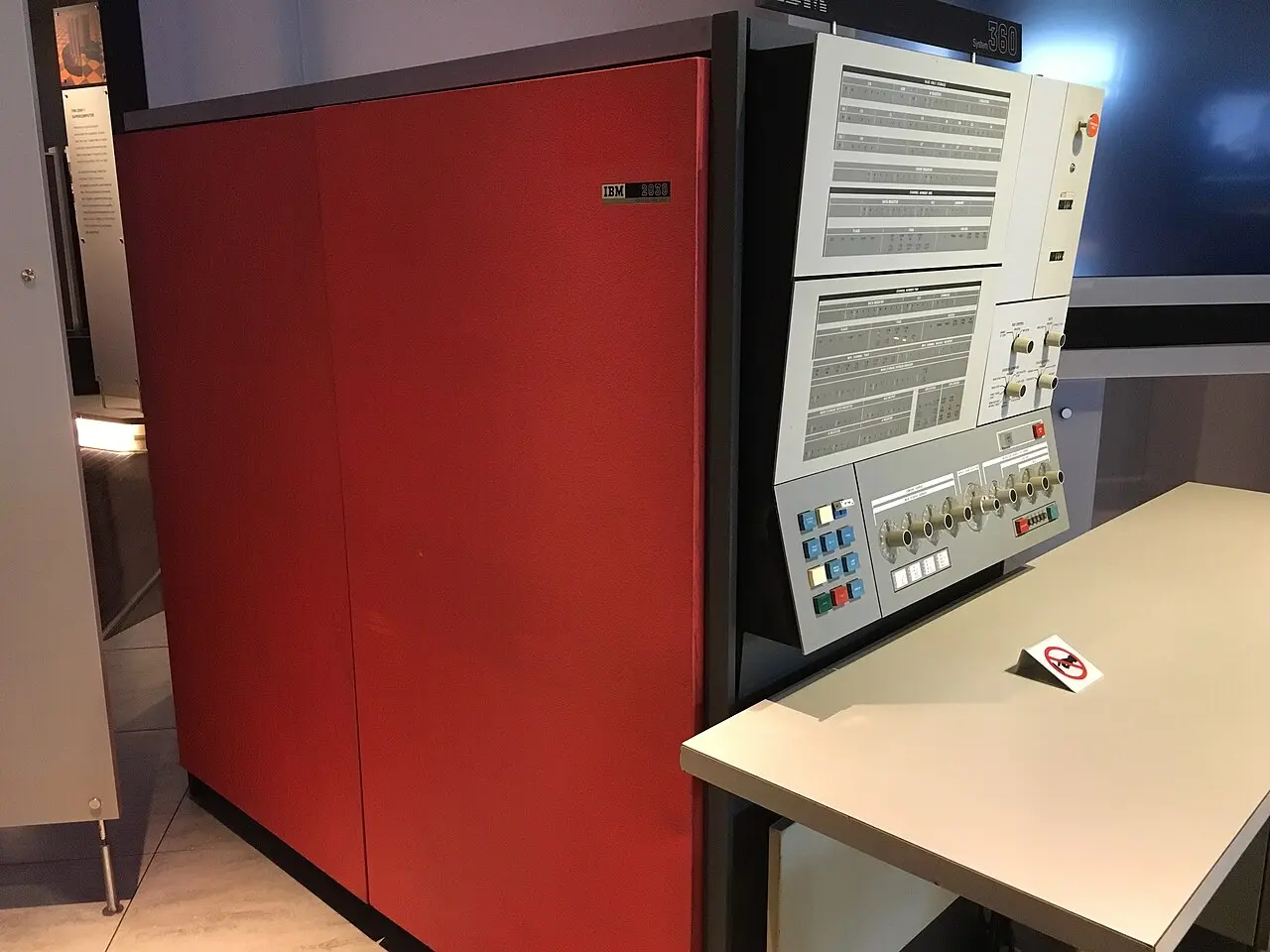
At noon Eastern time on 7 April 1964, IBM announced System/360. The press release put out by its Data Processing Division that day records that more than 100,000 people attended announcement meetings in 165 American cities. At a press conference in Poughkeepsie, board chairman Thomas J. Watson Jr. called it "a sharp departure from concepts of the past" in the designing and building of computers, and said it was the first time in a decade that IBM had redesigned the basic internal architecture of its machines. The release itself, not Watson in quoted words, describes the event as the most important product announcement in the company's history — a distinction worth keeping, because the sentence is usually reproduced as though he had said it.
Not the Speed — the Compatibility
Not the speed. The compatibility.
Until then, replacing a computer meant discarding the software that ran on it. IBM itself carried five mutually incompatible product lines; a customer running commercial work on a 1401 and engineering work on a 7040 owned two machines that, for all practical purposes, came from different companies. Buyers had to choose between a machine they would outgrow and one they could not justify — and a great many simply did not buy.
System/360 answered that with a single architecture: one instruction set, one I/O interface, one character encoding (EBCDIC). A program written for the smallest machine ran on the largest, provided the same class of peripherals was attached. That sounds unremarkable now. In 1964 it was the product.
Nineteen Combinations, and Counts That Drift
The press release does not count models. It counts 19 combinations of processor speed and memory capacity in the central processors, together with more than 40 types of peripheral equipment. IBM's present-day heritage page renders the same launch as six processor models and 54 peripheral devices; the Computer History Museum gives six computers and 44 new peripherals. The counts drift because what gets counted as "one" drifts; the contemporary document says 19 combinations and more than 40 peripheral types.
Six model numbers were made public: 30, 40, 50, 60, 62 and 70. Internal processing power of the largest configuration was roughly 50 times that of the smallest. Core storage ran from 8,000 to 524,000 characters, with a bulk core store holding up to 8,000,000 more. Monthly rentals were announced at $2,700 for a basic configuration up to $115,000 for a large multisystem one; purchase prices ran from $133,000 to $5,500,000.
The circuitry used IBM's Solid Logic Technology hybrid modules. IBM's release claimed System/360 as the first commercially available data processing system whose design was based on microminiaturised computer circuits — a vendor claim, and one worth reading as such, though it is not in dispute that this was an early volume application of the technique.
The Five-Billion-Dollar Bet
IBM's own history states that the new line would replace every existing IBM computer product and cost USD 5 billion over four years. The company's 1962 revenue was $2.5 billion, so the programme consumed twice a year's sales. That ratio is why the Computer History Museum recalls the period label "the five billion dollar gamble": failure would not have dented IBM, it would have ended it.
The origin was a 1961 task force called SPREAD — Systems Programming, Research, Engineering and Development — which met in secret at a motor hotel in Greenwich, Connecticut, and, after roughly six months of argument, endorsed a plan to kill IBM's own product lines. Gene Amdahl was chief architect. Fred Brooks led the project; IBM credits him with coining the term computer architecture. Brooks, Bob Evans and Erich Bloch later shared the first National Medal of Technology for the work.
Slippage, and the Book It Produced
Commercially the bet paid immediately: IBM records more than 1,000 orders in the first month. The schedule was another matter. The announcement promised small configurations in the third quarter of 1965 and the largest in the first quarter of 1966. In practice the 30, 40 and 50 began shipping in mid-1965, while the top three — 60, 62 and 70 — never shipped at all, superseded before delivery by the Model 65 (November 1965) and Model 75 (January 1966). Demand outran supply, and some customers waited years.
The deeper trouble was the software. OS/360 arrived late, wanted more memory than planned, and cost several times its estimate. Programmers were added in bulk to recover the schedule, and the schedule slipped anyway. Fred Brooks wrote that experience up as The Mythical Man-Month (1975), whose central claim — that adding people to a late software project makes it later — is a direct distillation of OS/360. The invention of hardware compatibility and the birth of software engineering as a discipline are the front and back of the same product.
Ground That Software Could Move Across
System/360 machines were delivered from 1965 to 1978. IBM states that by 1989, products based on the System/360 architecture and its extensions accounted for more than half of the company's total revenue. The eight-bit byte, the idea that software is an asset you carry forward rather than a cost you re-incur, and an entire third-party industry building plug-compatible peripherals all date from this announcement.
The line runs through the language history too. Simula 67 compilers, after the Control Data implementations of 1969, were ported to the IBM System/360 and 370 range — that work finished in May 1972 — so the object-oriented concepts spread across exactly the compatible family IBM had bet the company on. The 1964 decision looks like a hardware decision. It was really a decision to create ground that software could move across.
Sources
PrimaryThe IBM System/360 — IBM Heritage
IBM's own account of the development cost, the number of models and the number of peripherals
TertiaryIBM System/360 — Wikipedia
Last updated: