PERSON
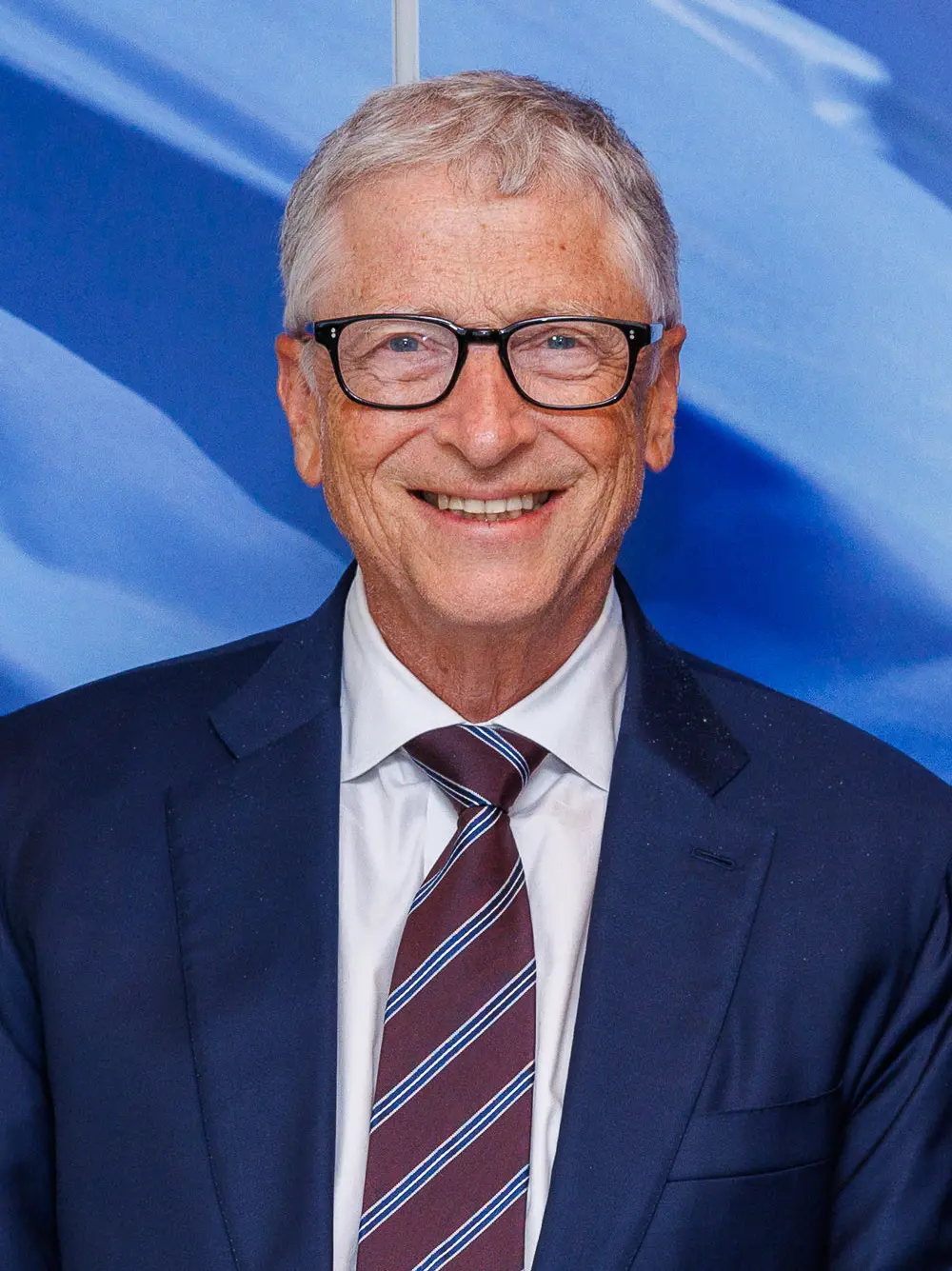
Bill Gates
Co-founder of Microsoft (1975, with Paul Allen). Beginning with BASIC for the Altair 8800, he led the strategy by which Microsoft came to dominate both the OS and the productivity-software layers of the PC market through MS-DOS, Windows, and Office. He handed the CEO role to Steve Ballmer in 2000, and from 2008 onward centred his work on the Bill & Melinda Gates Foundation. In May 2025 he announced the foundation will close at the end of 2045, spending some $200 billion in the meantime.
Profile
- Born
- 1955
- Status
- Living
- Span
- 1955–
- Appearances
- 15
- Name
- ENBill GatesJAビル・ゲイツ
William Henry Gates III (b. 28 October 1955) co-founded Microsoft with Paul Allen in 1975 and led the strategy by which the company came to dominate both the operating-system and the productivity-software layers of the PC market. He held the top spot on Forbes's list of the world's wealthiest people for thirteen consecutive years, from 1995 through 2007, and returned to it several times afterwards. Since 2008 he has centred his work on the Bill & Melinda Gates Foundation. In May 2025 he announced that he would give away almost his entire remaining fortune — some 200 billion dollars — and that the foundation will close on 31 December 2045.
A lawyer father, a bank-director mother
Gates was born on 28 October 1955 in Seattle. His father, William H. Gates Sr., was a prominent lawyer. His mother, Mary Maxwell Gates, was the first woman on the board of First Interstate Bank of Washington and the first woman to chair the national United Way's executive committee — where she served alongside John Opel, chairman of IBM. That acquaintance is often mentioned, fairly or unfairly, in connection with Microsoft's capture of the IBM operating-system contract in 1980. She was not, as is sometimes written, a director of IBM.
At the private Lakeside School the boy gained access to a General Electric time-sharing system that the school leased. In the computer club he met Paul Allen, two years his senior — Gates was thirteen at the time. The two worked on the school timetable program and, while still in their teens, took paid contracts from local businesses. Their partnership Traf-O-Data, formed with Paul Gilbert, processed the paper tapes that roadway traffic counters produced; to write the software before the hardware existed, Allen wrote a program that emulated the Intel 8008 on a PDP-10. The same manoeuvre produced Microsoft's first product three years later.
In 1973 Gates went up to Harvard to read applied mathematics and computer science. In 1975, on seeing the MITS Altair 8800 on the cover of Popular Electronics, he and Allen decided to write a BASIC interpreter for it. He left Harvard and did not return.
The first product was Altair BASIC
Altair BASIC (1975)
Microsoft's first product was a BASIC interpreter for the Intel-8080-based Altair 8800. Gates and Allen — with Monte Davidoff, Gates's Harvard housemate — built an 8080 emulator on Harvard's PDP-10 in the Aiken Computation Laboratory and wrote the interpreter against it, working from the published 8080 specification. Neither had ever touched a real Altair. Allen flew to Albuquerque with the paper tape without having once run the code on the hardware, and it ran. By Microsoft's own reckoning the software was finished and sold to its first customer in February 1975.
The founding itself came in stages, and the paperwork lagged the work by years; the Microsoft founding article sets out the dates. 4 April 1975 is the conventional date, but the name "Micro-soft" does not appear in writing until a letter of 29 July 1975, the trade name was registered in New Mexico in November 1976, and the company did not incorporate until June 1981.
In a one-page letter dated 3 February 1976 — the "Open Letter to Hobbyists" — Gates argued that the freely circulated copies of Altair BASIC amounted to theft, and that the consequence was not lost revenue but that nobody could afford to write good software. It is conventionally read as the first articulation of the idea that software is a discrete commodity to be sold.
MS-DOS and the IBM PC (1981)
In 1980 IBM came looking for an operating system for the forthcoming IBM PC (model 5150), and its first stop was Microsoft: it was Gates who sent the team on to Digital Research and CP/M-86. The familiar telling, that IBM went to Digital Research first and turned to Microsoft only when those talks collapsed, has the order backwards. The DRI negotiations did collapse, and IBM came back. Microsoft licensed and then, on 27 July 1981, bought outright for $50,000 the rights to 86-DOS — originally QDOS, "Quick and Dirty Operating System," written by Tim Paterson at Seattle Computer Products. It shipped with the machine as PC DOS 1.0 on 12 August 1981.
The decisive term was that Microsoft retained the right to sell the same software, as MS-DOS, to anyone else. When Compaq and the rest of the IBM-compatible cloners arrived, it was therefore Microsoft, not IBM, that became the operating-system monopolist of the PC era. The episode is the textbook example of Gates's strategic eye.
Windows and Office (1985-)
Windows 1.0 shipped in 1985. It was at first little more than a GUI shell over MS-DOS, but Windows 3.0 (1990) and Windows 95 (1995) made it universal. Alongside it the Office suite — Word, Excel, PowerPoint — used Microsoft's command of its own platform to drive out Lotus 1-2-3 and WordPerfect.
Through the 1980s and 1990s Gates was repeatedly accused — including under oath in the antitrust proceedings — of preserving a structural advantage by letting the Office team see Windows interfaces before third parties did.
United States v. Microsoft (1998-2001)
In May 1998 the US Department of Justice and twenty state attorneys general sued Microsoft under the Sherman Act. The central allegation was that bundling Internet Explorer with Windows had driven Netscape from the market. Judge Thomas Penfield Jackson issued findings of fact in November 1999 and conclusions of law in April 2000, holding that Microsoft had unlawfully maintained a monopoly, and in June 2000 ordered the company split in two — operating systems on one side, applications on the other.
The Court of Appeals overturned the breakup order in June 2001, and the case settled. The videotaped deposition of Gates himself — sullen, evasive, picking long fights with the prosecutor over the meaning of ordinary words — did lasting damage to his public image. In January 2000 he handed the CEO role to Steve Ballmer and assumed the new title of Chief Software Architect.
Awards and honours
- 2005 — Honorary Knight Commander of the Order of the British Empire (KBE).
- 2010 — Bower Award for Business Leadership (Franklin Institute).
- 2016 — US Presidential Medal of Freedom (from President Obama).
- 2017 — Commander of the Legion of Honour, presented with Melinda Gates by President Hollande at the Élysée on 21 April.
He holds neither the ACM Turing Award nor a Nobel.
Out of the chair in 2014, off the board in 2020
Gates stepped down as chairman of Microsoft in 2014 and left the board altogether in 2020. Since then he has devoted himself almost entirely to the Bill & Melinda Gates Foundation, the private investment vehicle Cascade Investment, and his own writing — the Gates Notes blog, the 2022 book How to Prevent the Next Pandemic, and the 2025 memoir Source Code.
In 2021 he and Melinda French Gates announced their divorce after twenty-seven years of marriage. During the proceedings, reporting on Gates's repeated meetings and trips with Jeffrey Epstein — the financier who died in jail in 2019 while awaiting trial on federal sex-trafficking charges, and who had pleaded guilty in 2008 to Florida state charges involving a minor — became public, as did the disclosure that in 2000 the Microsoft board had been concerned about a relationship with another employee. Gates has broadly denied wrongdoing, but Melinda has cited the Epstein connection as one reason for the divorce. His public image suffered considerably as a result.
The Gates Foundation Sunset (announced May 2025)
In May 2025, at the foundation's 25th anniversary, Gates announced that the Bill & Melinda Gates Foundation will close on 31 December 2045 and will spend, over the intervening twenty years, approximately 200 billion dollars — almost his entire remaining personal fortune, depending on markets. The original charter had specified a wind-down twenty years after Gates's own death; the new schedule is dramatically accelerated.
"There are too many urgent problems to solve for me to hold onto resources that could be used to help people," he wrote in the announcement. On 2 June 2025, in Nelson Mandela Hall at the African Union in Addis Ababa, he said the majority of that $200 billion would go to Africa, directed at health and development and conditioned on partnering with governments that prioritise their people's health and wellbeing: "I recently made a commitment that my wealth will be given away over the next 20 years. The majority of that funding will be spent on helping you address challenges here in Africa."
The foundation's headline priorities remain the eradication of polio — now endemic only in Afghanistan and Pakistan — along with tuberculosis, malaria and HIV, and climate-adaptation agriculture. Large grants to GAVI, the Global Fund and CEPI continue.
Hold the software, commoditise the hardware
What Gates exemplified was a third business model, distinct from both Apple's and IBM's: hold the operating system and the productivity applications inside one firm, and let hardware become a commodity made by others. That model defined the PC ecosystem of the late twentieth century, and its lineage runs straight into the revenue structure of Microsoft Azure and Microsoft 365 today.
As a philanthropist, the Gates Foundation is the largest private grant-making body in history, with an influence on global public health — through GAVI, polio eradication and malaria programmes — comparable to that of the WHO or the World Bank. There has been steady criticism, too: that a private individual should not effectively be setting global health priorities; that the foundation is over-attached to intellectual-property-protected interventions; that it has been too close to the agricultural-seed industry. Gates has acknowledged some of this while continuing to defend his preferred model — private capital de-risks interventions which public institutions then scale.
Whether that model will look like a defensible inheritance when the foundation closes its doors in 2045 remains, for now, an open question.
Appearances
- CP/M — The Standard OS for 8-bit Micros
- The Altair 8800 — The Personal Computer That Started on a Magazine Cover
- Microsoft Founded
- The IBM Personal Computer 5150 — An Open Design and the Market It Lost
- The Birth of MS-DOS — PC DOS 1.0 and the IBM PC
- Windows 1.0 Released
- The First Microsoft Office Suite
- Windows 3.0 — The First Commercially Successful Windows
- Windows NT — The 32-Bit Windows That Left DOS Behind
- Windows 95 Released
- United States v. Microsoft — The Antitrust Case
- Windows 98 — Home Windows with Built-in USB and the Browser Folded In
- Windows XP — Home Windows Moves onto the NT Line
- Windows Vista — XP's Successor, Launched in Two Steps
- Satya Nadella Becomes CEO of Microsoft
Questions this page answers
- Who is Bill Gates?
- An American businessman and philanthropist, born in Seattle on 28 October 1955, who co-founded Microsoft with Paul Allen in 1975. Since 2008 his work has centred on the Bill & Melinda Gates Foundation.
- What is Bill Gates's work history?
- He started Microsoft with Altair BASIC in 1975 and handed the CEO role to Steve Ballmer in January 2000, becoming Chief Software Architect. He stepped down as chairman in 2014 and left the board in 2020.
- Did Bill Gates write MS-DOS?
- No. It began as 86-DOS, written by Tim Paterson at Seattle Computer Products; Microsoft licensed it and then bought all rights for US$50,000 on 27 July 1981. The decisive move was keeping the right to sell the same software to other manufacturers as MS-DOS.
Sources
TertiaryBill Gates — Wikipedia
Last updated: