T1#research#standard
BASIC First Runs at Dartmouth
Metadata
- Date
- Decade
- 1960s
- Tier
- T1
- Sources
- 06
- Connections
- 00
- Tags
- #research#standard
At about four in the morning on 1 May 1964, in the basement of College Hall at Dartmouth College in Hanover, New Hampshire, RUN was typed on two adjacent teletype terminals at the same time. Both came back with the right answer.
Dartmouth's own computing timeline files that moment not under "birth of BASIC" but under birth of DTSS — the Dartmouth Time-Sharing System — noting that it executed two identical programs submitted from two teletypes simultaneously and returned the correct answer to each. The point was not that the arithmetic was right. The point was that there were two of them. At one terminal sat John Kemeny, professor of mathematics; at the other, a student programmer. The program, per the same timeline, was two lines:
10 Print 2+2
20 End
Why the Language and the System Are One Story
BASIC — Beginner's All-purpose Symbolic Instruction Code — did not begin as a language-design exercise. Kemeny and Thomas Kurtz were trying to solve a different problem: how to put a computer in front of every undergraduate at a liberal-arts college. Their answer was a pair, time-sharing plus a language for non-specialists, and neither half works without the other.
The time-sharing half came in from outside. The IEEE Computer Society's Computer Pioneers entry for Kurtz records that around 1961 John McCarthy advised him, "you guys ought to do time-sharing." The prevailing model was batch: a student handed in a deck of cards and collected output the next day. On that cycle a computer cannot be a teaching instrument — the feedback arrives after the thought has gone.
So they built both. In spring 1963 they selected General Electric's GE-225 with a DATANET-30 handling the terminals; it became operational in February 1964. Dartmouth's timeline gives a National Science Foundation grant of $500,000 for developing the time-sharing system and the language, against a price tag of $800,000 for the GE-225 and its software. The operating system and the BASIC compiler were written largely by undergraduates.
And on 1 May it worked — though the same timeline records, without flinching, that mean time between failures on DTSS was initially about five minutes.
Two Hours to a First Program
Every syntactic decision in BASIC — line numbers, English-like keywords, no declarations, immediate execution — points at one target: a person with no training should be writing programs after roughly two hours of instruction. FORTRAN and ALGOL, the serious languages of the day, were built for professionals and read like it.
One technical point is routinely mislaid. Dartmouth BASIC was a compiler, not an interpreter — a compile-and-go system. Because most of the BASICs that later shipped on microcomputers were interpreters, "BASIC" and "interpreted language" fused in the popular understanding. That fusion is an artefact of the destination hardware, not of the original design.
Whether the design worked is answerable from the usage data rather than from testimonial. A survey of DTSS usage in August 1967 found half the campus load coming from six departments — engineering, physics, mathematics, economics, psychology and business — and the single largest group of users was freshmen and sophomores, doing coursework two-thirds of the time and, in the survey's own category, "recreation" for the other third. The intended reader was not a computer scientist, and the intended reader is who showed up.
Distribution Decided the History
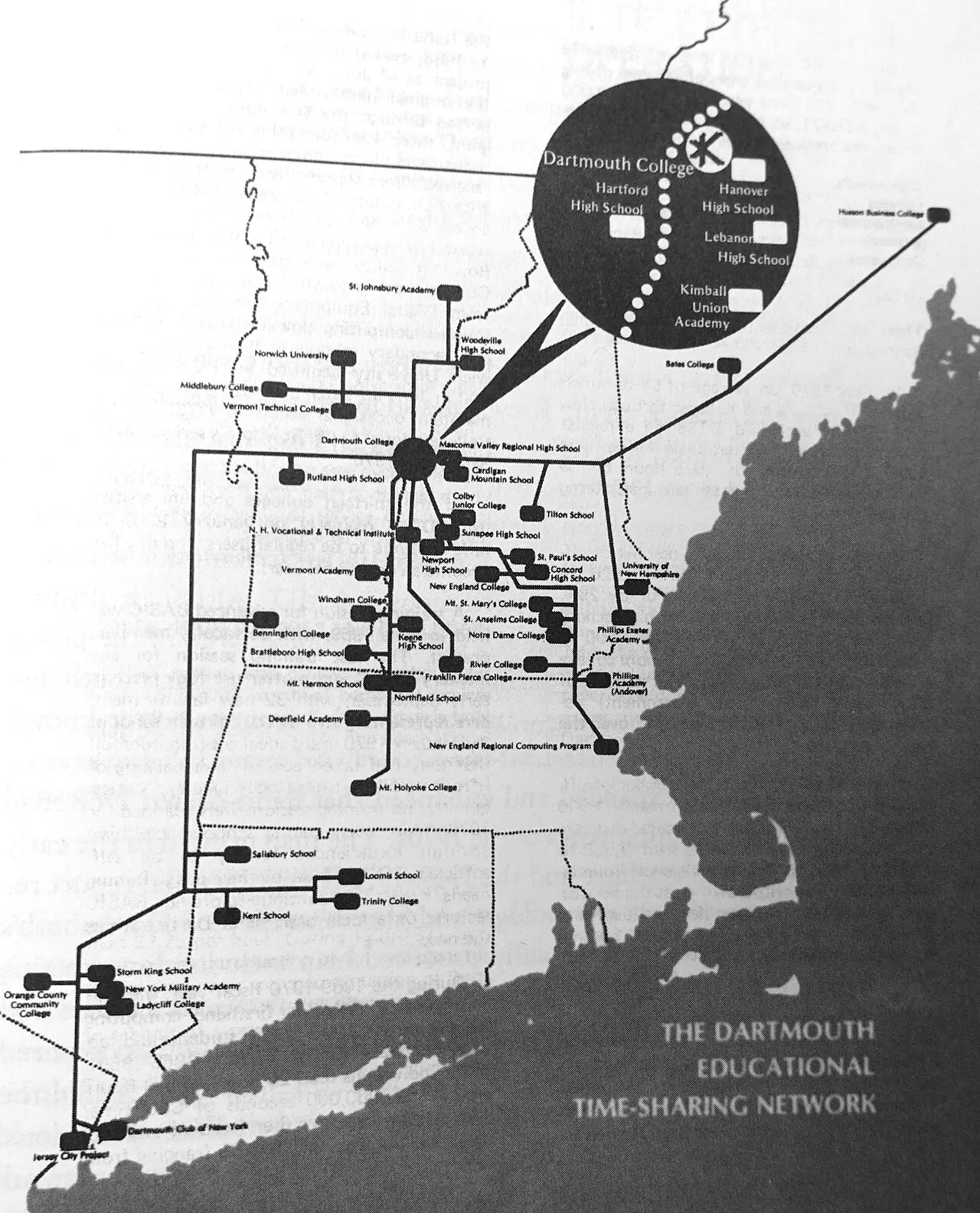
General use opened at Dartmouth in June 1964, and the terminal count went from three to eleven. That same year teletypes were installed at seven New England secondary schools — Phillips Exeter, St. Paul's, Hanover High and others — in an experiment to see whether a large computing facility could serve schools at all. It grew into the Dartmouth Educational Network, which at its peak reached thirty colleges and twenty secondary schools in New England and twelve colleges in Canada.
The decisive act, though, was that the compiler was given away. The 1960s were exactly the years in which software turned from a service bundled with expensive hardware into a chargeable commodity; Kemeny and Kurtz went the other way, making the compiler available free of charge because breadth of use was the goal. It is very commonly said that Dartmouth placed BASIC in the public domain, and the sources genuinely disagree about whether the college formally relinquished rights or simply never asserted them. What no source disputes is the operative fact: nobody was asked for money or permission. Anyone could write a thing called BASIC.
The consequence arrived in the following decade. In 1975 Bill Gates and Paul Allen wrote a BASIC for the Altair 8800 and founded a company on it (Microsoft's founding). After that, the Apple II, Commodore, TRS-80 and the Japanese eight-bit machines all booted to a BASIC prompt. BASIC was the first programming language of millions of people less because it was the best design available than because, in 1964, Dartmouth declined to put a price on it.
Free, Then Fragmented
Giving a language away also means giving up control of it. The dialects diverged, mutually incompatible, and their authors were not pleased. In 1983 Kemeny and Kurtz founded True BASIC with several former Dartmouth students to sell a standards-conforming implementation; Kurtz chaired the ANSI committee X3J2 on BASIC from 1974 to 1985 and later worked on the ISO standard.
You cannot make a language free and keep it whole. That tension recurs through the whole subsequent history of open software, and BASIC met it first.
Questions this page answers
- Who created BASIC, and when did it first run?
- John Kemeny and Thomas Kurtz designed it at Dartmouth College, and it first ran at about 4 a.m. on 1 May 1964 in the basement of College Hall. The same moment was the birth of the Dartmouth Time-Sharing System.
- Was the first BASIC an interpreter?
- No. The first Dartmouth implementation was a compiler, not an interpreter.
Sources
PrimaryThe 1960s — Dartmouth Computing Timeline, Dartmouth ITS Archive
The 4 a.m. entry for 1 May 1964, the NSF grant, the price of the GE-225, and the terminal count
TertiaryDartmouth BASIC — Wikipedia
Last updated: