ORGANIZATION
Intel
American semiconductor company incorporated on 18 July 1968 by Robert Noyce and Gordon Moore. It was a memory company for its first seventeen years; the withdrawal from DRAM announced on 10 October 1985 bet the firm on microprocessors instead. The x86 line descends not from the 4004 but from the 8008 and 8080 through the 8086/8088 that IBM chose for the PC in 1981. The 7 nm delay disclosed in 2020 cost Intel its manufacturing lead; the foundry business opened under IDM 2.0 lost US$10.3 billion at the operating line in 2025. Pat Gelsinger left in December 2024, Lip-Bu Tan arrived in March 2025, and in August 2025 the US government took a 9.9% stake.
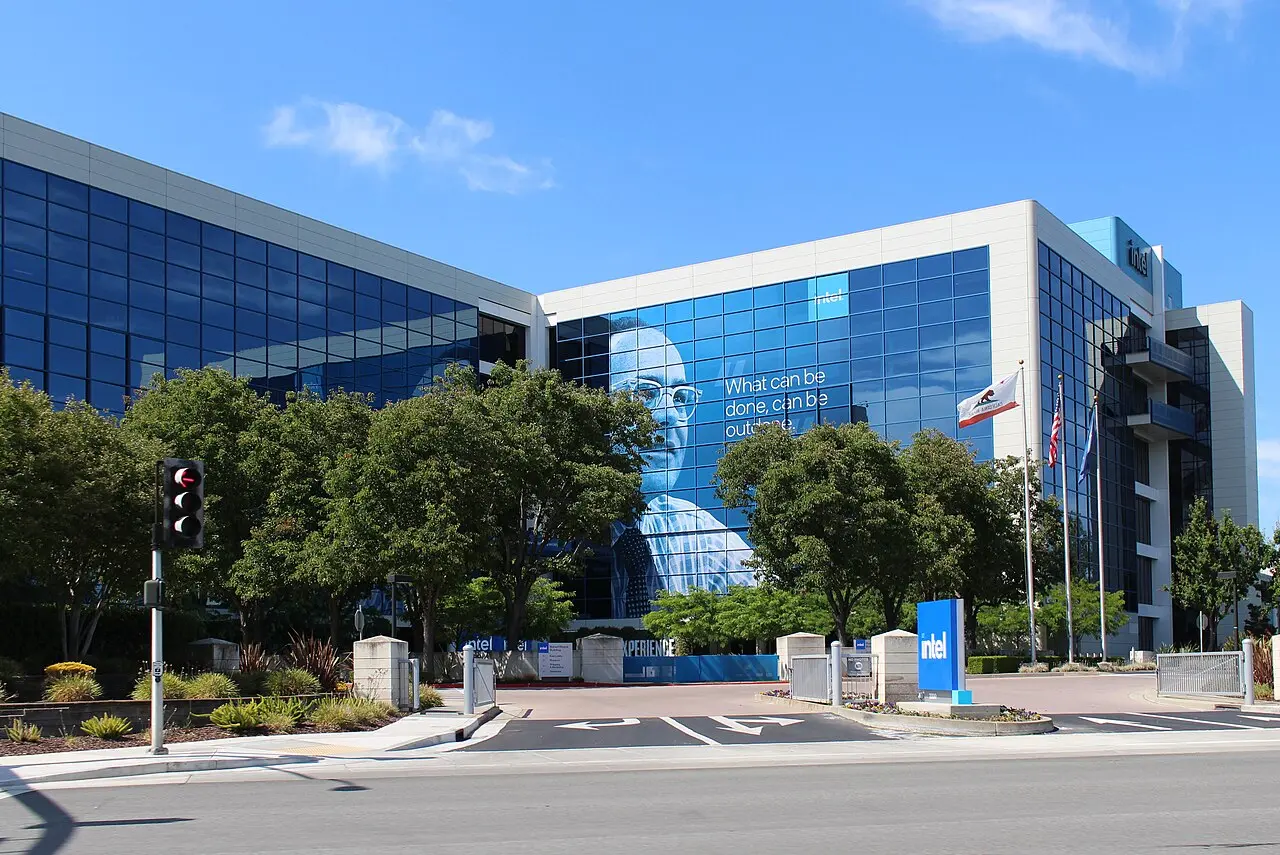
Organization
- Founded
- 1968
- Status
- Active
- Active
- 1968–
- Appearances
- 12
- Name
- ENIntelJAIntel
Intel is an American semiconductor company incorporated on 18 July 1968 by Robert Noyce and Gordon Moore. Andy Grove joined almost immediately and became the executive who defined the firm, but he was not a founder — a distinction Intel's own corporate history preserves. Headquartered in Santa Clara, California, Intel describes itself as the only company doing both leading-edge logic R&D and high-volume logic manufacturing inside the United States, and in 2025 that position turned it into an instrument of American industrial policy.
Memory, x86, and the fab that broke first
For its first seventeen years Intel was a memory company. The Intel 4004 of 1971 was a by-product of contract work for a Japanese calculator maker, and today's x86 is not descended from it. The line begins with the 8-bit 8008, a separate 1972 design for Computer Terminal Corporation, runs through the 8080 (1974), and reaches the 8086/8088 that IBM chose for the PC in 1981. What proved decisive was less any individual design than the structure it created: an instruction set that clone makers had to keep buying.
By the early 1980s Japanese DRAM pricing had erased the margin in memory. On 10 October 1985 Intel announced its withdrawal from the DRAM market. Grove's recollection survives on Intel's own history site — "It was an emotional decision," and "In retrospect, getting out of DRAMs when we did was the best business decision we ever made." Closing the founding business to bet everything on microprocessors is what made the Intel of the following quarter-century.
That Intel rested on two pillars: a design monopoly on the PC instruction set, and a manufacturing process ahead of everyone else's. Manufacturing broke first. On 23 July 2020 Intel disclosed that its 7 nm CPUs would slip roughly six months, because 7 nm yield was "trending approximately twelve months behind the company's internal target." In the same window TSMC put 7 nm into volume production and Apple began moving the Mac to its own silicon. Pat Gelsinger answered in March 2021 with "IDM 2.0": US$20 billion for two new Arizona fabs and a commitment to sell manufacturing capacity to outside customers. The foundry consumed capital long before it earned revenue, and Gelsinger left on 2 December 2024. Lip-Bu Tan was appointed CEO on 12 March 2025, effective the 18th. On 22 August 2025 the US government bought 433.3 million primary shares at $20.47 — US$8.9 billion for 9.9% of the company — funded from US$5.7 billion of unpaid CHIPS Act grants and US$3.2 billion awarded under the Secure Enclave programme.
Foundry's US$17.8 bn is mostly internal
| Segment | Scope | FY2025 revenue / operating income |
|---|---|---|
| Client Computing (CCG) | PC processors, AI PC platforms | US$32.2 bn / +US$9.3 bn |
| Data Center and AI (DCAI) | Server CPUs and data-centre silicon | US$16.9 bn / +US$3.4 bn |
| Intel Foundry | Wafer manufacturing and advanced packaging | US$17.8 bn / −US$10.3 bn |
| All other (Mobileye and so on) | Autonomous driving, remaining businesses | US$3.6 bn / +US$0.3 bn |
Most of Foundry's US$17.8 billion is internal: intersegment eliminations across the company ran to US$17.7 billion for the year, so external foundry revenue is still thin. The Core Ultra Series 3 processors released in 2025 were the first products built on Intel 18A, whose RibbonFET gate-all-around transistors and PowerVia backside power delivery Intel describes as two industry firsts in high-volume manufacturing. The next node, Intel 14A, has been designed from inception as an offering to external customers. Altera was deconsolidated on 12 September 2025 after Intel sold 51% of it.
Key events
- 18 July 1968: Noyce and Moore incorporate the company; Grove joins almost immediately.
- November 1971: Intel 4004 goes on sale; Intel goes public the same year.
- 1972 and 1974: The 8008, then the 8080 — the head of the x86 line.
- 1981: IBM picks the 8088 for the PC, making the instruction set an industry standard.
- 10 October 1985: Withdrawal from DRAM announced.
- 2009: The European Commission fines Intel EUR 1.1 billion, paid that year; sixteen years of litigation follow.
- 23 July 2020: Intel discloses that 7 nm yield is about twelve months behind its internal target.
- March 2021: IDM 2.0 announced, with US$20 billion for two Arizona fabs.
- 2 December 2024: Pat Gelsinger steps down.
- 12 March 2025: Lip-Bu Tan appointed CEO, effective 18 March.
- 22 August 2025: The US government takes a 9.9% stake for US$8.9 billion.
- 18 September 2025: NVIDIA invests US$5 billion at $23.28 a share alongside a joint x86-plus-NVLink roadmap.
Key metrics
- Revenue (FY2025): US$52.853 bn, flat year over year; consolidated operating loss US$2.2 bn
- Net loss attributable to Intel: US$0.3 bn in 2025, against US$18.8 bn in 2024
- Employees: 85,100 as of 27 December 2025, down from 124,800 at the end of 2023
- Restructuring charges of US$2.2 bn in 2025; core workforce cut about 15% against the Q2 2025 headcount
- US government holding: 9.9%, passive, no board seat, voting with the board
Killing DRAM once, and a government on the share register
Intel became the standard business-school example of a company that killed its own founding business in time. The 1985 DRAM exit is still cited whenever the cost of hesitating is being explained. The awkward sequel is that Intel could not make the same call twice: the margin on x86 was high enough that serious bets on mobile system-on-chips and on GPU-style parallel compute came late, a reading that is easiest to see next to NVIDIA's revenue mix.
On competition law, the European Commission fined Intel EUR 1.1 billion in 2009. In January 2022 the General Court annulled the findings on conditional rebates along with the fine, which was returned that February, and in October 2024 the Court of Justice dismissed the Commission's appeal. The separate 2009 finding that Intel had made payments to prevent sales of rival products survived, and on it the Commission imposed a fresh EUR 376 million penalty in September 2023; in December 2025 the General Court cut that to EUR 237 million. Sixteen years on, the case is still not closed.
The sharpest question is the 2025 government stake. The holder of 9.9% is simultaneously Intel's regulator, its subsidy provider, and — through Secure Enclave — its customer. Intel describes the holding as passive with no board representation, but the government also agreed to vote with the board on matters requiring shareholder approval, and received a five-year warrant for a further 5% at $20 a share, exercisable only if Intel ceases to own at least 51% of the foundry business. That is a structure designed to prevent a spin-off, and it marks the point at which one company's capital structure became an instrument of security policy. The human cost is visible too: headcount fell from 124,800 to 85,100 in two years, a gap that also reflects the Altera deconsolidation.
Appearances
- Moore's Law — Gordon Moore
- Intel 4004 — The First Commercially Available Microprocessor
- The Ethernet Memo — One Cable Through the Building
- The Altair 8800 — The Personal Computer That Started on a Magazine Cover
- The IBM Personal Computer 5150 — An Open Design and the Market It Lost
- NEC PC-9801 — The 16-Bit Machine That Became Japan's Standard PC
- Bluetooth 1.0 — Ericsson's Short-Range Radio, Named After a Viking King
- Windows Vista — XP's Successor, Launched in Two Steps
- TSMC Enters Volume Production at 7 nm
- Apple M1 — The Mac Moves to Apple's Own ARM Chip
- Intel CEO Pat Gelsinger Steps Down — A Semiconductor Empire Stumbles
- The United States Becomes an Intel Shareholder — CHIPS Act Grants Turned into Equity
Sources
Last updated: