PERSON
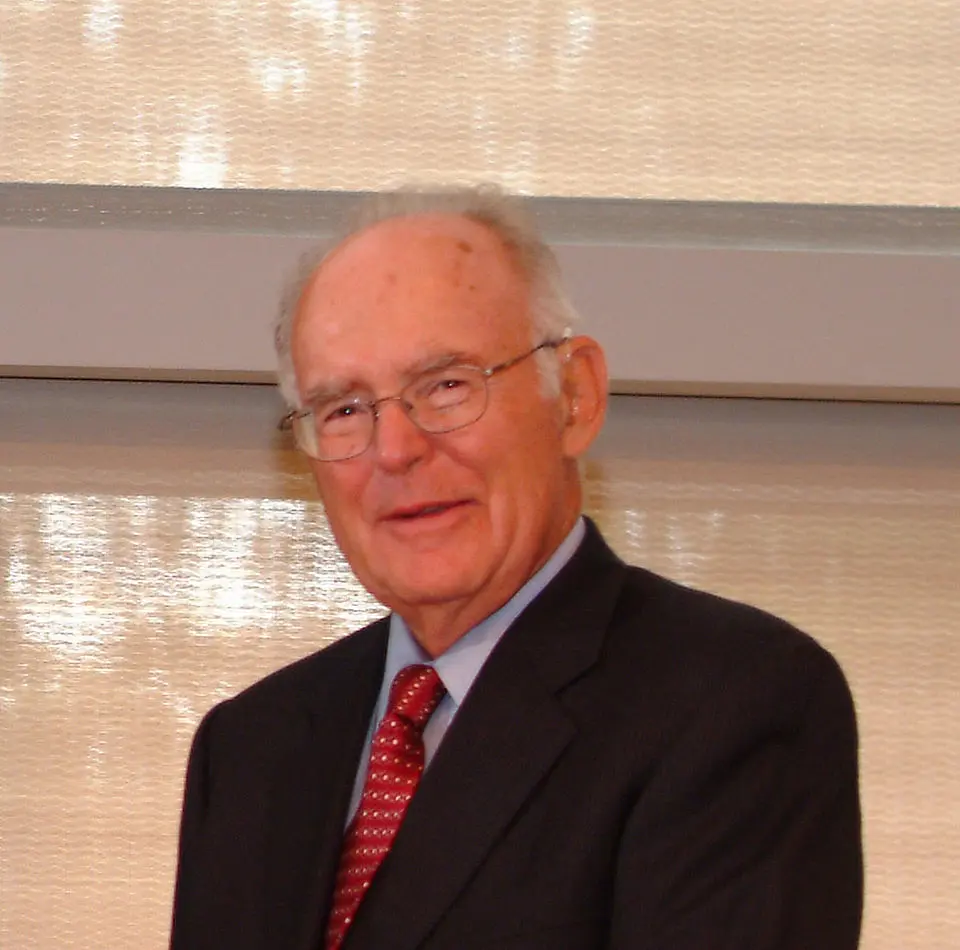
Gordon Moore
A physical chemist who became a semiconductor industrialist. One of the eight who left Shockley Semiconductor Laboratory in 1957 to found Fairchild Semiconductor, where he ran research and development. On 19 April 1965 an article in Electronics recorded his observation that the complexity giving the lowest cost per component had been rising by roughly a factor of two per year. He co-founded Intel with Robert Noyce on 18 July 1968, was its chief executive from 1975 to 1987 and its chairman from 1987 to 1997, and established the Gordon and Betty Moore Foundation in 2000.
Profile
- Born
- 1929
- Died
- 2023
- Span
- 94 years
- Appearances
- 01
- Name
- ENGordon MooreJAゴードン・ムーア
Gordon Earle Moore (3 January 1929 — 24 March 2023) is the one person in the semiconductor industry who put its rate of progress into words, and also the person who ran, for nearly thirty years, the company that had to deliver that rate. He is remembered for a single article published in 1965. Writing it was the easy part.
A chemist by training
Moore was born in San Francisco and spent his first decade in Pescadero, a coastal farming village north of Santa Cruz. He attended San Jose State for two years, transferred to the University of California, Berkeley, and took his BS in chemistry in 1950. His doctorate, completed at Caltech in 1954, was in physical chemistry, with work in infrared spectroscopy.
Moore did not come from electronics. That one of the central figures of the semiconductor industry entered it from the side of materials and reactions is not incidental to what Intel later became — a company that treated the manufacturing process itself as the competitive asset.
After his doctorate he spent more than two years as a research chemist at the Johns Hopkins University Applied Physics Laboratory. Hearing William Shockley lecture on transistors changed his direction, and in 1956 he joined Shockley's newly opened laboratory in Mountain View as the experienced chemist on a team building silicon transistors.
Fairchild and the eight
By 1957 eight of Shockley's staff had lost confidence in both his technical direction and his management, and left together. Through the investment bank Hayden Stone and the defence contractor Fairchild Camera and Instrument, they founded Fairchild Semiconductor — the first Silicon Valley spinoff, and the template for every one that followed.
Moore directed research and development from the founding. Within five years Fairchild had put silicon transistors and diodes into volume production, made Jean Hoerni's planar process the industry standard, and produced the silicon planar integrated circuit.
What the 1965 article actually said
The article, published in Electronics on 19 April 1965, was titled "Cramming more components onto integrated circuits". Its central sentence is a statement about the past: "The complexity for minimum component costs has increased at a rate of roughly a factor of two per year." Moore then argued there was no reason to expect the rate to change for at least ten years, and extrapolated that by 1975 the lowest-cost chip would carry 65,000 components.
Three things are worth keeping straight.
The word "law" does not appear in the article. Carver Mead of Caltech popularised that name.
The article's interval is one year, not two. Moore revised it at the IEEE International Electron Devices Meeting in 1975, and the two-year figure in circulation today is the revision.
The widely quoted "18 months" was never Moore's. It comes from David House at Intel, who reasoned that if transistor counts doubled every two years and the transistors themselves also got faster, chip performance would double roughly every eighteen months. Moore has stated plainly that he never said eighteen months.
Underneath all three is the point that matters: this was never a law of physics. It was an empirical regularity that the industry subsequently adopted as a target. That Moore, as chairman, led the Semiconductor Industry Association's technology roadmap says it exactly — the law stopped being something observed and became a schedule to be met.
Intel
Moore and Robert Noyce founded Intel on 18 July 1968. Arthur Rock assembled the funding; the first hire was Andy Grove, Moore's deputy in Fairchild's R&D. Moore was executive vice president until 1975, president and chief executive from 1975 to 1987, chairman from 1987 to 1997, and chairman emeritus thereafter.
The heaviest decision of his time as chief executive was to abandon memory, the business Intel had been built on, and re-stake the company on microprocessors. Intel's seventeen years as a memory company ended there.
Awards and honours
- 1984 IEEE Computer Society Computer Pioneer Award
- 1988 Founders Award, National Academy of Engineering
- 1990 National Medal of Technology (United States)
- 2002 Presidential Medal of Freedom
- 2008 IEEE Medal of Honor
Ten years that ran for sixty
In 2000 Moore and his wife Betty established the Gordon and Betty Moore Foundation with several billion dollars, directed at scientific research, environmental conservation, and projects in the San Francisco Bay Area; Caltech and Conservation International were among the largest beneficiaries.
He died on 24 March 2023, aged 94. The ten years he extrapolated in 1965 ran for sixty. Every time the physical limits of scaling come closer, someone announces that Moore's Law is over — and the fact that it can end is the clearest evidence that what Moore wrote was an observation and not a law.
Appearances
Sources
TertiaryMoore's law — Wikipedia
Last updated: