ORGANIZATION
NVIDIA
American semiconductor company founded in April 1993 by Jensen Huang, Chris Malachowsky, and Curtis Priem. Its first product, the NV1 of 1995, was designed outside the industry's emerging standards and failed; the Direct3D-aligned RIVA 128 of 1997 rescued the company, which went public at $12 a share in January 1999. Through CUDA, which opened the GPU to general-purpose computing, the AlexNet result of 2012, and the US$7 billion Mellanox acquisition of 2020, it turned from a gaming-chip vendor into a data-centre company. Fiscal 2026 revenue was US$215.9 billion, of which Data Center was US$193.7 billion.
Organization
- Founded
- 1993
- Status
- Active
- Active
- 1993–
- Appearances
- 09
- Name
- ENNVIDIAJANVIDIA
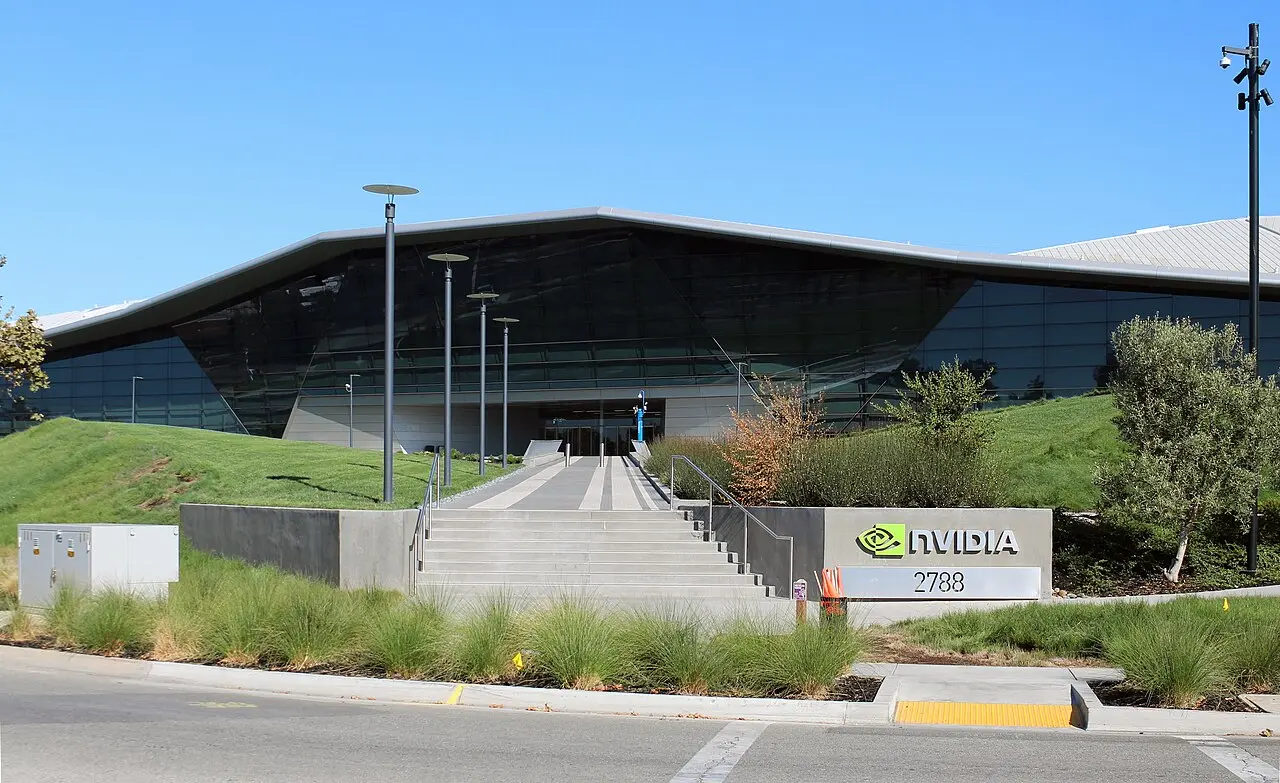
NVIDIA is an American semiconductor company founded in April 1993 by Jensen Huang, Chris Malachowsky, and Curtis Priem — incorporated in California and reincorporated in Delaware in April 1998. It is headquartered in Santa Clara. It began by selling graphics chips for PC games and, over three decades, became what its own filings now call a data center scale AI infrastructure company. Of the US$215.9 billion it took in during fiscal 2026 (the year ended 25 January 2026), US$193.7 billion came from Data Center.
A failed bet on its own standard, then CUDA
For its first two years the company shipped nothing. The NV1 arrived in May 1995: a multimedia accelerator combining 3D, video, and audio on one part, aimed mainly at the game-console market. It had been designed in the absence of industry standards, in the hope of becoming one. By the end of 1996 the PC industry had settled on Microsoft's Direct3D and SGI's OpenGL instead; NV1 revenue collapsed and NVIDIA stopped selling it. Accumulated deficit as of January 1999 was US$9.4 million. What saved the company was the opposite bet — the 128-bit RIVA 128 (1997) and RIVA TNT (1998), built to run the standards the market had chosen. NVIDIA went public on a prospectus dated 22 January 1999: 3.5 million shares at $12, US$42 million to the public.
NVIDIA's 10-K describes "our invention of the GPU in 1999" — the GeForce 256, which moved transform and lighting onto the chip. That is the company's own claim, and the word GPU itself comes from the same marketing. Two later moments matter more. The first is CUDA, which let the GPU be addressed as a parallel computer without going through a graphics API; NVIDIA's filings date its introduction to 2006, while the published Programming Guide 1.0 carries a June 2007 date. The second is AlexNet in 2012, which NVIDIA calls the "Big Bang" moment of AI. The first Tensor Core GPU followed in 2017, and on 27 April 2020 NVIDIA closed its US$7 billion acquisition of Mellanox, adding high-performance networking to GPUs and, later, CPUs. The attempt to buy Arm from SoftBank did not survive the regulators: the two companies terminated the agreement on 7 February 2022, citing significant regulatory challenges preventing the deal.
From there the line runs through H100 and Blackwell B200 to 18 June 2024, when NVIDIA briefly became the world's most valuable company. The counter-currents are equally sharp. On 26 August 2022 the US government imposed an immediate licence requirement on exports of the A100 and the then-unreleased H100 to China (including Hong Kong) and Russia. In January 2025 DeepSeek-R1 knocked about 17% off the stock in a single day, erasing roughly US$589 billion in market value. On 18 September 2025 NVIDIA invested US$5 billion in Intel alongside a joint roadmap for x86 CPUs connected by NVLink.
Two accounting segments, four markets
| Market | Scope | FY2026 revenue (YoY) |
|---|---|---|
| Data Center | Training and inference GPUs, Grace CPUs, NVLink, Mellanox-derived networking | US$193.7 bn (+68%) |
| Gaming and AI PC | GeForce RTX and AI PC platforms | US$16.0 bn (+41%) |
| Professional Visualization | RTX PRO and workstation graphics | US$3.2 bn (+70%) |
| Automotive and Robotics | Self-driving and robotics platforms | US$2.3 bn (+39%) |
NVIDIA reports two accounting segments — Compute & Networking and Graphics — and the table above is the market breakdown it publishes alongside them. The software side matters as much: on top of CUDA sit hundreds of domain libraries, frameworks, and SDKs, and that stack is what makes moving to another vendor expensive. Cumulative research and development since inception is over US$76.7 billion.
Key events
- April 1993: Huang, Malachowsky, and Priem found the company.
- May 1995: The NV1 ships — a bet against the emerging standards, and a failure.
- 1997 and 1998: RIVA 128 and RIVA TNT rebuild the business around Direct3D.
- 22 January 1999: IPO at $12 a share (3.5 m shares, US$42 m to the public).
- 1999: GeForce 256, which NVIDIA calls the invention of the GPU.
- 2006-2007: CUDA opens the GPU to general-purpose computing.
- 2012: AlexNet demonstrates GPU training at scale.
- 27 April 2020: Mellanox acquisition completes at US$7 bn.
- 7 February 2022: The Arm acquisition is abandoned on regulatory grounds.
- March 2022: H100 announced; on 26 August the US imposes China export licensing.
- March 2024: Blackwell B200 announced; on 18 June, briefly the world's most valuable company.
- January 2025: DeepSeek-R1 triggers a one-day fall of about 17%.
- 18 September 2025: US$5 bn invested in Intel.
Key metrics
- Revenue (FY2026): US$215.938 bn, up 65% year over year
- Net income: US$120.067 bn; GAAP gross margin 71.1%
- Data Center: US$193.7 bn, roughly 90% of revenue
- Revenue by customer headquarters: United States US$149.6 bn, Taiwan US$42.3 bn, China including Hong Kong US$19.7 bn
- Employees: about 42,000 across 38 countries, 31,000 of them in research and development
- US$41.1 bn returned to shareholders in buybacks and dividends during FY2026
The moat is CUDA, and the demand is partly its own
NVIDIA's position is better explained by software than by silicon. The libraries accumulated on top of CUDA are what make a move to competing hardware expensive in practice rather than merely in theory. The performance multiples routinely quoted for its GPUs — "up to N times the previous generation" — are almost always NVIDIA's own figures, published with its own choice of precision and workload, not independent measurements; the H100 and Blackwell articles on this site say so explicitly.
Geopolitics is already visible in the accounts. Since the August 2022 licence requirement, revenue from customers headquartered in China including Hong Kong has fallen from US$25.0 billion in fiscal 2025 to US$19.7 billion in fiscal 2026, and the outlook for the first quarter of fiscal 2027 assumes no Data Center compute revenue from China at all. Over the same period United States revenue roughly doubled, from US$77.5 billion to US$149.6 billion. Demand of that size is now tethered to the policy of particular governments. NVIDIA's own risk factors add the supply-side counterpart: manufacturing and final assembly are concentrated in Taiwan and South Korea, and it names TSMC and Samsung as its foundries.
Concentration cuts the other way too. The company's own fourth-quarter fiscal 2026 release lists an investment in Anthropic, a non-exclusive licensing agreement with Groq, and a collaboration with CoreWeave on building out more than five gigawatts of AI factories by 2030 — capital and contracts flowing toward the buyers of its chips. How much of the demand is independent of NVIDIA's own balance sheet is hard to assess from outside. Finally, the shape of the business is worth holding next to Intel's: about 42,000 people generating US$215.9 billion works only because someone else owns the fabs.
Appearances
- CUDA 1.0 Released — General-Purpose GPU Computing
- AlexNet — The Deep-Learning Era Begins
- Nintendo Switch — The Hybrid Console
- TSMC Enters Volume Production at 7 nm
- NVIDIA H100 — The Backbone of AI Compute
- NVIDIA Blackwell B200 — Flagship GPU for the Generative-AI Era
- NVIDIA Briefly Becomes the World's Most Valuable Company
- The DeepSeek-R1 Shock — A Low-Cost Chinese Reasoning Model Rocks the Market
- Nintendo Switch 2 Released
Questions this page answers
- Who founded NVIDIA, and when?
- Jensen Huang, Chris Malachowsky and Curtis Priem founded it in April 1993. It is an American semiconductor company headquartered in Santa Clara, California.
- What is the short history of NVIDIA?
- Its first product, the NV1 of 1995, bet on its own design before industry standards settled and failed; the Direct3D-aligned RIVA 128 of 1997 rescued it, and it went public in January 1999. CUDA, which opened the GPU to general-purpose computing, and the 2012 AlexNet result then turned a gaming-chip vendor into a data-centre company.
- Did NVIDIA invent the GPU?
- NVIDIA calls the 1999 GeForce 256 its invention of the GPU, but that is the company's own claim, and the term GPU itself comes from its marketing at the time.
Sources
Last updated: