T1#consumer#regulation#labor#market
Tesla Robotaxi — A Driverless Service That Began with a Monitor
Metadata
- Date
- Decade
- 2020s
- Tier
- T1
- Timelines
- A History of Artificial Intelligence · AI and Society: A History · A History of Self-Driving Cars
- Sources
- 10
- Connections
- 01
- Tags
- #consumer#regulation#labor#market
A robotaxi, as English Wiktionary defines it, is a self-driving car that passengers can hire on a per-journey basis. Unlike Tesla FSD, which assumes a driver on board supervising at all times, the goal of a robotaxi is that nobody sits behind the wheel when a customer rides. Tesla unveiled its purpose-built robotaxi, the Cybercab, on 10 October 2024, and on 22 June 2025 it began an invitation-only robotaxi service in Austin, Texas. The cars, however, were ordinary Model Ys, and a Tesla employee sat in the front passenger seat as a "safety monitor". Rides without an in-car monitor began on a limited basis on 22 January 2026, and in July 2026 Tesla said it had extended unsupervised service to cities in Texas and Florida.
Waymo had already opened fully driverless rides to the public in 2020; according to TechCrunch, Tesla is betting on a different belief, that fully autonomous vehicles can be deployed safely using just cameras and end-to-end AI. This page follows Tesla's attempt to turn itself from a driver-assistance company into a robotaxi company.
A history of promises
Tesla's robotaxi comes with a long record of promises. According to Electrek, at Autonomy Day in 2019 CEO Elon Musk predicted a million robotaxis on the road by 2020. In 2022 he said Tesla would mass-produce robotaxis by 2024, and in 2025 he told investors Tesla would have 500 vehicles in Austin and more than 1,000 in the Bay Area by the end of the year. None of these happened. Electrek put the actual numbers at about 42 in Austin and about 130 in San Francisco, almost all with safety monitors.
According to TechCrunch, Musk has described since at least 2019 a business in which Tesla runs its own fleet of dedicated vehicles on its ride-hailing app while owners add their own cars when they are not using them, with Tesla taking 25% to 30% of the revenue. TechCrunch wrote that this vision of autonomy is a large part of why investors price Tesla's stock as a technology company rather than a carmaker.
10 October 2024: "We, Robot" and the Cybercab
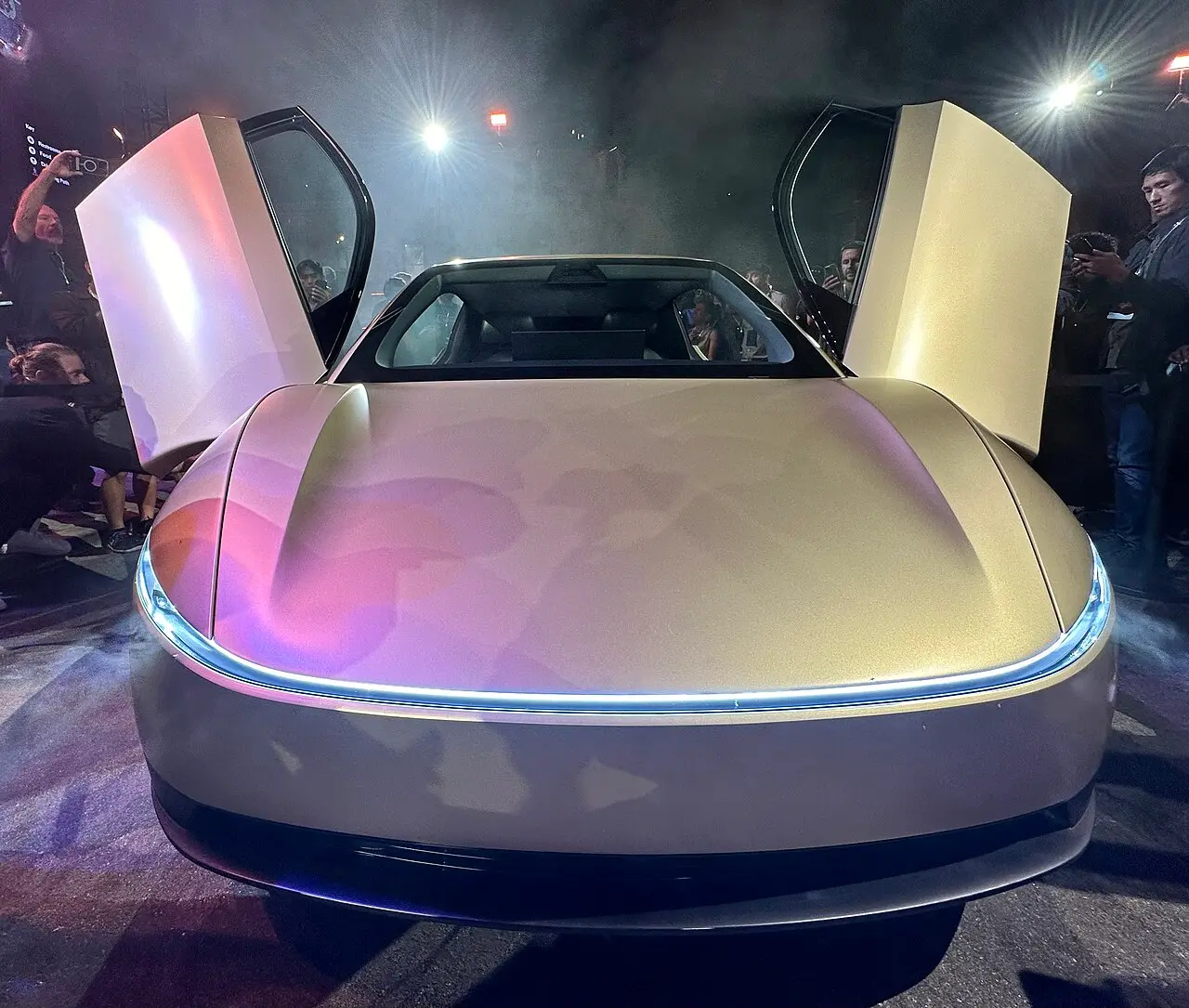
Tesla held an event called "We, Robot" at a Warner Bros. Discovery studio in Burbank, California, and showed the Cybercab. According to TechCrunch, it looks like a smaller, sleeker, two-seat Cybertruck, and there were 20 of them driving around the studio lot.
| Item | Musk's description (October 2024) |
|---|---|
| Price | Under $30,000, and individuals will be able to buy one |
| Operating cost | About $0.20 per mile over time |
| Charging | Inductive (wireless) rather than a plug |
| Production | 2026, or "before 2027" |
| Steering wheel and pedals | None |
Having no steering wheel or pedals means not complying with federal vehicle safety standards. TechCrunch pointed to GM's Cruise, which had tried to bring its purpose-built Origin to production but failed to win the necessary NHTSA approvals before scrapping it (see Cruise's suspension). The first company over that hurdle was Amazon's Zoox.
22 June 2025: the Austin launch
According to TechCrunch, Tesla sent invitations to vetted customers, who could hail rides in a new app from Sunday 22 June. Rides cost a flat $4.20, service ran daily from 6 a.m. to midnight, and the initial fleet, according to Musk, was about ten 2025 Model Ys in a narrowly defined area of South Austin. A safety monitor sat in the front passenger seat.
TechCrunch noted that other companies used monitors during testing, not commercial operations. It also reported that Tesla had tried to block TechCrunch's public-records request to the Texas Department of Transportation and a Reuters request to the city of Austin. On the first day, a robotaxi that had not yet picked up a rider was filmed braking hard twice as it passed police vehicles.
2026: removing monitors, adding cities
| Date | Event |
|---|---|
| 10 October 2024 | Cybercab unveiled |
| 22 June 2025 | Invitation-only robotaxi service starts in Austin (monitor in passenger seat) |
| December 2025 | Testing without a monitor begins in Austin (TechCrunch) |
| 22 January 2026 | In-car monitor removed on some paid rides |
| 18 April 2026 | Expansion to Dallas and Houston |
| Q2 2026 | Cybercab production starts at the Texas factory (Tesla's quarterly update) |
| 22 July 2026 | Q2 results: unsupervised service launched in Miami, Orlando and Tampa |
On 22 January 2026 Musk posted on X that Tesla had started robotaxi drives in Austin with no safety monitor in the car. According to TechCrunch, Tesla's AI chief said the company would start with a few unsupervised vehicles mixed into the monitored fleet and raise the ratio over time, though a chase car appeared to follow the driverless vehicles. Electrek reported at the end of March that only about four to eight cars were running without a monitor, and that they were still supervised remotely.
According to the second-quarter update Tesla published on 22 July, Cybercab production had begun at its Texas factory, with engineering test drives on public roads and, from July, employee rides on the factory campus. Tesla said its robotaxi was live in seven major metros, but the breakdown shows six, Austin, Dallas, Houston, Miami, Orlando and Tampa, as "Ramping Unsupervised" and the San Francisco Bay Area with a safety driver. The update's own footnote says Bay Area operations use FSD (Supervised) under a California charter-party carrier permit, that is, driver assistance that requires a supervising driver.
Safety information has been scarce. According to TechCrunch, Tesla had always redacted the narratives of its crash reports to NHTSA as confidential business information, but in May 2026 it changed course and released descriptions of all 17 crashes to date. Two were low-speed collisions while a remote teleoperator was driving. Most of the others involved a Tesla robotaxi being struck by another vehicle. Musk himself has said that making sure things are completely safe is the biggest factor limiting expansion.
Social impact: scale and transparency
Tesla's robotaxi sharpens the question of who will do the work of ride-hailing. According to Electrek, Waymo was giving 500,000 paid rides a week in 10 US cities by March 2026, and Tesla's unsupervised fleet is tiny by comparison. Yet Tesla's vision is of a different order: turning millions of privately owned cars into a ride-hailing network. According to Reuters, economists and industry experts see ride-hailing and taxi drivers as among the first workers in the world to face the threat of job loss from AI. In China, the growth of Baidu's Apollo Go has already drawn a backlash from drivers.
The other question is transparency. Where Waymo and Cruise went through stages of testing and permits, Tesla has been criticised for resisting records requests and redacting crash reports. As Cruise's suspension showed, how a company shares information with regulators can decide whether it keeps its permit at all. Electrek wrote that, given the track record, skepticism was warranted about Musk's claim at Davos that robotaxis would be widespread across the US by the end of 2026.
As for driverless ride-hailing in Japan, Waymo is working with GO and Nihon Kotsu to start service in Tokyo during 2027 (see the Waymo page). Definitions of automation levels are on the SAE levels of driving automation page, and the wider story is in the autonomous driving timeline. See also Elon Musk.
Questions this page answers
- What is a robotaxi?
- As English Wiktionary defines it, a self-driving car that passengers hire per journey. Unlike driver assistance, which assumes a driver on board supervising, the goal is that nobody is behind the wheel when a customer rides. In the US, Waymo opened fully driverless rides to the public in 2020.
- When did Tesla's robotaxi service start?
- On 22 June 2025, as an invitation-only service in Austin, Texas. Rides cost a flat $4.20, the cars were 2025 Model Ys, and a Tesla employee sat in the front passenger seat as a safety monitor. Rides with no monitor in the car began on a limited basis on 22 January 2026.
- What is the Cybercab?
- It is the two-seat robotaxi with no steering wheel or pedals that Tesla unveiled at its We, Robot event on 10 October 2024. Musk said it would cost under $30,000 and that individuals would be able to buy one. In its Q2 2026 results Tesla said production had begun at its Texas factory.
- Which cities does Tesla's robotaxi serve?
- It began in Austin and spread to Dallas and Houston in April 2026. In its update on 22 July 2026 Tesla said it had also launched unsupervised service in Miami, Orlando and Tampa and was live in seven metros, though the San Francisco Bay Area runs with a safety driver and reports say only a small number of cars run without a monitor.
Sources
PrimaryTesla Q2 2026 Update (Exhibit 99.1 to Form 8-K, Jul 22, 2026) — Tesla, Inc., SEC EDGAR
Cybercab production, public-road tests and campus rides; unsupervised launch in Miami, Orlando and Tampa in July; status by metro; Bay Area on FSD (Supervised) with a safety driver
20 Cybercabs; under $30,000; $0.20 a mile; inductive charging; production in 2026 or before 2027; no steering wheel or pedals and the Cruise Origin precedent; owners adding cars to the network
Invitations; $4.20; 6 a.m. to midnight; about ten Model Ys; safety monitor in the passenger seat; resistance to records requests
SecondaryTesla reveals two Robotaxi crashes involving teleoperators — TechCrunch, May 15, 2026
Release of narratives for all 17 crashes reported to NHTSA; two during teleoperation; earlier redactions
Four to eight unsupervised cars under remote supervision; missed deadlines including the 2019 million-robotaxi forecast; end-2025 fleet numbers; Waymo's 500,000 weekly rides
Tertiaryrobotaxi — Wiktionary
Last updated: