T1#consumer#regulation#market
Zoox — Amazon's Robotaxi Without a Steering Wheel
Metadata
- Date
- Decade
- 2020s
- Tier
- T1
- Sources
- 14
- Connections
- 01
- Tags
- #consumer#regulation#market
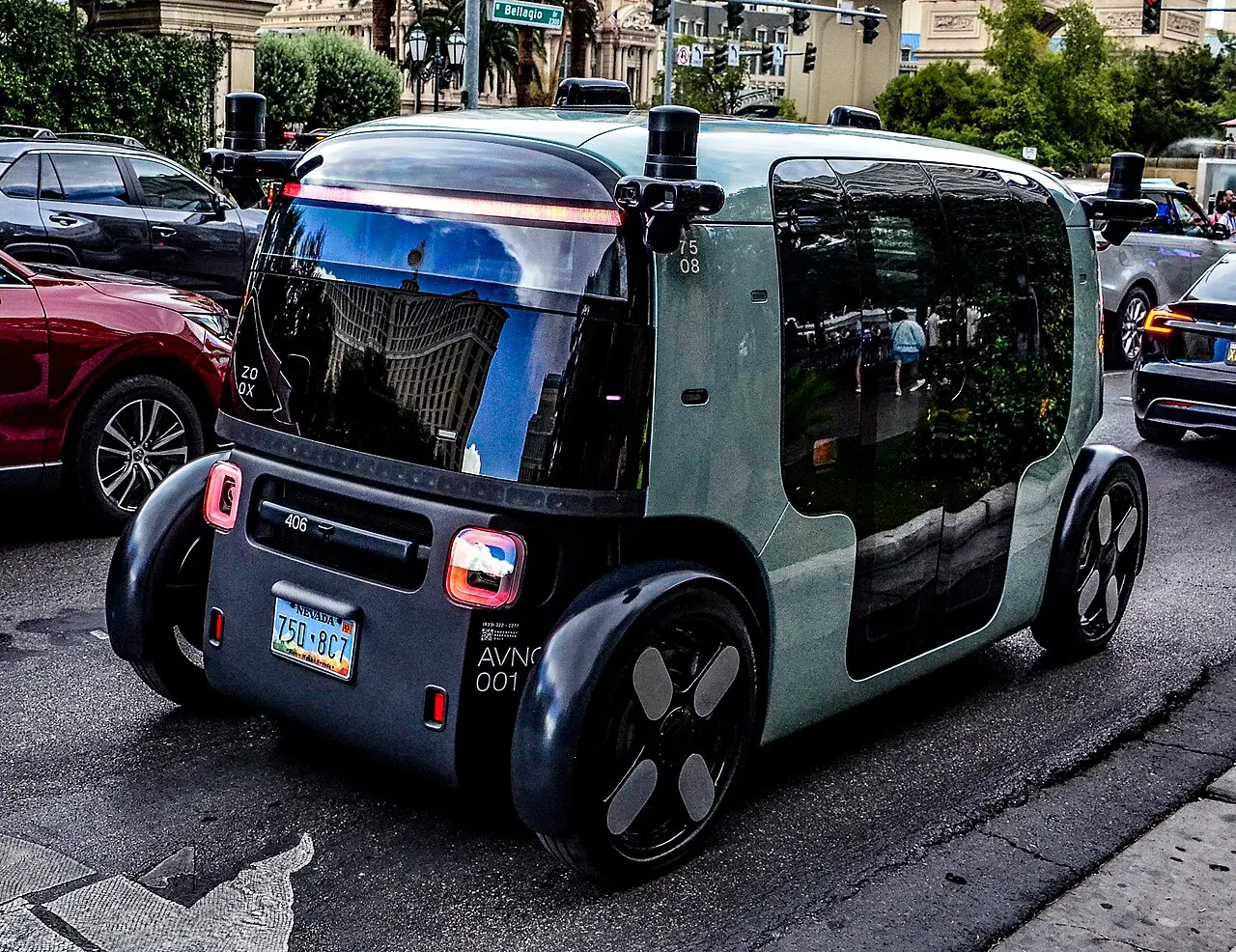
Zoox is Amazon's autonomous ride-hailing company. Founded in 2014, it chose not to retrofit existing cars and instead designed, from scratch, an electric robotaxi with no steering wheel or pedals: a boxy vehicle with no front or back that drives in both directions, with passengers seated facing each other. Amazon announced an agreement to acquire Zoox on 26 June 2020. On 10 September 2025 Zoox opened rides in this purpose-built vehicle to the public on and around the Las Vegas Strip in Nevada. Rides were free at first; on 30 July 2026 Zoox received a federal exemption from NHTSA allowing it to charge fares, and it began paid service in Las Vegas on 10 August.
What is Zoox? The choice not to convert a car
According to Amazon's announcement, Zoox started in 2014 with the vision of purpose-built, zero-emissions vehicles for autonomous ride-hailing, together with an end-to-end autonomy software stack. Many rivals, Waymo among them, fit sensors and systems to production cars from established carmakers. Zoox said in a 2026 announcement that it was founded on the belief that reinventing mobility means starting from scratch.
According to CNBC, Zoox was valued at $3.2 billion in a 2018 funding round, but suffered management turmoil, including the firing of co-founder and CEO Tim Kentley-Klay that year, and in April 2020 it cut about 100 jobs, roughly 10% of its staff. Amazon did not disclose the price; the Financial Times had reported that it would pay more than $1.2 billion. The announcement said CEO Aicha Evans and co-founder and CTO Jesse Levinson would continue to lead Zoox as a standalone business.
December 2020: the purpose-built vehicle revealed
According to Amazon, on 14 December 2020 Zoox showed its fully functional vehicle for the first time.
| Item | Zoox's description (December 2020) |
|---|---|
| Direction | Drives in either direction (bidirectional) |
| Steering | Four-wheel steering; changes direction without reversing |
| Top speed | 75 mph (about 120 km/h) |
| Safety | More than 100 safety innovations absent from conventional cars, including a new airbag system for bidirectional vehicles |
| Sensors | Cameras, radar and lidar at the four corners for a 270-degree field of view |
| Seating | Four seats facing each other |
Zoox says it created the first vehicle with bidirectional driving and four-wheel steering; that is the company's claim. At the time it was testing in Las Vegas and the San Francisco Bay Area.
A car without a steering wheel, and federal rules
A vehicle with no steering wheel or pedals does not fit the Federal Motor Vehicle Safety Standards (FMVSS), which were written for human drivers. Tesla's Cybercab faces the same problem, and GM's Cruise abandoned its purpose-built Origin without winning the approvals it needed (see Cruise's suspension).
According to Zoox, in 2025 the administration and NHTSA opened a new exemption pathway for American-built automated vehicles without traditional manual controls, and in August that year Zoox became the first AV company to receive a demonstration exemption under it. That allowed demonstrations and free rides on public roads, but not fares.
10 September 2025: open to the public in Las Vegas
On 10 September 2025 Zoox opened its app-based ride-hailing service to the public on and around the Las Vegas Strip. Zoox described itself as the first company in history to provide fully autonomous ride-hailing in a purpose-built robotaxi. CEO Aicha Evans said Las Vegas, a city famous for unforgettable moments, was the ideal place for its debut.
| Date | Event |
|---|---|
| 2014 | Zoox founded |
| 26 June 2020 | Amazon agrees to acquire Zoox |
| 14 December 2020 | Purpose-built vehicle revealed |
| August 2025 | NHTSA demonstration exemption |
| 10 September 2025 | Free public rides begin in Las Vegas |
| 18 November 2025 | San Francisco: waitlisted members of the public begin riding (free) |
| 11 March 2026 | Partnership with Uber: rides via the Uber app in Las Vegas in 2026 and Los Angeles in 2027 |
| 23 March 2026 | Robotaxi testing announced for Austin and Miami |
| 30 July 2026 | NHTSA grants the first commercial exemption |
| 10 August 2026 | Paid service begins in Las Vegas |
In San Francisco, where Zoox says it has tested since 2017, it began free rides in November 2025 for early riders in a programme called Zoox Explorers, covering most of SoMa, the Mission and the Design District. In March 2026 Zoox said that in less than a year since launching in Las Vegas its robotaxis had driven nearly two million autonomous miles and carried more than 350,000 riders.
Recalls and safety
As it expanded, Zoox filed a series of software recalls.
- March 2025: after two incidents in which its retrofitted test vehicles, which always carry safety drivers, braked and were rear-ended by motorcyclists. NHTSA had opened a preliminary evaluation in May 2024
- April–May 2025: after an unoccupied robotaxi made contact with a passenger car in Las Vegas. Zoox paused driverless operations, found the root cause and updated the software across its fleet
- May 2025: after an e-scooter rider struck a stopped robotaxi in San Francisco and fell next to it, and the vehicle then began to move
- July 2026: according to Quartz, covering the entire 105-vehicle fleet, after a robotaxi in Las Vegas failed to detect heavy smoke and drove into an active fire scene in June
Quartz reported that the recall followed a warning from NHTSA Administrator Jonathan Morrison that the agency had identified a pattern of driverless vehicles interfering with first responders. Zoox says that because it owns and operates its vehicles, it can push software updates to the whole fleet quickly.
2026: the day it could charge fares
On 30 July 2026 NHTSA granted Zoox a temporary exemption. According to Quartz, it covers eight safety standards, among them windshield defrosting and light-vehicle braking, and lets Zoox put vehicles without steering wheels or pedals on the road, up to 2,500 a year for two years. According to Reuters, NHTSA determined the vehicle was as safe as an equivalent vehicle meeting federal standards, but imposed additional reporting on crashes and inappropriate stopping. Zoox calls it the first-ever NHTSA commercial exemption for a purpose-built robotaxi.
Zoox says that since launching in Las Vegas and San Francisco it has welcomed more than half a million riders, with another half a million on its waitlist. According to Reuters, Zoox had until then been carrying passengers for free in Las Vegas, San Francisco, Austin and Miami as part of testing, and Las Vegas fares from 10 August were set at a level similar to the "comfort" tier of other ride-hailing services. To charge fares in California, Zoox still needs permits from the state's Public Utilities Commission and DMV.
Social impact
Zoox's path showed how much of the rulebook for cars assumes a human driver. Zoox says it is working with NHTSA towards changing the safety standards themselves, so that autonomous vehicles can be deployed without vestigial elements that only matter to human drivers. Companies like Waymo that use conventionally controlled cars do not need such exemptions, which puts the two on different regulatory tracks (Quartz).
Its relationship with ride-hailing work is changing too. Through its partnership with Uber, riders will be able to hail Zoox vehicles in Uber's app as well as its own, so human-driven cars and robotaxis will sit side by side in the same app. In China, Baidu's Apollo Go has raised the same question.
Zoox's parent is Amazon. Levels of automation are explained on the SAE levels of driving automation page, and the wider story is in the autonomous driving timeline.
Questions this page answers
- What is Zoox?
- It is Amazon's autonomous ride-hailing company. Founded in 2014, it designed from scratch an electric robotaxi with no steering wheel or pedals that drives in either direction, rather than converting existing cars. Amazon agreed to acquire it on 26 June 2020.
- Where can you ride a Zoox?
- Public service began around the Las Vegas Strip on 10 September 2025 and has been paid since 10 August 2026. In San Francisco it has offered free rides to waitlisted riders since November 2025. According to Reuters, it was also carrying passengers for free in Austin and Miami as part of testing.
- Why does Zoox need an NHTSA exemption?
- Because federal motor vehicle safety standards were written for human drivers, and a vehicle with no steering wheel or pedals does not comply. The August 2025 demonstration exemption did not allow fares; the exemption granted on 30 July 2026 allows paid service for up to 2,500 vehicles a year over two years.
- Has Zoox had recalls?
- Yes. It filed software recalls in March 2025 after test vehicles were rear-ended by motorcycles, and in April–May 2025 after contact with a passenger car in Las Vegas and an incident with an e-scooter rider in San Francisco. In July 2026 its entire 105-vehicle fleet was recalled after a robotaxi failed to detect heavy smoke at a fire scene.
Sources
PrimaryAmazon subsidiary Zoox reveals first look at autonomous robotaxi — Amazon, Dec 14, 2020
Bidirectional driving and four-wheel steering; 75 mph; over 100 safety innovations; 270-degree view from sensors at the four corners
PrimaryZoox granted first-ever NHTSA commercial exemption for purpose-built robotaxi — Zoox, Jul 30, 2026
The August 2025 demonstration exemption; the July 2026 commercial exemption; over half a million riders and half a million on the waitlist
SecondaryAmazon's Zoox gets federal OK to charge for robotaxi rides — Quartz, Jul 30, 2026
Eight standards; up to 2,500 vehicles a year for two years; permits still needed in California; the 105-vehicle recall and the NHTSA administrator's warning
TertiaryZoox — Wikipedia
Last updated: