T1#standard#regulation#japan
SAE J3016 — The Six Levels of Driving Automation
Metadata
- Date
- Decade
- 2010s
- Tier
- T1
- Sources
- 10
- Connections
- 00
- Tags
- #standard#regulation#japan
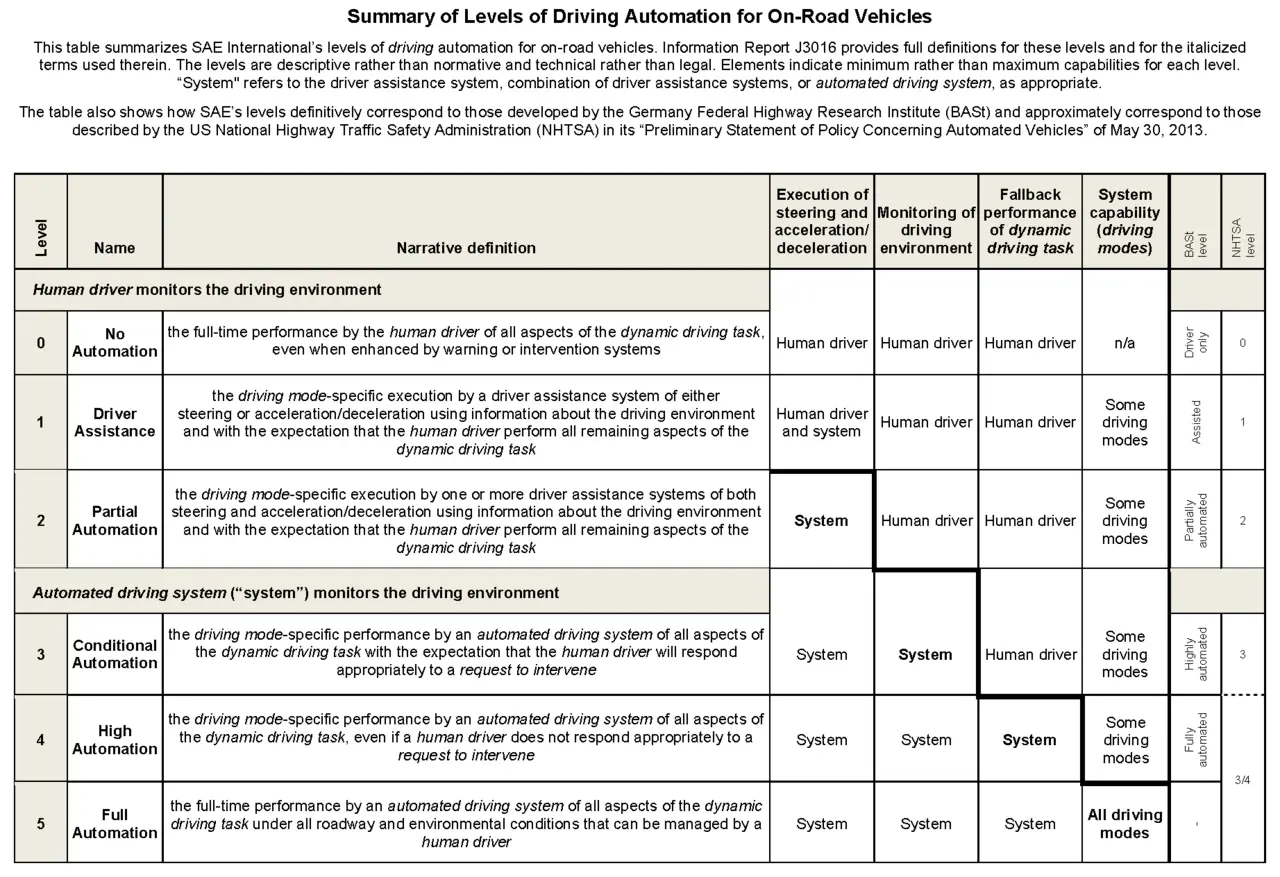
The levels of driving automation are the six stages, Level 0 to Level 5, defined in SAE J3016, a recommended practice from the US engineering body SAE International. The first edition of J3016 was issued on 16 January 2014. Level 0 is no automation and Level 5 is full automation, in which the system drives under any conditions. Up to Level 2, a human drives and watches the road while the system assists; from Level 3 upwards, the system itself does the driving within defined conditions. Japan's government adopted these definitions in its Public-Private ITS Initiative and Roadmap 2017 in May 2017, and the rules of Japan's transport ministry (MLIT) and National Police Agency are built on them.
Levels 0 to 5 at a glance
The descriptions below follow the table that Japan's Cabinet Office gave as the J3016 definitions in its 2018 White Paper on Traffic Safety. "Who monitors and responds" is the party responsible for monitoring and responding for safe driving. The last column gives the vehicle names set by MLIT: "driver-assistance vehicle" for Levels 1 and 2 in fiscal 2018, and the names for Levels 3 to 5 in December 2020.
| Level | SAE name | Summary | Who monitors and responds | MLIT vehicle name |
|---|---|---|---|---|
| 0 | No Driving Automation | The driver performs all driving tasks | Driver | — |
| 1 | Driver Assistance | The system performs a subtask of either longitudinal or lateral vehicle control | Driver | Driver-assistance vehicle |
| 2 | Partial Driving Automation | The system performs subtasks of both longitudinal and lateral vehicle control | Driver | Driver-assistance vehicle |
| 3 | Conditional Driving Automation | The system performs all driving tasks (within a limited domain) | System (the driver when continued operation becomes difficult) | Conditionally automated vehicle (limited domain) |
| 4 | High Driving Automation | The system performs all driving tasks (within a limited domain) | System | Automated vehicle (limited domain) |
| 5 | Full Driving Automation | The system performs all driving tasks (not within a limited domain) | System | Fully automated vehicle |
The white paper notes that the "domain" is not necessarily geographic and can include the environment, traffic conditions, speed and time of day. J3016 calls it the operational design domain (ODD). What separates Levels 3 and 4 is who deals with the moment the conditions are about to run out. At Level 3 the driver must take over when the system asks; at Level 4 the system itself is responsible for bringing the vehicle to a safe stop.
J3016 in 2014: what it defined
J3016 was not the first attempt to grade automation. In May 2013 the US National Highway Traffic Safety Administration (NHTSA), in its Preliminary Statement of Policy Concerning Automated Vehicles, set out five levels from no automation (Level 0) to full self-driving automation (Level 4).
The first edition of J3016, issued on 16 January 2014 by SAE's On-Road Automated Driving (ORAD) Committee, ran to 12 pages and was published as an Information Report. It laid out a taxonomy from no automation to full automation, but gave detailed definitions only for the top three levels (conditional, high and full automation); the lower levels were described only as points of reference to bound the range.
J3016 has since been revised three times.
| Version | Issued | Notes |
|---|---|---|
| J3016_201401 | 16 January 2014 | First edition (12 pages) |
| J3016_201609 | 30 September 2016 | Revision |
| J3016_201806 | 15 June 2018 | Revision |
| J3016_202104 | 30 April 2021 | Revised jointly with ISO (41 pages): clearer difference between Levels 3 and 4, definitions of remote assistance and remote driving, the name "driver support systems" for Levels 1 and 2 |
According to the rationale for the 2021 version, SAE's committee and ISO's TC204/WG14 formed a joint working group in 2018; SAE's announcement says representatives from nine countries took part.
What made the levels stick was regulators adopting them. In its Federal Automated Vehicles Policy of September 2016, the US Department of Transportation adopted the SAE definitions, explaining that they divide vehicles into levels based on "who does what, when." It then drew a line between Levels 0–2 and 3–5 according to whether the human or the automated system is primarily responsible for monitoring the driving environment.
Who is responsible?
What J3016 divides up is roles in the driving task. The 2021 version defines each level by the role played by three actors, the human user, the driving automation system and the rest of the vehicle, in performing the driving task and the fallback when it can no longer continue. A role is what the design expects, not what actually happens: a driver using a Level 1 adaptive cruise control without watching the road still has the role of driver. Active safety systems such as automatic emergency braking (AEB), electronic stability control (ESC) and momentary lane-keeping assistance fall outside the taxonomy because they do not perform the driving task on a sustained basis.
The 2021 version also states that the document does not impose requirements on driving automation systems. A level is not a safety rating; it describes who is driving.
Who pays for the damage after a crash is set by national law. In a report issued on 20 March 2018, MLIT's study group on liability for automated driving concluded that during the "transition period", when vehicles of Levels 0 to 4 share the road, the existing operator liability under Japan's Automobile Liability Security Act should be kept, while mechanisms are studied to help insurers recover costs from manufacturers. Crashes caused by hacking, it said, should be covered by the government guarantee scheme as with stolen cars, except where the owner failed to take the necessary security measures.
Drivers' duties are set by the Road Traffic Act. The 2019 amendments that allowed Level 3 on public roads are covered on the Honda Legend page, and the 2023 amendment that put driverless Level 4 under a permit system on the Level 4 page.
How Japan adopted it
The Japanese government's automated-driving plan, the Public-Private ITS Initiative and Roadmap, was first drawn up in 2014 and revised every year. According to an MLIT paper from 2017, the May 2016 roadmap used Japan's own Levels 1 to 4, with Level 4 meaning "fully automated driving". After the US Department of Transportation aligned with the SAE levels in September 2016, a proposal was made for Japan to use the same terms and divisions, and the Roadmap 2017 of May 2017 adopted the J3016 definitions.
| Year | Event |
|---|---|
| May 2013 | NHTSA sets out five levels, 0 to 4 |
| 16 January 2014 | First edition of SAE J3016 |
| September 2016 | US DOT adopts the SAE definitions |
| May 2017 | Japan adopts them in the Roadmap 2017 |
| 11 November 2020 | MLIT grants Level 3 type designation to the Honda Legend |
| December 2020 | MLIT announces vehicle names for Levels 3 to 5 |
| 1 April 2023 | Amended Road Traffic Act with a Level 4 permit system takes effect |
Government targets were written in these terms. The Roadmap 2017 aimed for an "autopilot" (Level 3) on expressways around 2020, driverless mobility services in limited areas by 2020, and full automation (Level 4) on expressways around 2025.
Criticism of the levels, and what they changed
A common vocabulary mattered. In the 2021 version SAE lists the purposes of standardising the levels, including clarifying the role of the human driver, answering questions of scope when developing laws, policies, regulations and standards, and providing a framework for specifications.
Numbered stages, though, are hard for ordinary drivers to read. The crash investigations and regulatory rulings around Tesla's Autopilot, a Level 2 feature that requires constant supervision but carries a name suggesting self-driving, show what can go wrong.
There is dissent from industry too. In February 2023 Amnon Shashua and colleagues at Mobileye, which supplies driver-assistance systems, argued that the SAE taxonomy is not suited to describing products and proposed four categories instead, based on whether the driver's eyes and hands are needed and whether there is a driver at all: eyes-on/hands-on, eyes-on/hands-off, eyes-off/hands-off, and no driver. They argued that supervised hands-off driver assistance has no place in the SAE taxonomy and is often wrongly classed as Level 3–4, and that the distinction between Levels 3 and 4 is unnecessary. It is a proposal made from the company's own position as a supplier.
Even so, the question J3016 poses, which part of driving a person does and which a machine does, remains the starting point for society's debate about automated driving. Concrete examples of the levels appear on the pages for Waymo's fully driverless rides and Mercedes-Benz DRIVE PILOT.
Questions this page answers
- What are the levels of driving automation?
- They are the six stages of driving automation defined in J3016, a recommended practice from SAE International: Level 0 no automation, 1 driver assistance, 2 partial automation, 3 conditional automation, 4 high automation and 5 full automation. The first edition was issued on 16 January 2014.
- What is the difference between Level 2 and Level 3?
- At Level 2 the driver monitors the road at all times and remains the one driving. At Level 3 the system performs the whole driving task within limited conditions, and the driver must take over when the system requests it, for example when the conditions are about to end.
- What is the difference between Level 3 and Level 4?
- Both have the system driving within limited conditions, but at Level 3 the system hands back to the driver when it can no longer continue, while at Level 4 the system brings the vehicle to a safe stop on its own. That is why Level 4 needs no driver.
- Since when has Japan used the SAE levels?
- Japan adopted the SAE J3016 definitions in its Public-Private ITS Roadmap 2017 in May 2017. The 2016 roadmap had used Japan's own Levels 1 to 4; the change followed the US Department of Transportation's adoption of the SAE definitions in September 2016.
Sources
sae.org renders only with JavaScript, so the archived copy is cited. Issue date 16 January 2014, 12 pages, the ORAD Committee, the scope defining only the top three levels in detail, and the revision history
Names of the six levels, definition by the roles of three actors, exclusion of active safety systems, no requirements imposed, the joint working group with ISO TC204/WG14, and the purposes of standardisation
Its standing since the 2014 launch, representatives from nine countries, and the main changes in the 2021 version
Primary特集 先端技術を活用した交通安全の取組(平成30年版交通安全白書)— 内閣府
Japan's adoption of the J3016 definitions; the table of Japanese names, summaries and monitoring parties for Levels 0–5; the note on 'domain'; the roadmap's history and target dates
Primary自動運転レベル分けの改正案について(第2回 自動運転における損害賠償責任に関する研究会 資料1-1)— 国土交通省自動車局
The May 2016 roadmap's own Levels 1–4 and the proposal to align with SAE (September 2016)
Primary「自動運転における損害賠償責任に関する研究会」の報告書を公表します!— 国土交通省, 2018年3月20日
Report summary: keeping operator liability during the transition, recovery from manufacturers, and the government guarantee scheme for hacking
PrimaryFederal Automated Vehicles Policy — U.S. Department of Transportation, September 2016 (archived)
Adoption of the SAE definitions, "who does what, when", and the line between Levels 0–2 and 3–5
Secondary国交省、自動運転車両の呼称を策定 レベル3は「条件付自動運転車(限定領域)」に — Car Watch, 2020年12月11日
The names for Levels 3–5, and 'driver-assistance vehicle' for Levels 1–2 (set in fiscal 2018)
Last updated: