T1#standard
iPhone 12 — 5G, MagSafe and a Launch in Two Waves
Metadata
- Date
- Decade
- 2020s
- Tier
- T1
- Sources
- 08
- Connections
- 03
- Tags
- #standard
Apple announced the iPhone 12 family on 13 October 2020, but the four models did not ship together. The iPhone 12 and iPhone 12 Pro went on sale on Friday 23 October; the iPhone 12 mini and iPhone 12 Pro Max on Friday 13 November. Japan was in the first wave both times: Apple's press release names it among the pre-order countries alongside Australia, China, Germany, the UK and the US.
A generation with two release dates
| Model | Screen | Pre-order | On sale | US starting price |
|---|---|---|---|---|
| iPhone 12 | 6.1-inch | 16 Oct | 23 Oct | $799 |
| iPhone 12 Pro | 6.1-inch | 16 Oct | 23 Oct | $999 |
| iPhone 12 mini | 5.4-inch | 6 Nov | 13 Nov | $699 |
| iPhone 12 Pro Max | 6.7-inch | 6 Nov | 13 Nov | $1,099 |
Give a single "iPhone 12 release date" and you are wrong about half the range. Apple's own launch-day post says that what reached stores on 23 October was the iPhone 12 and iPhone 12 Pro, plus the new iPad Air.
Why not September
The iPhone 11 had gone on sale on 20 September the year before. In 2020 the first models arrived more than a month later.
Apple had said so in advance. On the earnings call of 30 July 2020, CFO Luca Maestri said that last year the new iPhone had started selling in late September, and "this year, we project supply to be available a few weeks later". Pressed by an analyst, he confirmed he was talking about the new product. Jason Snell of Six Colors recorded the exchange that day. Apple did not spell out the cause.
5G, but not the same 5G everywhere
The iPhone 12 was Apple's first 5G iPhone, and Apple's headline called it "a new era for iPhone with 5G".
What "5G" meant depended on where you bought it. Apple's release states that "models in the US support millimeter wave, the higher frequency version of 5G", and the "speeds up to 4Gbps" figure is given in that context. An iPhone 12 bought in Japan used the non-millimetre-wave bands.
To protect battery life Apple added Smart Data mode, which "extends battery life by intelligently assessing 5G needs and balancing data usage, speed, and power in real time". It was a direct answer to the worry, common at the time, that holding a 5G connection all day would drain the phone.
Flat sides again
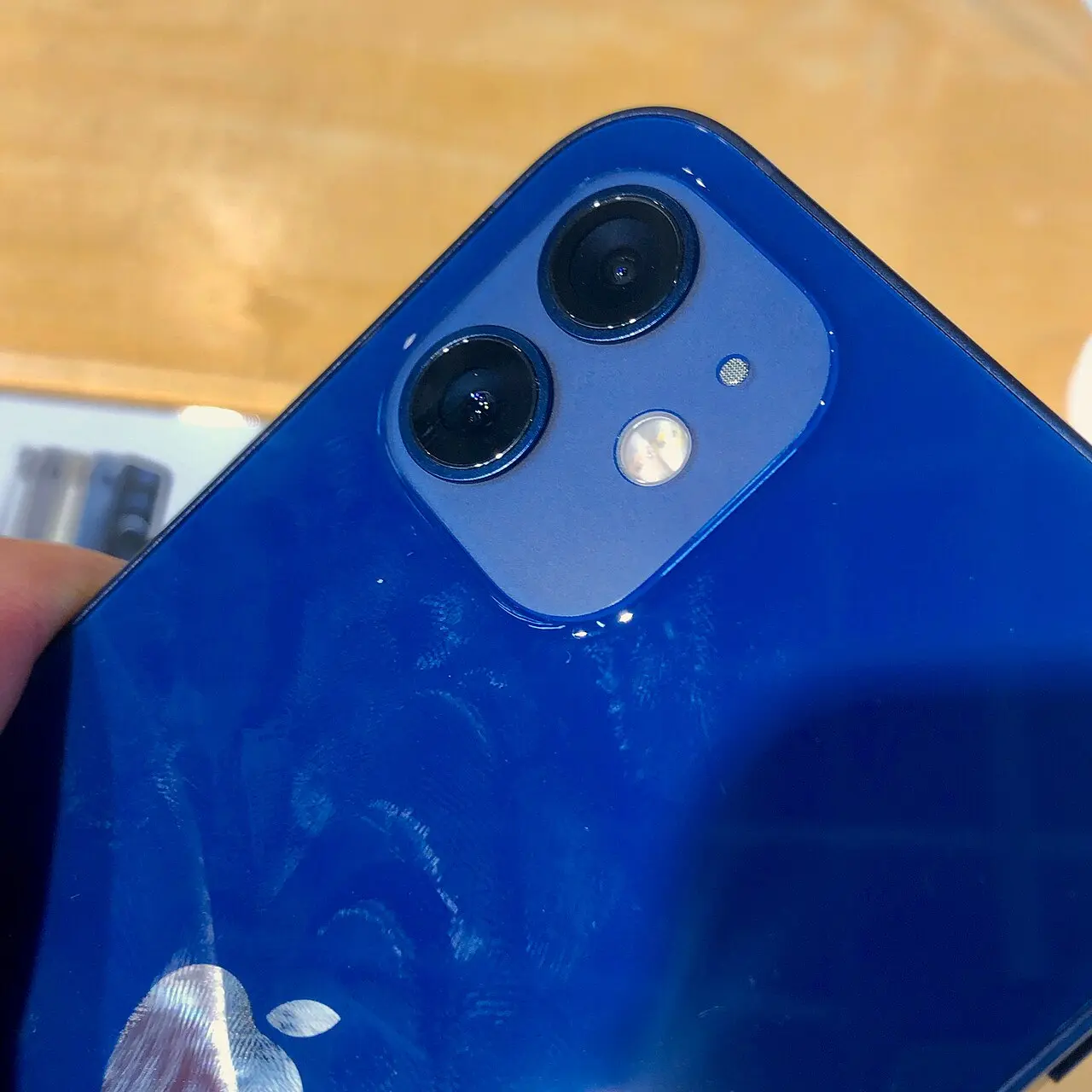
The outside changed visibly. Apple described "a sleek new flat-edge design with an aerospace-grade aluminum enclosure", dropping the rounded sides of the preceding generations for flat ones that recall the iPhone 4 of 2010.
The front glass became Ceramic Shield, which Apple said "increases drop performance by 4x". That is Apple's own test claim.
The standard iPhone 12 and 12 mini also got Super Retina XDR OLED displays. The iPhone 11 had used an LCD Liquid Retina panel, so with this generation all four models were OLED.
MagSafe: a name reused
Around the wireless-charging coil on the back sits a ring of magnets that snaps chargers, cases and wallets into place. Apple named it MagSafe, borrowing the name of the magnetic power connector it had used on MacBooks.
In Apple's words, MagSafe features "an array of magnets around the wireless charging coil, optimized for alignment and efficiency, that perfectly connects to iPhone every time", and MagSafe chargers "efficiently provide up to 15W of power". The point was alignment: a wireless charger that is slightly off-centre charges badly, and magnets remove the guesswork. Apple also pitched it as an accessory system — something you attach and detach — as much as a charger.
What the box lost
The most argued-over change in this generation was a removal.
Apple said it was "removing the power adapter and EarPods from iPhone packaging", citing lower carbon emissions and less mining of materials. Apple's specification page lists the box contents for the iPhone 12 as the phone, a USB-C to Lightning cable and documentation.
Apple's case was environmental: the smaller, lighter box "allows for 70 percent more boxes to be shipped on a pallet". The statement covered iPhone packaging generally, not just the new models. The 18 W fast charger that had first appeared in the iPhone 11 Pro box was gone a year later, along with the rest of the adapter.
What the Pros added
The two Pro models added:
- LiDAR Scanner, a depth sensor that Apple said "improves autofocus by 6x in low-light scenes" and enabled Night mode portraits
- HDR video with Dolby Vision, which Apple claimed made these "the first cameras and only devices in the world to enable an end-to-end experience" for Dolby Vision HDR, up to 60 fps; the same claim appears for the iPhone 12 and 12 mini
- Pro Max-only camera hardware: sensor-shift optical image stabilisation and a longer optical zoom range (5x, against the 12 Pro's 4x)
- Apple ProRAW, which at announcement "will be available in a future iOS 14 update" — it was not there on launch day
Night mode and Deep Fusion now ran on every camera: TrueDepth, Wide and Ultra Wide.
What stayed the same
The notch and Face ID layout introduced with the iPhone X were untouched, and the connector stayed Lightning; USB-C waited for the iPhone 15 in 2023. What this generation changed was the radio, the shape of the frame, the magnets on the back and the contents of the box.
For the full product line see iPhone; for the company, Apple.
Questions this page answers
- When was the iPhone 12 released?
- It was announced on 13 October 2020. The iPhone 12 and iPhone 12 Pro opened for pre-order on 16 October and went on sale on 23 October; the iPhone 12 mini and iPhone 12 Pro Max followed with pre-orders on 6 November and release on 13 November. Japan was in the first wave on both dates.
- Why did the iPhone 12 launch in October rather than September?
- Apple did not explain the cause in detail, but it flagged the delay in advance. On the earnings call of 30 July 2020, CFO Luca Maestri said that whereas the new iPhone had gone on sale in late September the previous year, this year's supply was projected to be available a few weeks later.
- Does the iPhone 12 come with a charger?
- No. With the iPhone 12 announcement Apple removed the power adapter and EarPods from iPhone packaging; the box contains the phone, a USB-C to Lightning cable and documentation. Apple said the smaller, lighter box let it ship 70 percent more boxes per pallet.
- What did the iPhone 12 range cost in Japan at launch?
- Before tax, the iPhone 12 mini started at ¥74,800, the iPhone 12 at ¥85,800, the iPhone 12 Pro at ¥106,800 and the iPhone 12 Pro Max at ¥117,800.
Sources
PrimaryApple、iPhone 12とiPhone 12 miniを発表:新時代の幕開けとなる5G対応iPhone — Apple Newsroom(日本), 2020年10月
Japanese pricing (before tax) and dates
TertiaryiPhone 12 — Wikipedia
Last updated: