T1#regulation#standard
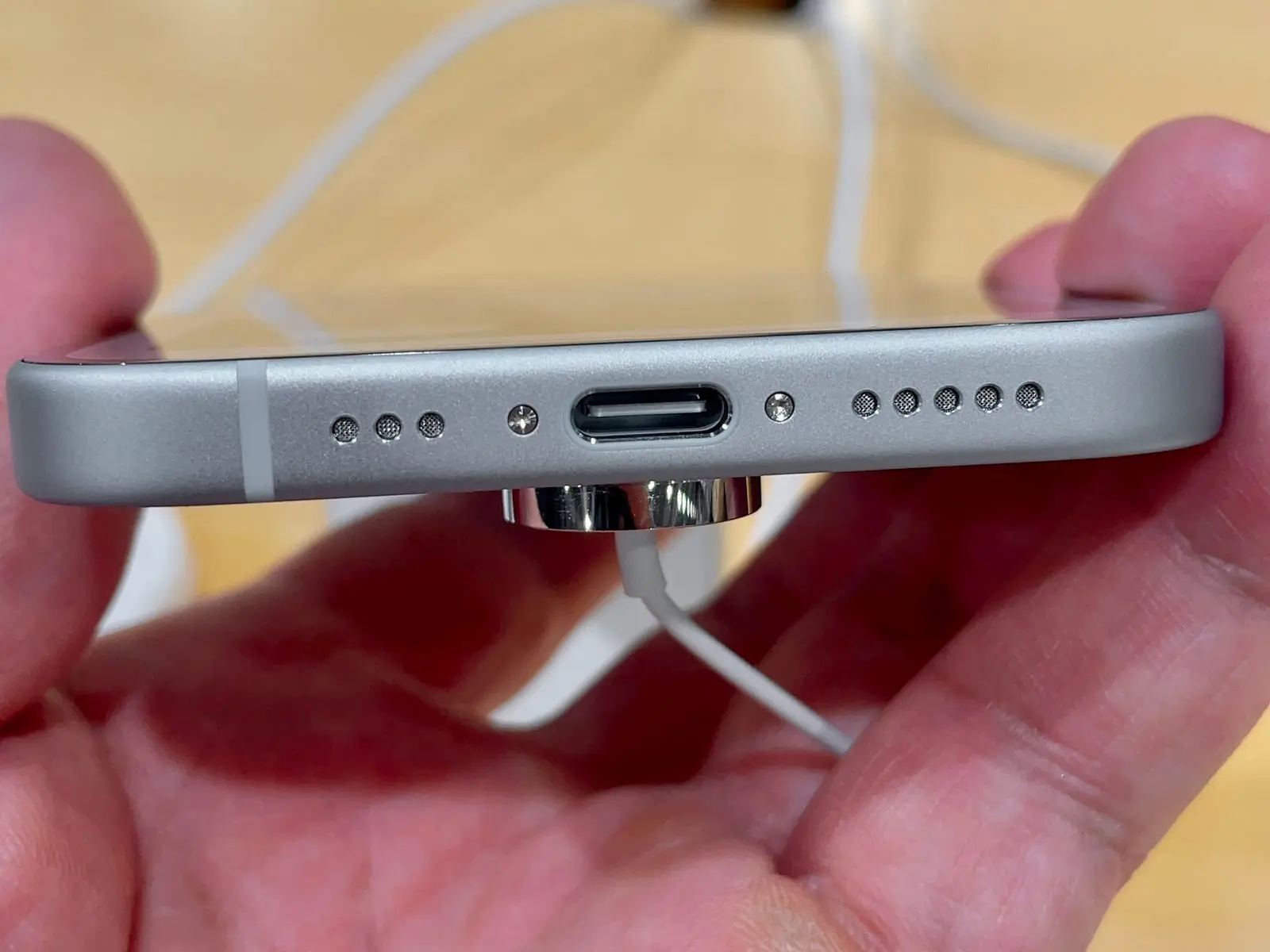
iPhone 15 — The Move to USB-C
Metadata
- Date
- Decade
- 2020s
- Tier
- T1
- Sources
- 09
- Connections
- 03
- Tags
- #regulation#standard
To describe the iPhone 15 as a product of Apple's own will is to miss the point. It is a rare case in twenty-first-century electronics in which regulation directly rewrote a major corporation's hardware specification.
What the Directive Actually Requires
The instrument is Directive (EU) 2022/2380, the act of 23 November 2022 amending the Radio Equipment Directive 2014/53/EU. The European Parliament adopted its position on 4 October 2022 and the Council decided on 24 October; the signed act carries the November date.
Its obligations are narrower and more specific than "phones must use USB-C":
| Obligation | Text of Annex Ia |
|---|---|
| Connector | Equipment must "be equipped with the USB Type-C receptacle, as described in the standard EN IEC 62680-1-3:2021", and that receptacle "shall remain accessible and operational at all times" |
| Cables | It must be chargeable with cables complying with the same standard |
| Fast charging | Anything recharging above 5 V, 3 A or 15 W must "incorporate the USB Power Delivery" per EN IEC 62680-1-2:2021, and any additional charging protocol must allow full USB PD functionality "irrespective of the charging device used" |
| Unbundling | A seller offering the device with a charger must also offer it without one |
Thirteen categories are listed: handheld mobile phones, tablets, digital cameras, headphones, headsets, handheld videogame consoles, portable speakers, e-readers, keyboards, mice, portable navigation systems, earbuds — and, separately, laptops.
The dates are in Article 2. Member States had to adopt implementing measures by 28 December 2023 and apply them from 28 December 2024 for the first twelve categories, and from 28 April 2026 for laptops.
Read the obligations again and note what is absent. The directive governs the shape of the receptacle and the charging protocol. It says nothing whatsoever about data-transfer speed. That gap turns out to matter.
The target was unmistakable. By 2022, essentially one major portable device sold in the EU did not use USB-C: the iPhone.
The Lightning Island
Apple introduced Lightning in September 2012, with the iPhone 5. Avoiding the then-dominant micro-USB, it was reversible, thin, and built around Apple's own authentication chip. Accessory makers reached it through the MFi (Made for iPhone) licensing programme, which gave Apple a say in — and a fee from — the market for cables and docks around its own port.
In the decade that followed, the rest of the industry finished moving to USB-C. USB-C was standardised in 2014; Android adopted it broadly by 2016; Apple itself put it on the 12-inch MacBook in 2015 and the iPad Pro in 2018. iPhone alone remained on Lightning.
What Apple Said, and When
Apple did not claim the regulation as a reason, but it did not deny it either — at least not at the time it was decided.
At the Wall Street Journal's Tech Live conference on 25 October 2022, the day after the Council's decision, Apple's vice president of worldwide marketing Greg Joswiak said the company respected the EU's decision to mandate a common charger, and then said the operative thing: "We'll have to comply."
Eleven months later, the 12 September 2023 press release announcing iPhone 15 and iPhone 15 Plus mentioned no directive at all. Its framing:
Both models use a USB‑C connector, a universally accepted standard for charging and transferring data, allowing the same cable to charge iPhone, Mac, iPad, and the updated AirPods Pro (2nd generation).
"Universally accepted" is doing a lot of work in a sentence about the last major holdout accepting it. Both statements are Apple's; only one of them is about the reason.
USB-C Is a Shape, Not a Speed
This is the distinction most often lost, and Apple's own specification pages state it plainly:
| Model | Charging and Expansion |
|---|---|
| iPhone 15 / 15 Plus | USB-C connector with support for charging, DisplayPort, USB 2 (up to 480Mb/s) |
| iPhone 15 Pro / Pro Max | USB-C connector with support for charging, DisplayPort, USB 3 (up to 10Gb/s) |
Ten gigabits against 480 megabits: the same physical port, differing by a factor of about twenty. Apple's Pro press release put the figure the other way round — USB 3 transfer "up to 20x faster than before" — and attached a footnote: "Requires a USB 3 cable with 10Gb/s speeds." The cable in the box is described only as a "USB‑C Charge Cable (1 m)" that "supports fast charging".
Nothing in Directive (EU) 2022/2380 prohibits any of this. The EU regulated the receptacle and the charging protocol; the data protocol behind the receptacle was left to the manufacturer, and Apple used the room.
What the port did gain on every model is charging outward — "users can also charge AirPods or Apple Watch directly from iPhone with the USB‑C connector" — and DisplayPort video out.
Apple Did Not Build an EU Variant
Nothing obliged Apple to ship USB-C outside Europe. It did anyway: the iPhone 15 line was a single design, sold with the same connector in every market, announced on 12 September 2023, pre-ordered from 15 September and on sale from 22 September, starting at US$799 for the iPhone 15 and US$999 for the iPhone 15 Pro. Fragmenting the world's most-produced consumer electronics product by region would have cost more than complying everywhere.
28 December 2024 — The Rule Bites
The deadline applies to units placed on the market after that date, not merely to newly designed models. Older Lightning devices therefore had to stop being sold, and they did: in the final days of December 2024 Apple removed the iPhone 14, iPhone 14 Plus and third-generation iPhone SE from its online stores across the EU, and in Switzerland and Northern Ireland, which participate in the single market. Stock already with authorised resellers could sell through. The UK, outside the EU since 2020, was unaffected and kept selling them.
A regulation had ended the sale of a still-current product.
The second wave arrived on 28 April 2026, when the same obligations reached laptops — the category the directive deliberately held back by sixteen months. The Commission is separately required to report by 28 December 2026 on whether charger unbundling should be made mandatory rather than merely offered.
The Brussels Effect, Made Canonical
From the user's side, a single cable charges iPhone, iPad, Mac and headphones, and the Lightning cables scattered through homes began a long withdrawal.
For the industry, a precedent was set: regulation could determine a global product specification. Alongside the Digital Markets Act, the USB-C mandate became a canonical example of the "Brussels effect" — the EU setting a rule for its own market and the rest of the world receiving it, because building two products is more expensive than obeying.
Questions this page answers
- When did the iPhone switch to USB-C?
- With the iPhone 15 series, released on 22 September 2023. Announced on 12 September, it went on sale on the 22nd in more than 40 countries and regions including Japan, and all four models, iPhone 15, 15 Plus, 15 Pro and 15 Pro Max, use USB-C in place of Lightning.
Sources
TertiaryiPhone 15 — Wikipedia
Last updated: