T1
iPhone 11 — Night Mode, and the First iPhone Called Pro
Metadata
- Date
- Decade
- 2010s
- Tier
- T1
- Sources
- 10
- Connections
- 02
Apple announced the iPhone 11 on 10 September 2019, took pre-orders from Friday 13 September and released it on Friday 20 September. All three models — iPhone 11, iPhone 11 Pro and iPhone 11 Pro Max — went on sale that same day. Japan was in the first wave: Apple's Japanese-language press release names Japan first in its launch list, ahead of the US, Puerto Rico and the US Virgin Islands, and on launch day Apple's newsroom showed queues at Apple Marunouchi in Tokyo alongside New York and Paris.
Looking back, this generation is defined as much by what it renamed and removed as by what it added.
Three phones, one day, two price tiers
| iPhone 11 | iPhone 11 Pro | iPhone 11 Pro Max | |
|---|---|---|---|
| Rear cameras | Ultra Wide + Wide | Ultra Wide + Wide + Telephoto | same |
| Display | 6.1-inch Liquid Retina (LCD) | Super Retina XDR (OLED) | same, larger |
| US starting price | $699 | $999 | $1,099 |
| Japan starting price (before tax) | ¥74,800 | ¥106,800 | ¥119,800 |
| Power adapter in the box | 5 W | 18 W USB-C | 18 W USB-C |
The previous year's range had been the iPhone XS and XS Max plus the iPhone XR. The iPhone 11 took the XR's slot, and its US starting price fell, from the XR's $749 to $699. The upper models dropped the XS name and, for the first time on an iPhone, called themselves Pro.
Night mode started with a sensor
The signature feature was Night mode, which makes photos taken in dim light brighter, with more natural colour and less noise.
Apple's explanation began with hardware. On the iPhone 11, it said, "a new Wide sensor with 100 percent Focus Pixels enables Night mode", delivering large improvements indoors and outdoors in low light. The Pro release used the same frame: the new Wide sensor "and advanced software" enable Night mode.
So Night mode was not presented as a software trick that could be shipped to older phones later; it came as a pairing of that sensor with the A13 Bionic. Apple described the A13 as having a faster Neural Engine plus new Machine Learning Accelerators in the CPU, allowing "more than 1 trillion operations per second".
Deep Fusion followed the same line of thinking: machine-learning processing of each photo pixel by pixel to optimise texture, detail and noise. At announcement Apple said it was "coming later this fall"; it reached the iPhone 11 and 11 Pro with iOS 13.2 on 28 October. People who bought on launch day received part of their camera a month later.
Ultra Wide comes to the standard model
The second change was the Ultra Wide camera reaching the cheaper phone. Apple said it captured "four times more scene".
The XR had one rear camera. With the iPhone 11 the standard model went to two and the Pros to three. Whatever you paid, you could now switch field of view; the difference between tiers became how many lenses you had, not whether you had a choice at all.
The front TrueDepth camera also moved up, to 4K video at up to 60 fps and 120 fps slow motion.
What went away: 3D Touch
One feature ended quietly in this generation: 3D Touch.
Introduced with the iPhone 6s in 2015, 3D Touch measured how hard you pressed the screen, enabling gestures such as Peek and Pop. None of the three iPhone 11 models had it. In its place came Haptic Touch, a long press combined with a haptic tap.
Haptic Touch was not new; the iPhone XR had used it the year before. MacRumors noted on announcement day that the XR's approach "has now expanded to the entire iPhone lineup". Unlike 3D Touch, Haptic Touch has no pressure levels. The experiment of making the whole display pressure-sensitive lasted four years.
What "Pro" bought
From Apple's own material, this is what the Pro name added:
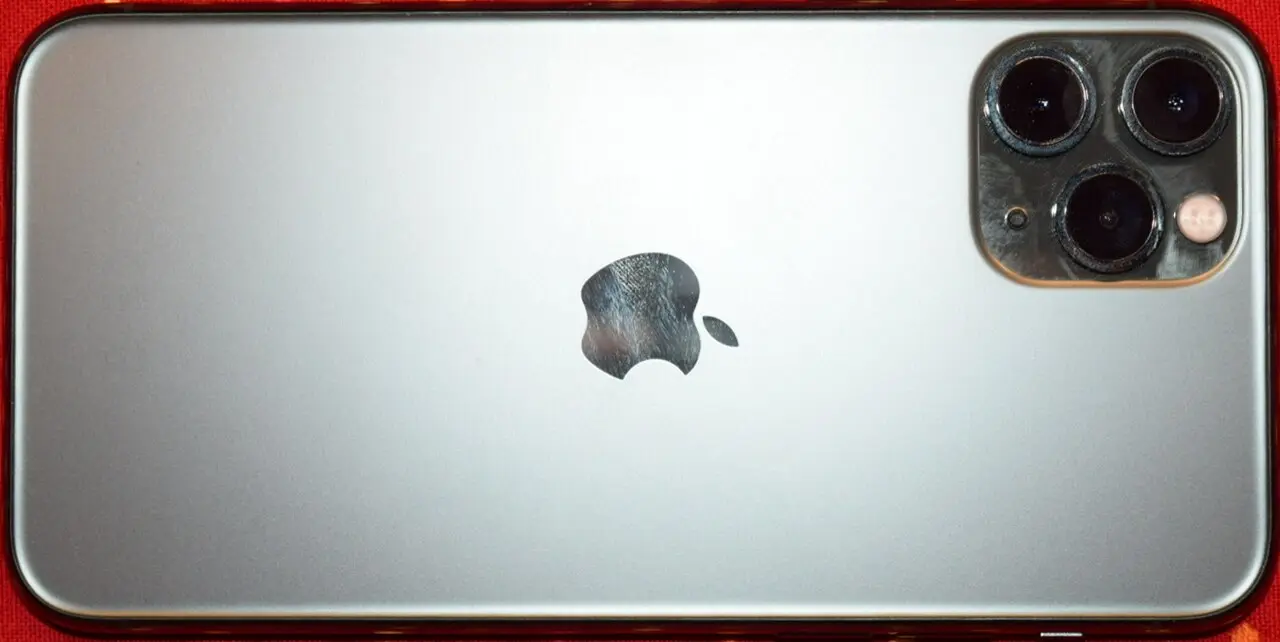
- Telephoto camera with a wider ƒ/2.0 aperture, which Apple said captured 40 percent more light than the iPhone XS
- Super Retina XDR, a custom OLED panel reaching up to 1,200 nits in HDR, with a two-million-to-one contrast ratio
- Finish: a textured matte glass back and a polished stainless-steel band, with a new midnight green
- Battery: by Apple's figures, up to four more hours a day for the 11 Pro than the XS, and up to five more for the Pro Max than the XS Max
- In the box: an 18 W USB-C power adapter and a USB-C to Lightning cable. Fast chargers had previously been sold separately, and MobileSyrup reported the change on announcement day. The standard iPhone 11 kept its 5 W adapter
That last point looks ironic in hindsight: a year later, in 2020, with the iPhone 12, Apple took the power adapter out of the box altogether.
The "firsts" are Apple's claims
Apple called the A13 Bionic "the fastest chip ever in a smartphone" and said the new U1 chip used Ultra Wideband "for spatial awareness", "the first ever in a smartphone". Both are Apple's claims. The only use Apple named at launch was AirDrop: with iOS 13.1 on 30 September, it would make "directionally aware suggestions" based on which way you pointed the phone.
Water resistance was rated IP68, which Apple specified as up to 2 metres for up to 30 minutes, and the phones gained Dolby Atmos playback.
Where it sits in the line
The notch and Face ID arrangement that the iPhone X introduced was unchanged on the iPhone 11. This generation changed the back of the phone — the number of cameras and the amount of processing behind each photo — not the front. The front did not move until the iPhone 13 shrank the notch in 2021 and the iPhone 14 Pro replaced it with cut-outs in 2022.
For the full product line see iPhone; for the company, Apple.
Questions this page answers
- When was the iPhone 11 released?
- It was announced on 10 September 2019, opened for pre-order on 13 September and released on 20 September. All three models, iPhone 11, iPhone 11 Pro and iPhone 11 Pro Max, went on sale the same day, and Japan was among the first-wave countries alongside the US.
- How much did the iPhone 11 cost at launch?
- In the US it started at $699, with the iPhone 11 Pro at $999 and the Pro Max at $1,099; the iPhone 11 undercut the previous year's iPhone XR, which had started at $749. In Japan the starting prices were ¥74,800, ¥106,800 and ¥119,800 before tax.
- Does the iPhone 11 have 3D Touch?
- No. All three iPhone 11 models dropped pressure-sensitive 3D Touch in favour of Haptic Touch, a long press paired with haptic feedback that the iPhone XR had introduced the year before.
- Did the iPhone 11 come with a fast charger?
- Only the two Pro models. The iPhone 11 Pro and 11 Pro Max shipped with an 18 W USB-C power adapter and a USB-C to Lightning cable; the standard iPhone 11 kept the 5 W adapter.
Sources
PrimaryApple、デュアルカメラ搭載のiPhone 11を発表 — Apple Newsroom(日本), 2019年9月
Japanese pricing (before tax) and dates
PrimaryiPhone 11 Pro と iPhone 11 Pro Max:最もパワフルかつ先進的なスマートフォン — Apple Newsroom(日本), 2019年9月
Names Japan among the launch countries
TertiaryiPhone 11 — Wikipedia
Last updated: