T1#military#market
ARPANET's First Message
Metadata
- Date
- Decade
- 1960s
- Tier
- T1
- Sources
- 05
- Connections
- 01
- Tags
- #military#market
At 22:30 on 29 October 1969, in room 3420 of Boelter Hall at UCLA, the graduate student Charley Kline was trying to log in from the SDS Sigma 7 in front of him to an SDS 940 at SRI—the Stanford Research Institute—to the north. Waiting at the other end was another programmer, Bill Duvall.
He started to type "login". L. O. Then the SRI host crashed. What arrived was "lo".
That is the recorded first transmission of what would become the Internet.
The ARPA Vision
ARPANET was a packet-switched network funded by the US Department of Defense's Advanced Research Projects Agency (ARPA, later DARPA). In 1962, J. C. R. Licklider arrived at ARPA and laid out the conception he called the 'Galactic Network'—geographically distributed computers interconnected into a single virtual space in which data and programs could be shared.
This was heretical at the time. Each early-1960s computer was an island. A program written on one machine did not run on another; transferring data meant either physically carrying a tape or running a dedicated one-to-one circuit.
What turned Licklider's vision into something implementable was packet switching, proposed independently by Paul Baran at RAND and Donald Davies at Britain's NPL. Break data into small packets; each finds its own best path to the destination; if an intermediate node fails, the rest takes another route.
Survivable communication under nuclear attack was indeed the frame for Baran's work at RAND. The familiar claim that this was the purpose of ARPANET itself, however, is denied by the people who ran it: Charles Herzfeld, the ARPA director who funded it, later stated flatly that ARPANET was not begun to build a command-and-control system that would survive a nuclear attack. The motive was sharing expensive and scarce computers among researchers.
Four Nodes
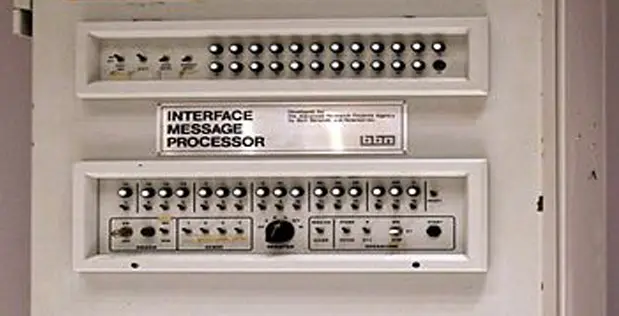
In September 1969, the first ARPANET node—an IMP (Interface Message Processor, the ancestor of the dedicated router)—was installed at UCLA. SRI followed on 1 October, then UC Santa Barbara in November and the University of Utah in December; the four-node network was in place by 5 December.
The 29 October test was the first host-to-host communication between UCLA and SRI. Kline and Duvall kept a telephone line open, sending one character at a time and confirming receipt by voice. L, then O; on the G, the SDS 940 at SRI went down. Two characters had arrived: "lo".
Duvall adjusted the parameters on his machine and brought it back; about an hour later the full "login" went through.
"LO" — An Accidental Prophecy
The two letters that arrived in that first test, "LO", have been retold many times.
"Lo"—the archaic English exclamation. "Lo and behold."
The person who first put the coincidence on record was Leonard Kleinrock, the UCLA professor supervising Kline. On his own page reproducing the UCLA IMP log, he writes that they succeeded in transmitting the "l" and the "o" and then the system crashed, and that "the first message on the Internet was 'lo', as in 'lo and behold!'" Nobody intended it. But the fact that the first word across the network that would reshape the world came out that way is the kind of coincidence that journalists treasure.
From NCP to TCP/IP
ARPANET ran for its first years on a protocol called NCP, the Network Control Program. Its replacement began with "A Protocol for Packet Network Intercommunication," published by Vint Cerf and Bob Kahn in IEEE Transactions on Communications in May 1974. The TCP of that paper was still a single protocol; the split into TCP and IP came in 1978.
The cutover procedure was set out in RFC 801, Jon Postel's NCP/TCP Transition Plan of November 1981, and on 1 January 1983 ARPANET switched over in a single day, remembered as 'Flag Day'. The date is often cited as the formal beginning of the network we now call the Internet.
ARPANET itself was decommissioned in 1990. Its high-water mark was September 1984, when 68 of its 113 nodes were split off as the military MILNET. By then the focus of interconnection had moved on—first to NSFNET, begun in 1985, for academic computing, then to commerce: the acceptable-use restrictions were relaxed step by step in the early 1990s, and federal support for the NSFNET backbone ended on 30 April 1995, leaving commercial ISP backbones in its place.
The "LO" of 29 October 1969 is the start of all of it.
Questions this page answers
- What was the first message sent over ARPANET?
- The operator set out to type 'login', but only the first two letters, 'lo', arrived: the host at SRI went down on the third character. It came back about an hour later and the whole word went through.
- When and where did the first ARPANET message happen?
- At 22:30 on 29 October 1969, from UCLA, where Charley Kline was at the keyboard, to an SDS 940 at SRI. The time is written in UCLA's IMP log.
- Which four sites made up the original ARPANET?
- UCLA, SRI, UC Santa Barbara and the University of Utah. The four-node network was complete on 5 December 1969.
Sources
TertiaryARPANET — Wikipedia
Last updated: