T1#research#military
The DARPA Grand Challenge — The Day Driverless Cars Finished the Desert
Metadata
- Date
- Decade
- 2000s
- Tier
- T1
- Timelines
- A History of Artificial Intelligence
- Sources
- 07
- Connections
- 03
- Tags
- #research#military
The DARPA Grand Challenge was a prize competition for driverless vehicles run by the US Defense Advanced Research Projects Agency. At the second race, on 8 October 2005, Stanford University's robot car Stanley completed a 132-mile (about 212 km) desert course in 6 hours, 53 minutes and 58 seconds, won, and took the $2 million prize. Eighteen months earlier, at the first race on 13 March 2004, none of the 15 starters had finished and the $1 million prize went unclaimed. In that year and a half, vehicles appeared that could cover long distances with no human help at all.
2004: nobody finishes
According to the Stanford team's paper, DARPA launched the Grand Challenge in 2003 to spur innovation in unmanned ground vehicle navigation. Congress was in the background. A Congressional Research Service report records that Section 220 of the defence authorization act for fiscal 2001 set the armed forces a goal that "by 2015, one-third of the operational ground combat vehicles are unmanned." Wikipedia connects the prize money to that goal.
The first race, on 13 March 2004, asked robots to cover a 142-mile course from near Barstow, California, to Primm, Nevada, in under ten hours. The paper says 107 teams registered and 15 raced, yet no robot navigated more than 5% of the course. By DARPA's figures the best vehicle stopped after 7.5 miles. The day after the race DARPA announced a second event for eighteen months later.
8 October 2005: five finishers
| Item | First race, 2004 | Second race, 2005 |
|---|---|---|
| Date | 13 March 2004 | 8 October 2005 |
| Course | Barstow to Primm, 142 miles | Start and finish at Primm, 132 miles |
| Registered / raced | 107 teams / 15 vehicles | 195 teams / 23 vehicles |
| Finished | 0 | 5 |
| Prize | $1 million (not paid) | $2 million (Stanford Racing Team) |
| Winning time | — | 6 h 53 min 58 s |
Carnegie Mellon's H1ghlander started first and Stanley second. The paper records that Stanley caught up, that DARPA twice paused Stanley to give H1ghlander room, and that at mile 101.5 DARPA finally paused H1ghlander and let Stanley pass. Stanley's overall average speed was 19.1 mph and its top speed 38.0 mph.
Stanley: driving as a software problem
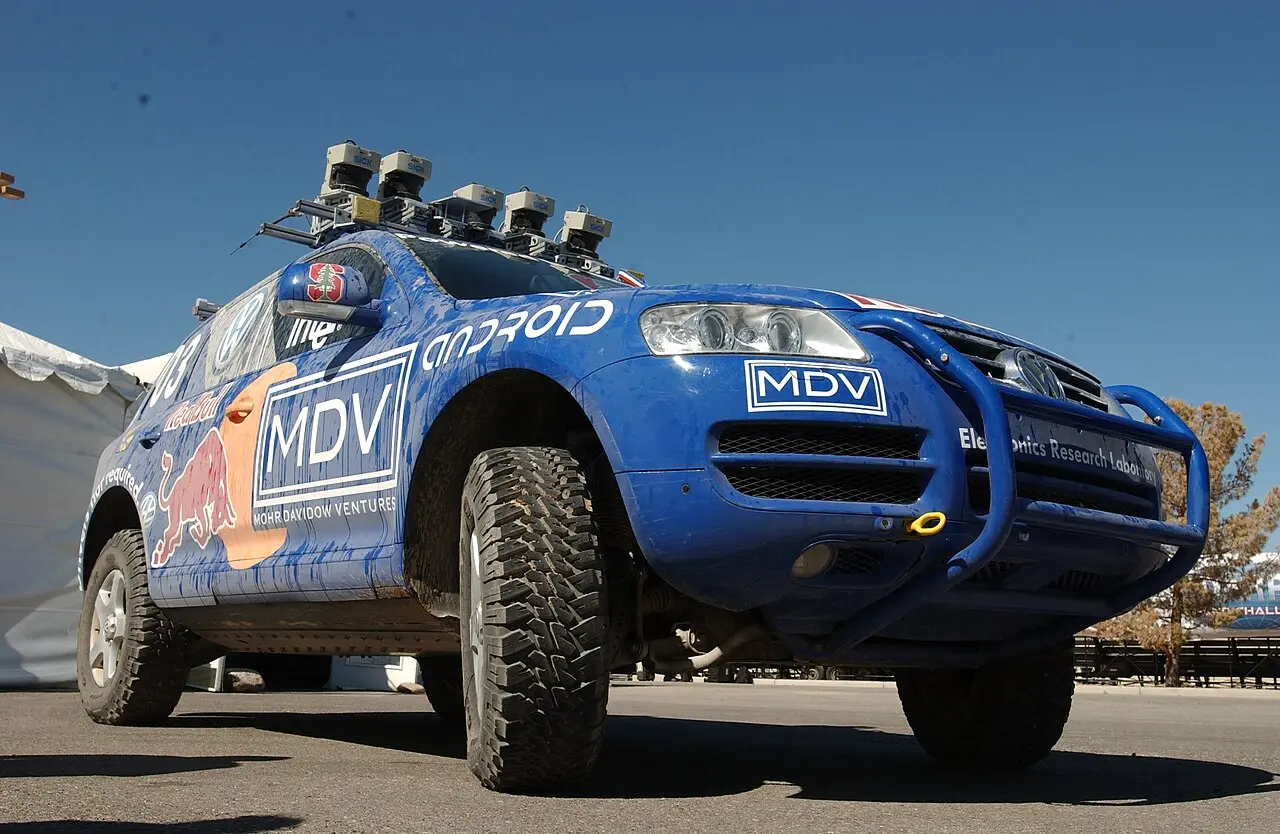
Stanley was a modified 2004 Volkswagen Touareg. The effort was led by Stanford's Sebastian Thrun, with the Electronics Research Laboratory of Volkswagen of America, Intel Research and the venture firm Mohr Davidow Ventures. The roof rack held five SICK laser range finders, a colour camera and GPS antennae; the boot held six Pentium M computers.
Before both races DARPA told competitors that a stock four-wheel-drive pickup could physically traverse the course. The team read this to mean that the innovation needed was in driving software, not exotic vehicles, and adopted a design philosophy in the paper's words: "Treat autonomous navigation as a software problem." The paper's abstract says the software relied predominately on artificial-intelligence techniques such as machine learning and probabilistic reasoning.
| Component | What the paper describes |
|---|---|
| Terrain | Obstacles found in laser point clouds. Thresholds were tuned on data collected by a human driving only over clear ground, cutting the rate at which drivable ground was mislabelled as obstacle from 12.6% to 0.002% |
| Distant road | Camera images classified using the road surface the lasers could see (about 22 m) as training examples, finding road up to 70 m ahead |
| Speed | Slows for rough terrain; how much it slows was learned from recordings of human driving |
| Reliability | Mean distance between failures needing a human rose from about 1 mile in December 2004 to 20 miles in July 2005 |
Without the camera's long-range view, the paper estimates, Stanley would have been held to 25 mph and finished in about 7 hours 5 minutes, possibly behind Carnegie Mellon's Sandstorm. Learned perception decided the race.
The 2007 Urban Challenge
In 2007 DARPA built a mock city at Victorville, California, for the Urban Challenge, in which vehicles had to handle moving traffic and obey traffic rules. On race day, 3 November 2007, six of 11 teams finished. Scored on time and on compliance with California driving rules, Carnegie Mellon's Tartan Racing placed first and won $2 million, according to DARPA. Stanford's entry, Junior, also finished.
The impact: from the desert to Google and Waymo
The races' biggest product was people. On 9 October 2010 Sebastian Thrun revealed Google's self-driving cars on the company's official blog and wrote that the team had gathered "some of the very best engineers from the DARPA Challenges." He named Chris Urmson, technical team leader of the Carnegie Mellon team that won in 2007; Mike Montemerlo, software lead for the Stanford team that won in 2005; and Anthony Levandowski, who had entered a Grand Challenge with an autonomous motorcycle. The cars had by then logged over 140,000 miles, always with a trained safety driver aboard. That project became Waymo; its later story is on the Waymo driverless service page.
The gap between promise and delivery starts here too. In the same post Thrun cited the World Health Organization's figure of more than 1.2 million road deaths a year and wrote that the technology had the potential to cut that number "perhaps by as much as half." That was Google's expectation. DARPA's 2014 retrospective judged that the research community the races created had made autonomous vehicles a near certainty for the first quarter of the 21st century. On the military side, CRS warned in 2006 that the Navy's unmanned combat aircraft programme and the Gladiator unmanned ground vehicle programme would likely fall far short of the Section 220 goals.
The prize model itself lasted. DARPA's retrospective credited the fresh thinking that entrants brought, and the agency went on to run further competitions such as the Robotics Challenge and the Cyber Grand Challenge.
A mobile robot that entered homes in the same decade is the Roomba, and driver assistance on a mass-market car arrived with Tesla Autopilot. The wider story is in the AI timeline.
Questions this page answers
- Who won the DARPA Grand Challenge?
- At the second race on 8 October 2005, Stanford University's Stanley covered the 132-mile course in 6 hours, 53 minutes and 58 seconds and won $2 million. No vehicle finished the first race in 2004, so no prize was paid.
- What happened at the first race in 2004?
- On 13 March 2004, 15 vehicles started a 142-mile desert course and none finished. By DARPA's count the best travelled 7.5 miles, and the $1 million prize went unclaimed.
- What kind of vehicle was Stanley?
- A modified 2004 Volkswagen Touareg with five laser range finders, a colour camera and GPS on the roof and six Pentium M computers in the boot. The team's paper says its software relied mainly on machine learning and probabilistic reasoning.
- How is the Grand Challenge connected to Waymo?
- When Google announced its self-driving car work in 2010, Sebastian Thrun wrote that the team had been drawn from engineers of the DARPA Challenges, naming the software lead of the 2005 Stanley team and the technical leader of the 2007 winning team. That project later became Waymo.
Sources
107 registered and 15 raced in 2004; 195 registered, 23 raced and five finished in 2005; 6 h 53 min 58 s; vehicle and sensors; learned laser false positives cut from 12.6% to 0.002%; 19.1 mph average; overtaking H1ghlander
PrimaryThe DARPA Grand Challenge: Ten Years Later — DARPA, Mar 13, 2014
Best distance of 7.5 miles in 2004, the next race announced the following day, the 2007 Urban Challenge (six of 11 teams finished, Carnegie Mellon won)
PrimaryWhat we're driving at — Sebastian Thrun, Official Google Blog, Oct 9, 2010
Engineers drawn from the DARPA Challenges (Urmson, Montemerlo, Levandowski), 140,000 miles driven, the WHO figure of 1.2 million deaths a year and Google's claim it might be halved
The goal in Section 220 of the FY2001 defence authorization act: one-third of operational ground combat vehicles unmanned by 2015
Last updated: