T1
Google Founded
Metadata
- Date
- Decade
- 1990s
- Tier
- T1
- Timelines
- A General History of Information Technology · A History of the Internet and the Web · A History of Search Engines
- Sources
- 10
- Connections
- 03
In August 1998, Andy Bechtolsheim, a co-founder of Sun Microsystems, wrote a $100,000 check to "Google Inc."—a company that did not yet exist. Google's own account of its history treats that check as the moment the company was born; the legal paperwork followed on 4 September, when Larry Page and Sergey Brin filed for incorporation in California. The first office was a garage in Menlo Park, California.
By then the search engine itself was already two years old and had been running in public on Stanford's network.
BackRub at Stanford
Page and Brin met at Stanford, and in 1996 began a research project called BackRub. Its premise came from academic citation analysis: a paper cited by many important papers is probably important itself. Applied to the web, a link becomes a citation, and the importance of a page can be estimated from the importance of the pages that link to it.
The project outgrew its name. The domain google.com was registered on 15 September 1997, according to the .com registry's own record. The name, as the founders explained in their paper, is "a common spelling of googol", that is, 10 to the power of 100—a nod to their goal of building very large-scale search engines.
The 1998 Paper: "The Anatomy of a Large-Scale Hypertextual Web Search Engine"
The best primary record of what Google was at its founding is the paper Brin and Page published in April 1998 in the journal Computer Networks and ISDN Systems (vol. 30, pp. 107–117). It is unusually candid about the state of the field and about the system's own internals.
The paper describes a prototype "with a full text and hyperlink database of at least 24 million pages", publicly available at google.stanford.edu. Some of its working numbers:
| Item | Figure given in the paper |
|---|---|
| Pages fetched | 24 million |
| URLs seen | 76.5 million |
| Anchors indexed | over 259 million |
| Crawl speed at peak | over 100 pages per second, using four crawlers |
| Time to index 24 million pages | less than one week |
| Total storage with repository | 108.7 GB |
Its diagnosis of the competition was blunt. People searching the web, it said, often started with "high quality human maintained indices such as Yahoo!" or with search engines; human lists were "subjective, expensive to build and maintain", and automated engines relying on keyword matching "usually return too many low quality matches". Some advertisers, it added, were already gaming those engines.
How PageRank Actually Worked
PageRank is often described as "Google's algorithm", which overstates its role. In the 1998 paper it is one signal among several. The formula itself is short:
PR(A) = (1−d) + d (PR(T1)/C(T1) + … + PR(Tn)/C(Tn))
Here T1…Tn are the pages linking to A, C(T) is the number of outbound links on page T, and d is a damping factor that the authors "usually set … to 0.85". The intuition offered is a "random surfer" who follows links and occasionally gets bored and jumps to a random page.
Alongside it the paper describes using anchor text—the words of a link—as a description of the page it points to, which, the authors noted, made it possible to return pages that had not actually been crawled; proximity of query words within a document; and visual presentation such as font size. What set Google apart from Yahoo!, the leading directory of the day, was not a single trick but the fact that every one of these signals was computed by machine from the web's own structure, with no human editors classifying sites.
The Paper's Warning About Advertising
Appendix A of the paper, titled "Advertising and Mixed Motives", reads differently today. The authors wrote that the goals of the advertising business model "do not always correspond to providing quality search to users", and that they expected "advertising funded search engines will be inherently biased towards the advertisers and away from the needs of the consumers." They argued for a competitive search engine "that is transparent and in the academic realm."
Two years later, on 23 October 2000, Google launched AdWords, a self-service program that placed keyword-targeted text ads beside search results. The press release reported more than 20 million searches a day on google.com. The ads appeared to the right of the results rather than inside them—but the company that wrote Appendix A had become an advertising business.
From Garage to Default Engine
The growth after incorporation is well documented in Google's own press releases:
- June 7, 1999 — Google announced a $25 million equity round led by Sequoia Capital and Kleiner Perkins Caufield & Byers, with Michael Moritz and John Doerr joining the board. The release, describing the company as founded in September 1998, said it was now headquartered in Palo Alto.
- June 26, 2000 — Two announcements on the same day. Yahoo! selected Google as its "default search results provider", to complement its own directory. And Google said it had indexed more than one billion URLs: 560 million full-text indexed pages and 500 million partially indexed URLs, which it called the largest search engine on the Internet.
- October 23, 2000 — AdWords.
- August 19, 2004 — Initial public offering at $85 a share, raising $1.67 billion.
The Yahoo! deal is the pivot. The directory whose model the 1998 paper had criticised was now routing its users' web searches to the engine that criticised it.
What the Founding Date Does and Does Not Mean
The founding of Google is easy to date in more than one way, and the dates are often conflated:
| Date | What happened | Source |
|---|---|---|
| 1996 | BackRub research project begins at Stanford | Google; History of Google |
| 15 Sep 1997 | google.com registered | .com registry record |
| Apr 1998 | Journal paper describes the Stanford prototype | Brin & Page |
| Aug 1998 | Bechtolsheim's $100,000 check | Google, "Our story" |
| 4 Sep 1998 | Incorporation filed in California | History; History of Google |
| 7 Jun 1999 | $25 million from Sequoia and Kleiner Perkins | Google press release |
This page takes 4 September 1998, the date the company legally came into being. The search engine, the domain and the core algorithm all predate it.
Legacy
Google's later history—Gmail, Maps, Android, the acquisition of YouTube, and in the 2020s the move to generative AI Overviews at the top of results—belongs to Google the company. What began in 1998 was narrower: the claim, made in a conference paper and then in a garage, that the structure of the web itself was the best available guide to its contents, and that a machine could read that structure better than an editor could.
Questions this page answers
- When was Google founded?
- It was incorporated on 4 September 1998. The PageRank work behind it had begun two years earlier, in 1996, as a Stanford research project called BackRub.
- Who founded Google?
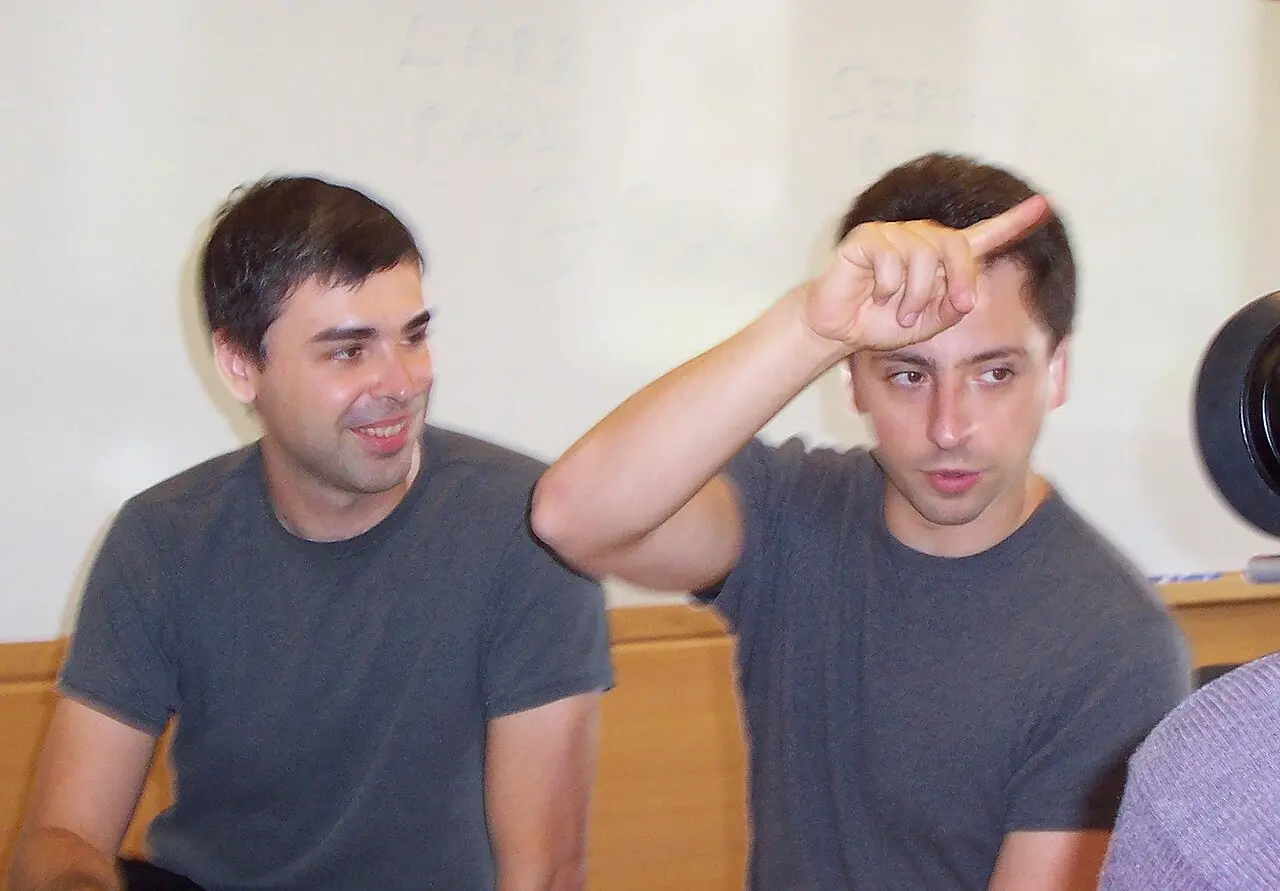
- Larry Page and Sergey Brin, both graduate students at Stanford at the time.
- What made Google different from the search engines before it?
- A fully automated ranking that combined the link structure between pages (PageRank) with anchor text and other signals. Their 1998 paper split the field between 'high quality human maintained indices such as Yahoo!' and 'automated search engines that rely on keyword matching', which it said 'usually return too many low quality matches'.
Sources
TertiaryHistory of Google — Wikipedia
Primarygoogle.com — registration record (Verisign RDAP)
Registered 15 September 1997
PrimaryOur story — Google
Last updated: