T1#consumer
Roomba — The Robot That Went Home
Metadata
- Date
- Decade
- 2000s
- Tier
- T1
- Sources
- 13
- Connections
- 01
- Tags
- #consumer
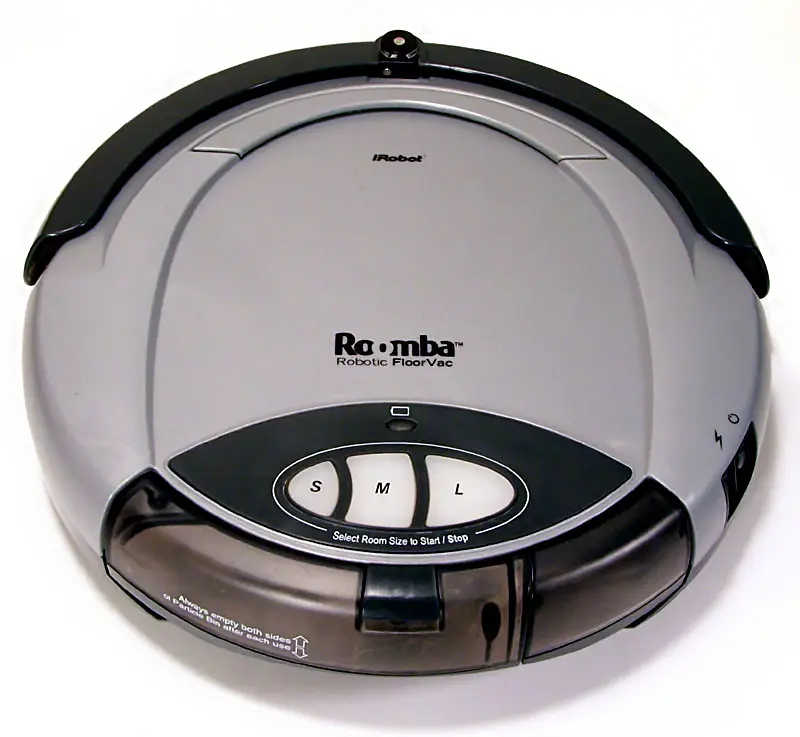
The first Roomba was announced in the United States by iRobot on 18 September 2002. Sold as the Roomba Intelligent FloorVac at a suggested retail price of $199.95, it went on sale online that week at Brookstone, The Sharper Image and Hammacher Schlemmer, and reached their stores in October. iRobot billed it as the first automatic floor vacuum available in the US; that is the company's own description. Japan was not in the first wave: the Roomba went on sale there in 2004, handled by the Japanese sole distributor Sales On Demand.
So the short answer to "when did the Roomba come out" is September 2002 in the US and 2004 in Japan. What makes it a landmark in the history of AI is less its intelligence than its address: an autonomous mobile robot, the kind of machine that had lived in laboratories and factories, went into ordinary homes at the price of a household appliance.
From the laboratory to the living room
iRobot was founded in 1990 by Rodney Brooks of the MIT Artificial Intelligence Lab and two of his former students, Colin Angle and Helen Greiner. According to The Robot Report, it began as IS Robotics, aiming at practical robots for space, military and industrial use. In 1998 it won a DARPA contract that led to the PackBot military robot, and PackBots were used to search the World Trade Center site after the attacks of September 2001. The household Roomba came from the same company, alongside its defence work.
The mechanism described in the 2002 launch material is simple, and it does not involve building a map.
| Item | First Roomba (announced September 2002) |
|---|---|
| Price | $199.95 (extra virtual wall $39.95, spare battery $59.95) |
| Size | 13.4 in. diameter, 3.6 in. high |
| Weight | 5.88 lb (2.668 kg) with battery |
| Running time | About 1 to 1.5 hours, depending on the floor |
| Movement | Spirals outward until the bumper meets a wall or object, then follows the wall |
| Sensors | Cliff sensors that detect stairs and turn it away; a wall-following sensor |
| Controls | Press S, M or L for the size of the room |
iRobot wrote that over time the robot passes over each part of a room two to five times. Rather than memorising the room and planning an efficient route, it was designed to cover the floor statistically, bumping and turning again and again. An infrared "virtual wall" accessory could keep it from crossing openings up to 15 feet wide.
At the launch, chief executive Colin Angle said: "Our vision is to create products that make it possible for housekeeping to be something you do by choice." In a release that November he went further: "There hasn't been an appliance as liberating as this since the dishwasher." Both are the seller's words.
How many were sold: every figure is iRobot's
| Date | Cumulative figure announced | What was counted |
|---|---|---|
| 25 October 2004 | More than 1 million | Roomba |
| 22 May 2006 | More than 2 million | Roomba |
| 5 January 2010 | More than 5 million | All home robots |
| 4 April 2024 | More than 50 million | All robots, worldwide |
Note that the thing being counted changes. From 2010 the announcements cover all of iRobot's home robots, including floor-washing models, and later all of its robots.
The 2004 release recalled that the United Nations Economic Commission for Europe had once forecast sales of 400,000 vacuum-cleaning robots by 2006, and said Roomba had considerably exceeded that number two years early. By 2006 iRobot was selling five models priced from $150 to $330 in more than 7,000 stores, including Target and Best Buy. The product had moved from upmarket gadget catalogues to mass-market appliance shelves.
In Japan, according to BCN, Sales On Demand reported cumulative domestic sales of one million by 2013 and two million by the end of October 2016. In November 2016 it was reported that iRobot would buy Sales On Demand's iRobot sales business.
The impact on society
The first thing the Roomba changed was where the word "robot" lived. The 2004 release quoted Neena Buck of Strategy Analytics, who said that "$200 mobile robotic vacuum cleaners and other such devices" signalled the beginning of a new industry of cost-effective mobile machines. Millions of machines were now moving without human control through one of the least tidy environments there is, the domestic floor.
A machine that roams the home also brings data with it. Later models used cameras to recognise furniture and obstacles and built maps of the home. In December 2022 Eileen Guo of MIT Technology Review reported that images taken in 2020 by development versions of the Roomba J7 series had leaked onto social media through contract workers who were labelling them for the data-annotation company Scale AI. One showed a woman on the toilet. iRobot said the images came from special development robots, not consumer products, given to paid data collectors and employees who had signed agreements, and that the annotation provider had broken a non-disclosure agreement. The episode showed how the human work of preparing machine-learning training data can reach directly into private life.
Amazon walks away, and a Chinese owner
In 2022 Amazon agreed to buy iRobot for about $1.7 billion. According to The Robot Report, the US Federal Trade Commission examined whether Roomba data could give Amazon an unfair retail advantage, and the European Commission opened its own investigation in 2023. On 29 January 2024 the two companies ended the agreement, citing no path to regulatory approval in the European Union. TechCrunch reported that iRobot would lay off about 350 people, roughly 31% of its workforce, and that Colin Angle stepped down as chairman and chief executive.
The business did not recover. The Register reported that iRobot entered Chapter 11 in December 2025, saying it had lost market share to competition and to rising costs from US tariffs. On 23 January 2026 Picea of Shenzhen, its main contract manufacturer and a secured lender, acquired all of iRobot's equity and the process ended. iRobot says it is setting up an independent US subsidiary, iRobot Safe, to protect US consumer data. Two decades after the first Roomba, the question of who owns a machine that holds a map of your home had become a question of national security as well.
The autonomous-driving challenge of the same years is on the DARPA Grand Challenge page, and an ancestor of mobile robots is Shakey. The wider story is in the AI timeline, and the hardware lineage in the hardware timeline.
Questions this page answers
- When did the first Roomba come out?
- It was announced in the US on 18 September 2002, went on sale online at Brookstone and two other retailers that week, and reached stores in October. The suggested retail price was $199.95.
- When did the Roomba go on sale in Japan?
- In 2004, through the Japanese sole distributor Sales On Demand, which reported that cumulative Japanese sales passed two million by the end of October 2016. Japan was not part of the first US launch.
- How many Roombas have been sold?
- By iRobot's account, Roomba sales passed one million in October 2004 and two million in May 2006. In April 2024 it said it had sold more than 50 million robots of all kinds, not only Roombas. All of these are the company's own figures.
- What happened to iRobot?
- Amazon's purchase was abandoned in January 2024 because there was no path to EU approval. iRobot entered Chapter 11 in December 2025, and on 23 January 2026 its contract manufacturer Picea acquired all of its equity, ending the process.
Sources
Announcement date, $199.95, the three retailers and in-store availability in October, spiral and wall-following, cliff sensors, 13.4 in. diameter and 3.6 in. height, 1 to 1.5 hours of running, Colin Angle's quote
PrimaryiRobot's Roomba Robotic Floorvac Surpasses 1 Million In Sales — iRobot, Oct 25, 2004 (archived)
One million sold, the UN Economic Commission for Europe's forecast of 400,000 by 2006, quotes from Angle and Strategy Analytics' Neena Buck
PrimarySales of iRobot Roomba Vacuuming Robot Surpass 2 Million Units — iRobot, May 22, 2006 (archived)
Two million sold, five models from $150 to $330, more than 7,000 stores
PrimaryiRobot Introduces $275 Roomba Combo Essential Robot — iRobot, Apr 4, 2024
More than 50 million robots of all kinds sold
Picea's acquisition of all equity; iRobot Safe, the subsidiary for US consumer data
Secondary「ルンバ」の日本累計販売台数が200万台突破、直近3年間で100万台増える — BCN+R、2016年11月21日
Japanese launch in 2004, sole distributor Sales On Demand, two million by the end of October 2016
Secondaryセールス・オンデマンドのアイロボット製品販売事業をアイロボット社が買収 — BCN+R、2016年11月22日
One million in Japan by 2013 and two million by the end of October 2016
Last updated: