T1#consumer
Nintendo 64 Released
Metadata
- Date
- Decade
- 1990s
- Tier
- T1
- Sources
- 07
- Connections
- 01
- Tags
- #consumer
The Nintendo 64 reached North America on 29 September 1996, priced at US$199.99. Japan had received it about three months earlier, on 23 June 1996 at ¥25,000, and Europe waited almost another six months, until 1 March 1997. The machine launched in Japan first, then spread to North America and Europe.
| Region | Release date | Price | Launch games |
|---|---|---|---|
| Japan | 23 June 1996 | ¥25,000 | Super Mario 64, Pilotwings 64, Saikyō Habu Shōgi |
| North America | 29 September 1996 | US$199.99 | Super Mario 64, Pilotwings 64 |
| Europe | 1 March 1997 | — | — |
The Japanese date comes from Nintendo's own product page and from its IR table of sales by region, which records the console as "released on June 23, 1996" with the region given as Japan; the Japanese price and three launch titles from a GAME Watch article. The North American date and its two launch games come from TechSpot and English Wikipedia, and the European date and the North American price from English Wikipedia.
The specifications Nintendo published
Nintendo's Japanese hardware page describes the console like this:
| Item | Detail |
|---|---|
| CPU | MIPS 64-bit RISC CPU (customised R4000 series), 93.75 MHz |
| Memory | 36 Mbit RAMBUS DRAM, up to 4,500 Mbit/s transfer |
| Coprocessor (RCP) | SP (sound and graphics processing) and DP (pixel drawing), 62.5 MHz |
| Resolution | 256×224 to 640×480 |
| Rendering | Z-buffer, anti-aliasing, trilinear mip-map interpolation, perspective correction and more |
| Size and weight | 260 mm wide × 190 mm deep × 73 mm tall; about 880 g |
Nintendo pitched the CPU as a kind of super-chip admired by designers working in 3D and image processing. According to English Wikipedia, Nintendo developed the chipset with Silicon Graphics (SGI) from 1993 under the name "Project Reality". Nintendo's own page does not mention SGI.
A controller built for 3D
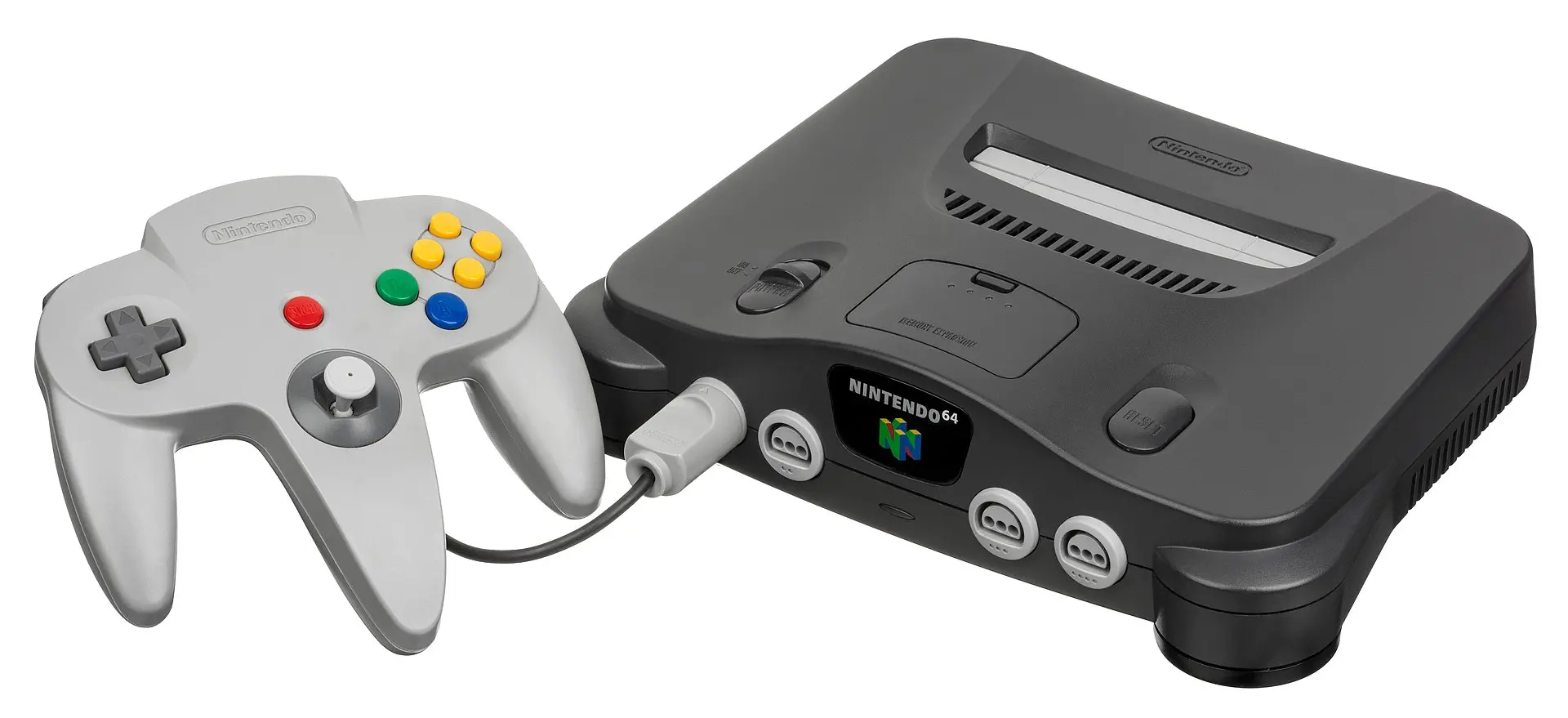
The controller says more about the machine than the chip list. Nintendo's page describes it as a new controller born for controlling 3D, and puts the 3D Stick at its centre: rolling the protruding stick with the thumb allows very fine movement in 3D space, and the example Nintendo gives is grabbing Bowser and swinging him around in Super Mario 64.
The four C buttons change the camera angle—close up, far away, from above, from below, from an angle. Nintendo stresses that they work independently of the other controls, so a player can keep running while the camera swings round, and calls that a pleasure particular to 3D games.
Nintendo described three basic ways to hold it. The "right position" used the stick and buttons fully, for 3D action, racing and flight games. The "left position" let the right hand work the stick. The "Famicom position" suited scrolling action games, role-playing games and puzzles—keeping the directional pad of the Famicom era while adding analogue control.
Four controller ports were built into the console, so four people could play without any adapter. A slot on the underside of the controller took the Controller Pak, a memory pack for saving game data.
The Rumble Pak came ten months later
Force feedback was not part of the launch hardware. Nintendo's accessory page gives the Rumble Pak's release date as 27 April 1997, at ¥1,400 before tax on its own. It ran on two AAA alkaline batteries, and the same page notes that it was bundled with Star Fox 64. The memory of a Nintendo 64 that vibrated from day one is not accurate.
Staying with cartridges
The Nintendo 64 kept ROM cartridges as its software medium while its rivals had moved to CD-ROM—a contrast covered on the original PlayStation page. English Wikipedia describes the decision as highly controversial and frequently cited as a key factor in Nintendo losing its dominant position. In Japan, a magnetic-disk add-on called the 64DD came out in 1999, only in that market, and received just nine games, according to the same article.
Most were sold outside Japan
Nintendo's IR table of sales by region starts with the fiscal year ended March 1998. In the first year for which the overseas breakdown is complete—the year ended March 2000, April 1999 to March 2000—Nintendo 64 hardware sales came to 6.49 million units: 0.94 million in Japan, 4.71 million in the Americas and 0.84 million elsewhere. Japan was only about 14% of the total. Software that year told the same story: of 56.66 million games, Japan took 8.10 million and the Americas 40.49 million. The console launched in Japan first, but by volume it was an American machine.
How many were sold
Nintendo's IR figures for worldwide consolidated sales give the Nintendo 64 32.93 million consoles and 224.97 million games (table as of 30 June 2026). In the same table the generation before it, the Super NES, stands at 49.10 million, and the GameCube that followed at 21.74 million. The console that set the pattern for 3D control sold fewer units than its predecessor.
Nintendo's hardware line as a whole is traced on the Nintendo page.
Questions this page answers
- When was the Nintendo 64 released?
- In North America it launched on 29 September 1996 at US$199.99. Japan had it first, on 23 June 1996 at ¥25,000, and Europe followed on 1 March 1997.
- What were the Nintendo 64's launch games?
- In Japan there were three: Super Mario 64, Pilotwings 64 and Saikyō Habu Shōgi. North America launched with two, Super Mario 64 and Pilotwings 64.
- Did the Rumble Pak come with the console?
- No. The Rumble Pak went on sale in Japan on 27 April 1997, ten months after the console. It cost ¥1,400 before tax on its own and was bundled with Star Fox 64.
Sources
PrimaryNINTENDO64 ハードウエア紹介 — 任天堂
Release date, console specifications and controller
PrimaryNINTENDO64 周辺機器:振動パック — 任天堂
Released 27 April 1997
PrimaryDedicated Video Game Sales Units — Nintendo IR (life-to-date hardware and software units)
As of 30 June 2026
PrimaryConsolidated Sales Transition by Region (XLSX) — Nintendo IR
Lists the Nintendo 64 as "released on June 23, 1996" with the region given as Japan
Secondary【今日はなんの日?】任天堂がNINTENDO64を発売(1996年6月23日) — GAME Watch、2024年6月23日
The ¥25,000 launch price and the three Japanese launch titles
SecondaryThe Nintendo 64 turns 30 today, and we're feeling old — TechSpot, September 29, 2026
The North American release date and its two launch titles
TertiaryNintendo 64 — Wikipedia
Last updated: