T1#consumer
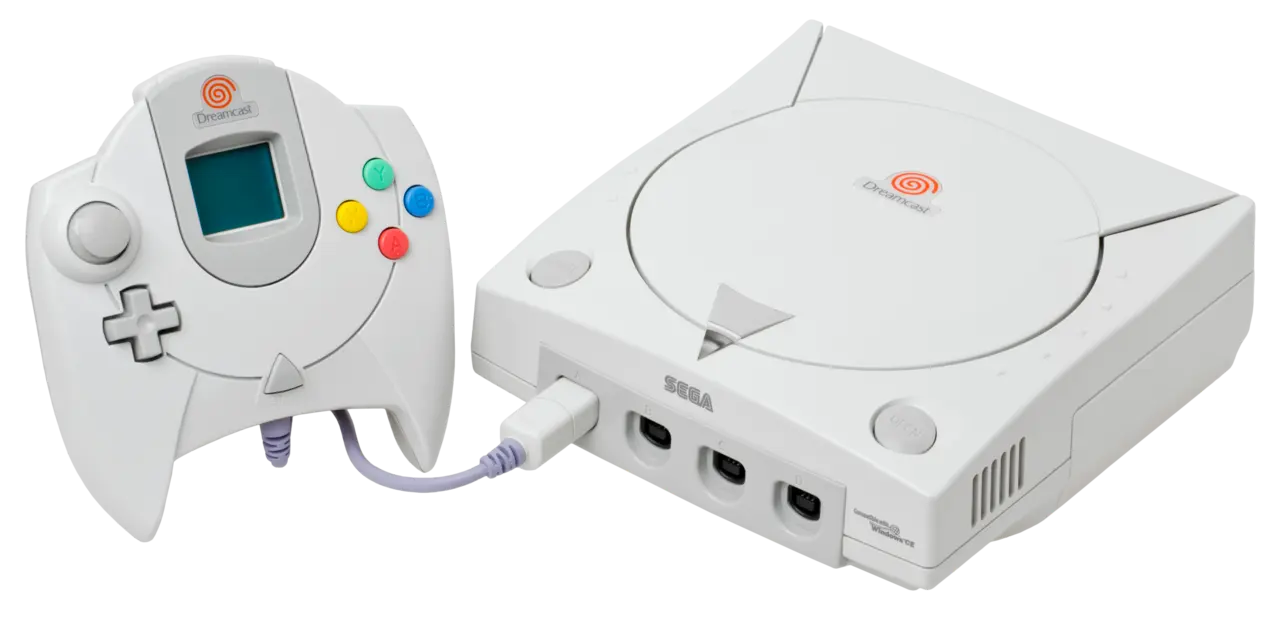
Dreamcast — A Built-in Modem and Sega's Last Console
Metadata
- Date
- Decade
- 1990s
- Tier
- T1
- Sources
- 06
- Connections
- 00
- Tags
- #consumer
The Dreamcast was released in North America on 9 September 1999, at $199. Japan had it first: Sega launched it there on 27 November 1998 at ¥29,800, more than nine months earlier. Europe followed on 14 October 1999. The Japanese date and price had been announced on 6 October 1998.
| Region | Release date | Price | Source |
|---|---|---|---|
| Japan | 27 November 1998 | ¥29,800 | Sega's hardware encyclopedia; PC Watch |
| North America | 9 September 1999 | $199 | The Ringer |
| Europe | 14 October 1999 | — | English Wikipedia |
Ahead of the PlayStation's successor
Sega's official hardware encyclopedia explains why the Dreamcast came when it did. In the home-console market the gap between the Saturn and the PlayStation was widening, so Sega moved to put out a new console ahead of the PlayStation successor it knew would come.
In Japan, the Dreamcast did arrive a year and three months before the PlayStation 2 of 4 March 2000.
According to PC Watch's report of 6 October 1998, the box held a controller, power and AV cables, a 5-metre modular phone cable and Dream Passport, a CD-ROM of communications software. The launch titles named were Sega's Virtua Fighter 3tb, Sega Rally 2 and Godzilla Generations, plus two from other publishers.
There were not enough machines on day one. According to English Wikipedia, a high failure rate in manufacturing the PowerVR chipset kept Sega from meeting its shipping targets; more than half of the limited stock was pre-ordered, pre-orders were stopped, and stock sold out on launch day. Sega reportedly estimated it could have sold another 200,000–300,000 units with enough supply.
Inside
The main items from the specification table in Sega's hardware encyclopedia:
| Item | Detail |
|---|---|
| CPU | SH4, a RISC CPU with a built-in 128-bit graphics engine; 200 MHz, 360 MIPS / 1.4 GFLOPS |
| Graphics | PowerVR2 DC, more than 3 million polygons a second |
| Sound | Built-in 32-bit RISC CPU, 64 channels of PCM/ADPCM |
| Memory | 16 MB main, 8 MB texture, 2 MB sound |
| Modem | 33.6 kbps as standard, removable |
| Media | GD-ROM, about 1 GB |
| OS | Custom version of Microsoft Windows CE |
| Saves | Visual Memory (VM) |
The same page says that moving from the Saturn's SH2 to the much more capable SH4, and adding PowerVR2, greatly strengthened the 3D polygon and translucency effects the Saturn had struggled with, to the point that arcade games could be ported without visible compromise. On the arcade side, Sega released NAOMI, a board compatible with the Dreamcast.
A modem in every box
What set the Dreamcast apart from its contemporaries was an internet modem built in from the start. Sega's brochure of the time claimed it was the first home console in the world with a built-in 33.6 kbps high-speed modem, and the hardware encyclopedia calls it the industry's first home console with full online communication features. Both are Sega's own claims.
According to the encyclopedia, the Dream Passport browser handled web pages and e-mail, and Sega ran a range of network services: an official web magazine, dricas; a shopping site, Dreamcast Direct; and Dream Library, a monthly game-download subscription. Sega also set up its own internet-provider business with free connection, to lower the barrier for ordinary users getting online. The name, Sega says, comes from the idea of broadcasting a dream.
The North American model's modem ran at 56 kbps. According to The Ringer, the SegaNet online service started in North America in September 2000, and Phantasy Star Online followed in December 2000. Sega's corporate history describes Phantasy Star Online as the first full-scale network RPG on a home console.
Day one in North America
According to English Wikipedia, the Dreamcast sold 225,132 units in its first 24 hours in North America, taking $98.4 million, which Sega executives called the biggest 24 hours in entertainment retail history. The Ringer says 18 titles were available on the North American launch day and sales reached one million by November 1999.
Price cuts, then the exit
| Date | Event | Source |
|---|---|---|
| 24 June 1999 | Japanese price cut from ¥29,800 to ¥19,900 | Sega hardware encyclopedia |
| 31 January 2001 | Sega announces it will focus its home-console business on content; Dreamcast production to end with the fiscal year to March 2001 | Sega hardware encyclopedia |
| 1 March 2001 | Japanese price cut again, to ¥9,900 | Sega hardware encyclopedia |
The encyclopedia says breaking the hold of the PlayStation, with its overwhelming worldwide share, proved extremely difficult, and closes by noting that Sega's history of home consoles, begun in 1983, ended there. According to The Ringer, the North American price was cut to $99 after the exit announcement. English Wikipedia gives worldwide sales of 9.13 million units.
Ten months after Sega's announcement, in November 2001, Microsoft's Xbox went on sale in North America; with its Ethernet port, it became the base for Xbox Live, which opened in November 2002. For the wider story, see the game consoles timeline.
Questions this page answers
- When was the Dreamcast released?
- In North America it launched on 9 September 1999 at US$199. Japan had it first, on 27 November 1998 at ¥29,800, more than nine months earlier, and Europe followed on 14 October 1999.
- Did the Dreamcast have a modem?
- Yes, as standard. According to Sega, the Japanese model had a removable 33.6 kbps modem, and the bundled Dream Passport disc offered web browsing and e-mail. The North American model's modem ran at 56 kbps.
- When was the Dreamcast discontinued?
- On 31 January 2001 Sega announced it would concentrate its home-console business on software, and that Dreamcast production would end with the fiscal year to March 2001. In Japan the price was cut to ¥9,900 from 1 March 2001.
- What CPU did the Dreamcast use?
- The SH4. Sega's specification lists it as a RISC CPU with a built-in 128-bit graphics engine, running at 200 MHz for 360 MIPS and 1.4 GFLOPS. Graphics came from a PowerVR2 DC chip rated at more than 3 million polygons a second.
Sources
Primaryドリームキャスト — セガハード大百科(セガ公式)
Date, price and specifications; Dream Passport; the June 1999 price cut; the 31 January 2001 exit announcement; the 1 March 2001 price change
Primary沿革 — 株式会社セガ
SecondarySEGAのWindows CE搭載ゲームマシンDreamcast、価格は29,800円 — PC Watch、1998年10月6日
Announcement of date and price; bundled items; launch titles
SecondaryThe Dreamcast Died Too Soon, but Its Legacy Lives On — The Ringer, Sep 11, 2019
North America on 9 September 1999 at $199; 56K modem; SegaNet; $99 after the exit
TertiaryDreamcast — Wikipedia
Last updated: