T1#consumer
Super Famicom (SNES) — 16 Bits and the L and R Buttons
Metadata
- Date
- Decade
- 1990s
- Tier
- T1
- Sources
- 08
- Connections
- 01
- Tags
- #consumer
The Super Nintendo Entertainment System (SNES) began reaching North American shops in late August 1991. The date most often given is 23 August 1991, though, as set out below, the official nationwide release date was 9 September. Japan had the machine first, as the Super Famicom, on 21 November 1990—the date Nintendo's own IR data records as its release. Europe followed in 1992.
| Region | Release date | Price | Source |
|---|---|---|---|
| Japan | 21 November 1990 | ¥25,000 | Nintendo IR (date); English Wikipedia (price) |
| North America | In shops from late August 1991; official nationwide release 9 September 1991 | $199.95 | SNES Central, citing the New York Times and others |
| Europe | 11 April 1992 | — | English Wikipedia |
On price, Nintendo's own Japanese product page lists a later recommended price of ¥9,800 before tax. The launch price of ¥25,000 comes from English Wikipedia.
A delay of a year and four months
According to Famitsu, the Super Famicom had originally been due in July 1989 but was postponed, a semiconductor shortage among the reasons. Seven years after the Famicom of 1983, the CPU went from 8 bits to 16.
When it finally arrived on 21 November 1990, only two games launched with it, both from Nintendo: Super Mario World and F-Zero. Inside, a Japanese games site, recalls that December releases including Pilotwings, ActRaiser and Final Fight then drew players.
According to English Wikipedia, Nintendo's first shipment of 300,000 units sold out within hours, and the consoles were moved at night to avoid theft.
What was new
| Item | Detail | Source |
|---|---|---|
| CPU | 16-bit; Ricoh 5A22 at 3.58 MHz | Famitsu (16-bit); English Wikipedia (part and clock) |
| Graphics | Hardware scaling, shrinking and rotation | Famitsu |
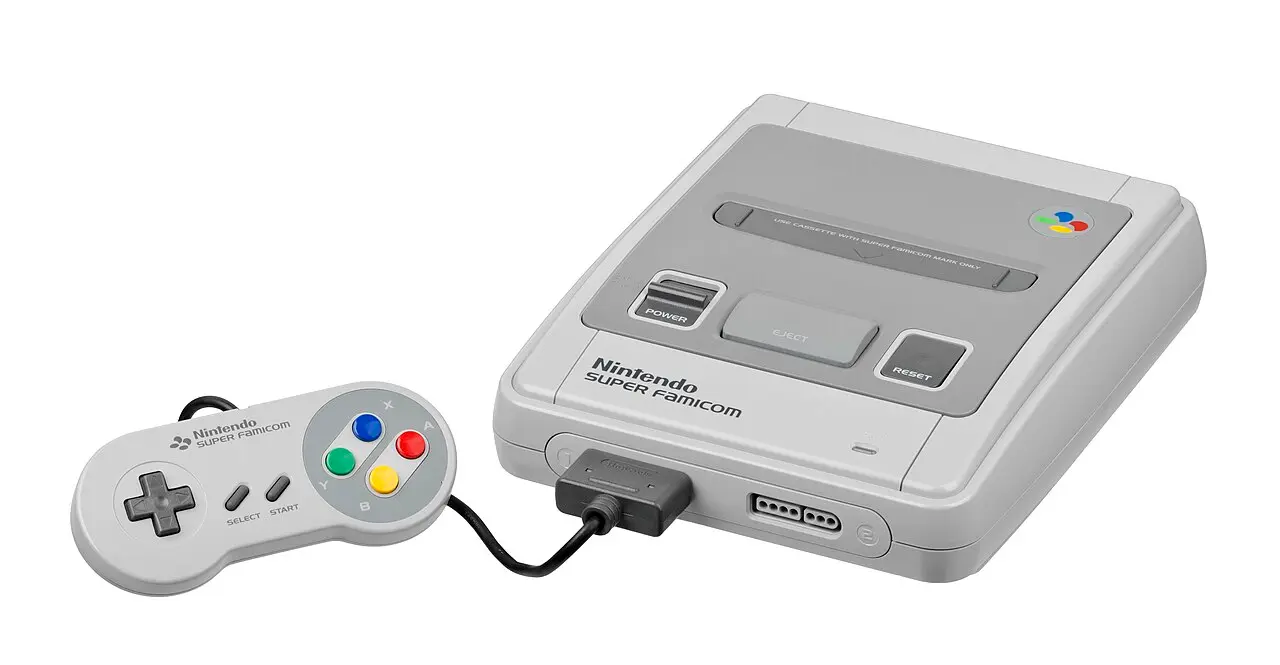
| Controller | X and Y added to the Famicom's A and B, plus L and R | Famitsu |
Famitsu stresses that the ability to enlarge, shrink and rotate images was revolutionary at the time. English Wikipedia describes this as Mode 7, a means of producing pseudo-3D effects.
The other legacy was the controller. Famitsu judges that the shape with the added L and R buttons became the basic form of game controllers from then on.
North America: no single SNES release date
The North American SNES was sold in a different shell from the Japanese machine. According to English Wikipedia, against the rounded Japanese design, the North American model was boxy, with purple sliding switches.
The North American date most often quoted is 23 August 1991. SNES Central, a site documenting the console, has compared contemporary sources:
| Source | What it says |
|---|---|
| Orange County Register (27 August 1991) | Units began showing up in Southern California shops on Wednesday 21 August, nearly three weeks before the official 9 September release date |
| USENET post (26 August 1991) | Stock arrived at a Toys "R" Us on the afternoon of 22 August; the poster bought one on Friday 23 August |
| New York Times (10 September 1991) | Nationwide launch on 9 September, at $199.95 with Super Mario World included |
| EGM (November 1991) | Gives the release date as 23 August |
SNES Central concludes that the official nationwide launch was 9 September, but that the console could be bought in California from 21–23 August. It also dismisses the 13 August date sometimes seen, tracing it to an unsourced Wikipedia edit in 2005. Canada followed in December 1991.
Either way, North America waited about nine months after Japan.
Set beside Nintendo's other home consoles, the gaps between Japan and North America look like this. Dates come from Nintendo IR and the individual pages on this site.
| Console | Japan | North America | First |
|---|---|---|---|
| Famicom / NES | 15 July 1983 | Test market October 1985; full release 27 September 1986 | Japan, by more than two years |
| Super Famicom / SNES | 21 November 1990 | In shops late August 1991; official nationwide release 9 September | Japan, by about nine months |
| Nintendo 64 | 23 June 1996 | 29 September 1996 | Japan, by about three months |
| Wii | 2 December 2006 | 19 November 2006 | North America, by 13 days |
| Nintendo Switch | 3 March 2017 | 3 March 2017 | Same day |
The gap narrowed with each generation, flipped with the Wii and closed with the Switch. The Super Famicom sits near the end of the era in which Japan ran well ahead.
Sales
Nintendo IR publishes these lifetime figures:
| Region | Hardware | Software |
|---|---|---|
| Japan | 17.17 million | 194.85 million |
| The Americas | 23.35 million | 135.00 million |
| Other | 8.58 million | 49.22 million |
| Total | 49.10 million | 379.06 million |
Japan sold fewer consoles than the Americas but more games. Per console, that is roughly 11.3 games in Japan against about 5.8 in the Americas.
Afterwards
A cheaper Super Famicom Jr. followed on 27 March 1998 (listed by Nintendo at ¥7,800 before tax). A reissue, the Nintendo Classic Mini: Super Famicom, came out on 5 October 2017.
Nintendo's next home console was the Nintendo 64 of 1996. The story of the CD-ROM add-on Sony was to build for the Super Famicom, and how its collapse led to the first PlayStation, is told on the original PlayStation page. On the handheld side, the Game Boy had arrived the year before, in 1989. For the company, see Nintendo; for the wider story, the game consoles timeline.
Questions this page answers
- When was the Super Famicom / SNES released?
- The Super Famicom launched in Japan on 21 November 1990, after a delay from a planned July 1989. In North America the SNES began appearing in shops, first in Southern California, in late August 1991; 23 August is the date most often given, and 9 September 1991 was the official nationwide date.
- What games launched with the Super Famicom?
- Only two, both from Nintendo: Super Mario World and F-Zero.
- How many Super Famicom / SNES consoles were sold?
- According to Nintendo IR, 49.10 million consoles worldwide (17.17 million in Japan, 23.35 million in the Americas and 8.58 million elsewhere) and 379.06 million games.
- What was new about the Super Famicom controller?
- To the Famicom's A and B buttons it added X and Y, plus L and R shoulder buttons. Famitsu describes this layout as becoming the basic form of game controllers afterwards.
Sources
PrimaryConsolidated Sales Transition by Region (XLSX) — Nintendo IR
Release date of 21 November 1990 (Japan) and sales by region
Primaryスーパーファミコン — 任天堂
Release dates of the console and the Super Famicom Jr., with later list prices
Secondaryスーパーファミコンが発売30周年。拡大・縮小・回転機能を搭載したファミコンの後継機で数々の名作を生み出した【今日は何の日?】 — ファミ通.com、2020年11月21日
Two launch titles; scaling and rotation; X, Y, L and R buttons; the Jr. model (27 March 1998)
Secondaryスーパーファミコン発売35周年。現代でも続く名作シリーズを数多く生み出した16ビットマシン。LRボタンの存在がゲームの新時代を開いた【今日は何の日?】 — ファミ通.com、2025年11月21日
Delay from the planned July 1989 launch; the move to 16 bits; the L and R buttons
SecondaryRelease of the Super NES — SNES Central
Investigation of the North American date: Southern California from 21–23 August, nationwide 9 September, $199.95
Last updated: