T1#consumer
Nintendo Switch 2 Released
Metadata
- Date
- Decade
- 2020s
- Tier
- T1
- Timelines
- A General History of Information Technology · A History of Game Consoles and Game Technology
- Sources
- 10
- Connections
- 03
- Tags
- #consumer
On 5 June 2025, Nintendo launched the Switch 2 worldwide—eight years and three months after the original Switch (3 March 2017). US$449.99 in the United States, or US$499.99 bundled with Mario Kart World. Japan got two SKUs: a Japanese-language-only system at ¥49,980 and a multi-language system at ¥69,980.
Over 3.5 million units sold worldwide in the first four days. Nintendo's own framing of that number is narrower than it is usually quoted: "the highest global sales level for any Nintendo hardware within the first four days"—Nintendo's own line-up, not all consoles. The broader record belongs to a different measurement: Circana counted 1.6 million US units in June, the largest single month for any video-game hardware in US history, well past the previous mark (PlayStation 4, 1.1 million, November 2013).
This was not merely a successor. The console arrived carrying multiple themes of the year 2025 at once: tariff politics, a price-point controversy, and backwards compatibility.
Hardware — Continuity and a Leap
Nintendo's own tech-spec page says exactly one thing about the silicon: "custom processor made by NVIDIA." The Tegra T239 designation, the Ampere-class GPU, the eight ARM Cortex-A78C cores and DLSS support are all reporting and teardown, not manufacturer specification—worth flagging, because they are usually quoted as though Nintendo had published them.
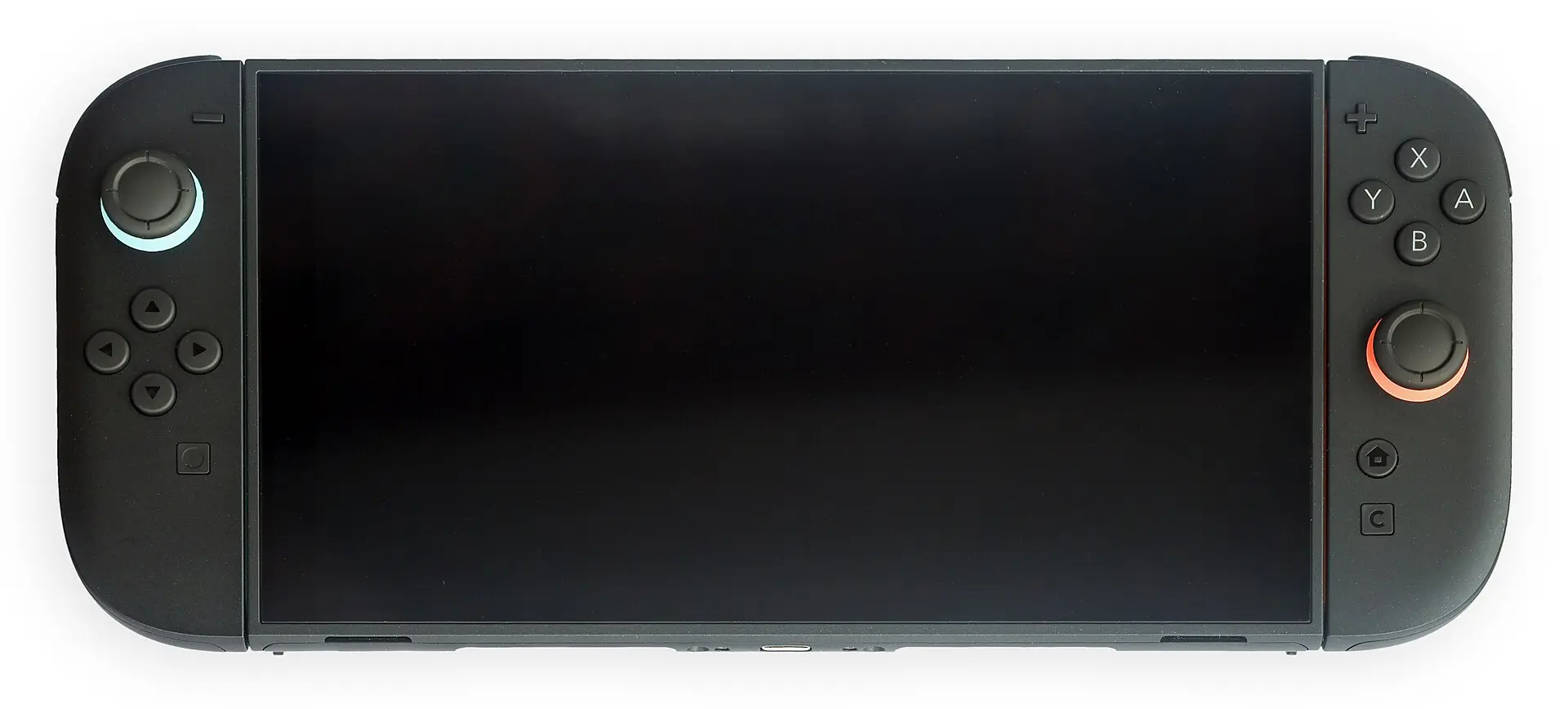
What Nintendo does publish: a 7.9-inch, 1920×1080 LCD with HDR10 and VRR up to 120 Hz in handheld mode; docked output up to 3840×2160 (4K) at 60 fps, or 120 fps if 1080p or 1440p is selected; 256 GB of UFS internal storage.
The Joy-Con 2 attaches magnetically to the rails, replacing the original Switch's mechanical slide. An optical sensor on the controller's rail face enables mouse mode—slide the Joy-Con on a desk and it works as a mouse. Ports of Civilization VII and Cyberpunk 2077 demonstrated the feature's practicality.
A new GameChat function spins up voice or video chat and screen sharing from the new C button on the Joy-Con 2—an explicit move into the online-social territory Nintendo had long kept at arm's length. It requires a paid Nintendo Switch Online membership, waived until 31 March 2026. The system maintains backwards compatibility with the original Switch, game cards and digital alike, though a minority of titles are unsupported or only partly so. At launch the original Switch stood at 152.12 million units shipped (as of 31 March 2025); carrying that base across was the design problem the whole machine was built around.
US$449 and the Shadow of Tariffs
The price was controversial from the moment it was announced. At the 2 April 2025 reveal, the US$449.99 US price exceeded industry expectations (largely clustered at US$300–400). Japan's ¥49,980 (tax included) was over 1.5× the original Switch's ¥32,378—and that is the cheaper SKU, restricted to Japanese as the system language and to Nintendo Accounts registered in Japan; the multi-language model at ¥69,980 is more than double. Nintendo's stated reason for the split was to keep an affordable option available to Japanese consumers. Social-media reaction was dominated by "too expensive".
Then, later the same day, the Trump administration unveiled sweeping reciprocal tariffs: 46% on Vietnam, 54% on China once existing duties were counted, 24% on Japan—Nintendo's manufacturing base and its home country at once. On 4 April Nintendo of America postponed US preorders, which had been scheduled to open on 9 April.
NoA President Doug Bowser gave NPR a carefully bounded account rather than a headline. The US$449.99 and US$499.99 prices, he said, "were made based on previous tariffs, and there was no impact from previous tariffs on those pricing"; as for what came next, "much like every other company, I think in the U.S. right now, we're in the process of actively assessing what the impact may be, but we really have nothing further to announce in regards to pricing." Asked specifically about the 24% on Japanese exports: "we're just going to have to actively assess what that impact may be. Things may change in the days ahead."
Nintendo then chose to hold the US$449.99 price and reopened preorders on 24 April, adjusting accessory prices instead and leaving the door open on other products. Tariffs were absorbed rather than passed through—a decision that would last just over a year.
Launch Line-up — Mario Kart and Bananza
The launch centred on Mario Kart World (US$79.99)—the first open-world entry in the series, with the entire map traversable seamlessly. Circana found that in the US launch month 82% of Switch 2 buyers also took it home, counting new physical copies and the hardware bundle but excluding standalone digital purchases: roughly 1.3 million copies. Worldwide, 5.63 million by 30 June.
Donkey Kong Bananza was not a launch title. It arrived six weeks later, on 17 July: a 3D action game built around terrain-destruction mechanics, an ambitious title that reaffirmed Nintendo's internal-studio competence in 3D action.
On the third-party side, Cyberpunk 2077: Ultimate Edition, Street Fighter 6, Split Fiction, Hogwarts Legacy and Yakuza 0 Director's Cut were all there on day one—overturning the original-Switch-era assumption that AAA titles would skip the platform on performance grounds. The counter-example is instructive: Elden Ring Tarnished Edition, announced at the same 2 April Direct for a 2025 release, was pushed back over performance work and did not arrive until 28 August 2026.
Year One — and What It Cost
The pace held. Nintendo's original guidance for the fiscal year ending March 2026 was 15 million units; the result was 19.86 million, with 48.71 million units of Switch 2 software. That comfortably beat the original Switch's own first year (15.05 million in FY2018) and came within reach of Nintendo's best-ever annual figure, the Switch's 28.83 million in FY2021. On software: Mario Kart World reached 14.70 million including bundles, Donkey Kong Bananza 4.52 million. The original Switch added 3.80 million in the same year, taking its lifetime total to 155.92 million.
| Original Switch, first year — FY ending March 2018 | 15.05M | |
|---|---|---|
| Switch 2, first year — FY ending March 2026 | 19.86M | |
| Nintendo's best year — Switch, FY ending March 2021 | 28.83M |
Why did it sell this hard? First, demand had stacked up across a base of more than 150 million original-Switch owners waiting for "the next box". Second, in a market where PlayStation and Xbox had drifted upmarket—PS5 Pro at US$699.99, the ROG Xbox Ally X at US$999.99 when it shipped in October 2025—the Switch 2 offered a single clear proposition: a US$449.99 handheld/dock hybrid. Third, Mario Kart—a demand-generation machine thirty years deep.
Then the other shoe dropped. On 8 May 2026 Nintendo announced price revisions: the Japanese-language system from ¥49,980 to ¥59,980 on 25 May 2026; the United States from US$449.99 to US$499.99 on 1 September 2026; Europe from €469.99 to €499.99 the same day. The stated causes were rising component prices—memory above all—and tariff measures, together booked as roughly ¥100 billion of additional cost of goods sold in the FY2027 forecast. The pass-through Nintendo declined in April 2025 became unavoidable thirteen months later.
The Switch 2 is the emblematic console of 2025. Hardware that legitimately advances the line; the fastest start any Nintendo machine has had; and a backdrop of international politics and component inflation that will accompany every subsequent quarter. Nintendo's next decade rests on that balance.
Sources
TertiaryNintendo Switch 2 — Wikipedia
Last updated: