ORGANIZATION
Nintendo Co., Ltd.
Nintendo began in 1889 when Fusajiro Yamauchi started making hanafuda playing cards in Kyoto. It was incorporated as Marufuku Co., Ltd. in 1947, renamed Nintendo Playing Card Co., Ltd. in 1951, and took its present name in 1963. By way of toys and arcade machines it entered home consoles with the 1983 Family Computer, and has since repeatedly redrawn the market with designs that decline to compete on raw performance — Game Boy, Nintendo DS, Wii, Nintendo Switch. Net sales for the fiscal year ended March 2026 were ¥2,313.0 billion, 76.9% of it outside Japan.
Organization
- Founded
- 1889
- Status
- Active
- Active
- 1889–
- Appearances
- 08
- Name
- ENNintendo Co., Ltd.JA任天堂
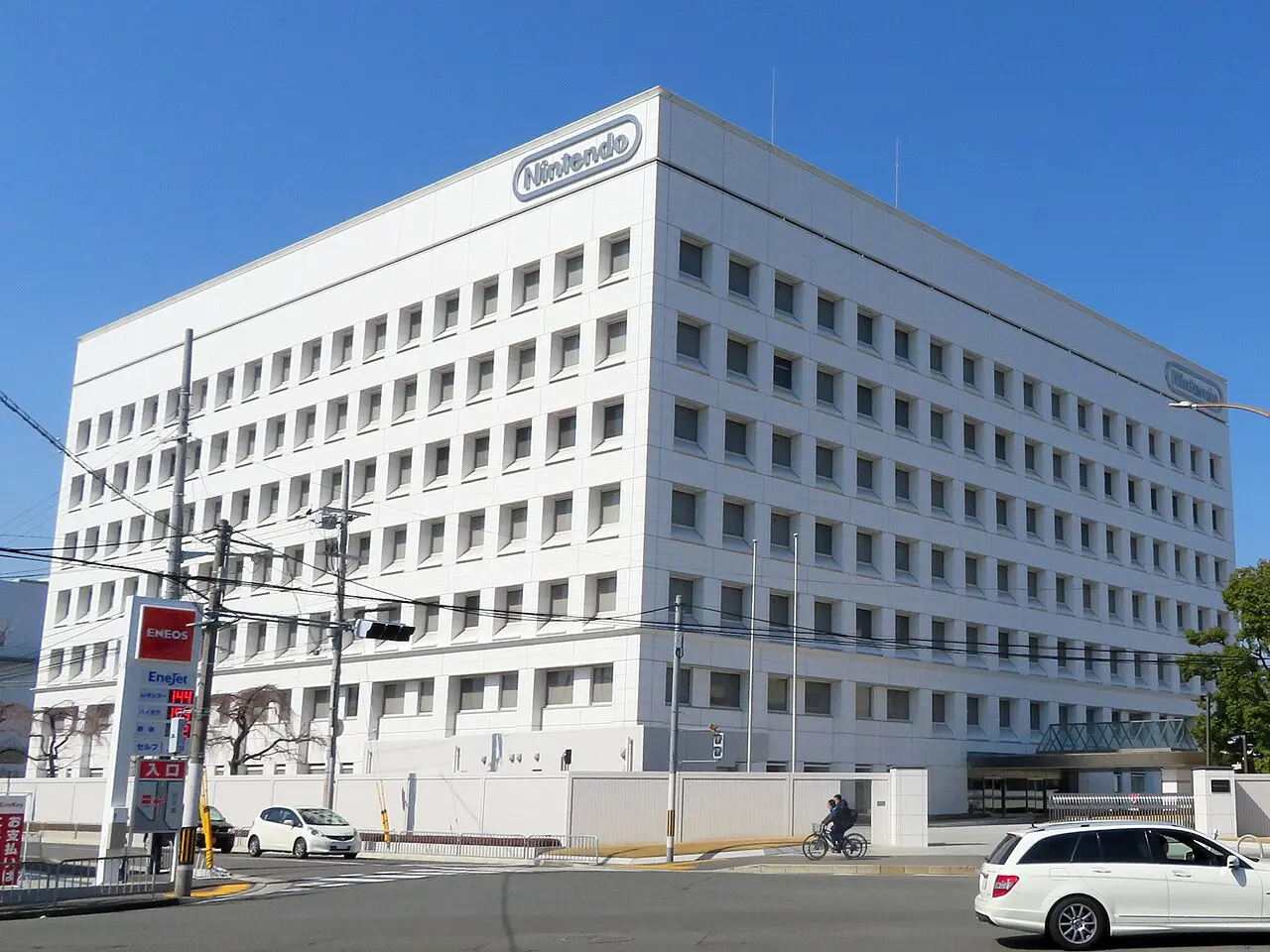
Nintendo Co., Ltd. began in 1889, when Fusajiro Yamauchi started manufacturing hanafuda playing cards in Kyoto. It was incorporated as Marufuku Co., Ltd. in 1947, renamed Nintendo Playing Card Co., Ltd. in 1951, and took its present name in 1963. The head office is in Kamitoba, Minami-ku, Kyoto; capital is ¥10,065,400,000, consolidated headcount 8,666, and the Representative Director and President is Shuntaro Furukawa (all as of March 2026). Of 137 years in business, only the most recent 43 have involved selling dedicated game systems.
94 years before the first console
For the first 94 years this was a paper-and-plastic company. It took up the manufacture of Western playing cards in 1902, pioneered mass-produced plastic cards in Japan in 1953, and listed on the Second Section of the Osaka Securities Exchange and on the Kyoto Stock Exchange in 1962. Around the 1963 renaming it moved into toys — a turn English Wikipedia credits to Hiroshi Yamauchi, the third president, who ran the company from 1950 to 2002 and under whom, the same article records, an American subsidiary opened in 1979. Game & Watch shifted the centre of gravity to electronic toys in 1980, and the Family Computer of 1983 took Nintendo into home consoles.
The 43 years since have been a cycle of falling and rebuilding on different ground. Against the Super NES's 49.10 million units, the Nintendo 64 managed 32.93 million and the GameCube 21.74 million; the living-room line kept shrinking. The dual-screen Nintendo DS (154.02 million) and the Wii (101.63 million) then widened the audience by stepping outside the performance race. The counter-swing was the Wii U at 13.56 million — the smallest home-console figure on Nintendo's own investor table — and in the middle of that recovery, on 11 July 2015, President Satoru Iwata died in office. Tatsumi Kimishima served in the interim and Furukawa took over in 2018. The Switch now stands at 156.59 million units and Switch 2 reached 23.68 million in roughly thirteen months on sale.
What the unit table does and does not count
| Platform (as Nintendo labels it) | Hardware | Software |
|---|---|---|
| NES | 61.91 m | 500.01 m |
| SNES | 49.10 m | 379.06 m |
| Game Boy | 118.69 m | 501.11 m |
| Nintendo 64 | 32.93 m | 224.97 m |
| Nintendo GameCube | 21.74 m | 208.58 m |
| Game Boy Advance | 81.51 m | 377.42 m |
| Nintendo DS | 154.02 m | 948.76 m |
| Wii | 101.63 m | 921.85 m |
| Nintendo 3DS | 75.94 m | 392.31 m |
| Wii U | 13.56 m | 103.60 m |
| Nintendo Switch | 156.59 m | 1,561.95 m |
| Nintendo Switch 2 | 23.68 m | 58.17 m |
The figures are what Nintendo's investor page calls worldwide consolidated sales in units, life-to-date as of 30 June 2026; the metric names neither shipments nor sell-through. Rows cross both regions and hardware revisions. Nintendo heads the first row "NES" in English and 「ファミリーコンピュータ」 in Japanese, yet the Famicom that went on sale in Japan on 15 July 1983 and the NES that reached North America in 1985-86 are different machines. The DS and 3DS rows likewise fold in the Lite, DSi and New revisions.
Everything else is booked in one line, "IP related income, etc." — films and video, smart-device content, royalties and merchandise at official stores — which came to ¥73.5 billion in the year to March 2026, down 9.7 per cent and 3.2 per cent of total sales. The Nintendo Museum in Uji sits inside that line, as does the sequel to The Super Mario Bros. Movie (2023), a film Nintendo says grossed over US$1.3 billion worldwide; Nintendo's results material puts the sequel's global release at 1 April 2026 and over US$800 million in four weeks.
Key events
- 1889: Fusajiro Yamauchi begins manufacturing hanafuda in Shimogyo-ku, Kyoto.
- 1947: Marufuku Co., Ltd. founded in Higashiyama-ku, Kyoto (Nintendo Playing Card Co. from 1951; the present name from 1963).
- 15 July 1983: Family Computer goes on sale in Japan. Nintendo lists on the First Section of the Tokyo Stock Exchange the same year.
- 2000: Head office moves to Kamitoba, Minami-ku, Kyoto — the present site.
- 11 July 2015: President Satoru Iwata, appointed in May 2002, dies in office.
- 18 September 2024: Nintendo and The Pokémon Company jointly sue Pocketpair for patent infringement in the Tokyo District Court.
- 2 October 2024: The Nintendo Museum opens in Uji, Kyoto.
- 5 June 2025: Nintendo Switch 2 released.
- 8 May 2026: Switch 2 price rises announced — the Japanese-Language System from ¥49,980 to ¥59,980 on 25 May; the United States from $449.99 to $499.99, and Europe (My Nintendo Store prices), on 1 September.
Key metrics
- Net sales (FY ended March 2026): ¥2,313.0 bn (+98.6%) / Operating profit ¥360.1 bn (+27.5%) / Net profit ¥424.0 bn (+52.1%)
- Gross margin: 61.0% to 39.3% (-21.7 pt), as hardware rose from 43.7% to 66.7% of dedicated-platform sales
- Digital sales: ¥407.6 bn, 54.6% of dedicated-platform software sales
- Regional mix: Japan 23.1% / the Americas 40.4% / Europe 23.8% / other 12.7%
- Annual playing users: over 100 million for April 2025 - March 2026 (Nintendo estimate)
- Consolidated employees: 8,666, of whom 3,084 at the parent company (March 2026)
Never the fastest machine, and now a price rise in year two
Nintendo's design position is a refusal to build the fastest machine. The Wii and the DS posted historic numbers while losing on raw processing to their contemporaries, and the Switch dissolved the distinction between console and handheld outright. The cost is paid at every generational handover in compatibility, online services and third-party support, and occasionally the market simply does not answer, as with the Wii U. The 21.7-point fall in gross margin in the year to March 2026 is the same structure seen from the accounts: hardware was two-thirds of platform sales in a launch year, and Nintendo still places the box thinly and recovers on its own software.
Enforcement of intellectual property has become markedly more explicit. What Nintendo and The Pokémon Company sought from Pocketpair on 18 September 2024 was an injunction and damages founded on patents rather than copyright, and the news release says the company will keep taking the measures needed to protect intellectual property built up over many years. That choice of instrument, together with sustained legal pressure on emulators and ROM distribution, divides opinion over whether the effect is protection or chilling. The argument running the other way, over Joy-Con stick drift, ended without a ruling: Nintendo Life reports that the US class actions filed in 2019 and 2020 were dropped in May 2024.
From FY2027 the dominant theme is external. Nintendo has built roughly ¥100 billion of cost of sales into its forecast for rising component prices — memory above all — and for tariff measures, and has announced matching Switch 2 price increases. Raising the price of a flagship system in its second year on sale is the clearest sign, taken from the company's own results material, that a Kyoto firm now moves as a dependent variable of the semiconductor cycle and of trade policy.
Appearances
Sources
Primary会社の沿革 — 任天堂
From the start of hanafuda production in 1889 through the renamings, the listing and the head-office moves
PrimaryCompany Profile — Nintendo Co., Ltd.
Capital, headcount and representative director, as of March 2026
Primaryゲーム専用機販売実績 — 任天堂 IR
Consolidated worldwide cumulative unit sales, as of the end of June 2026
PrimaryDedicated Video Game Sales Units — Nintendo IR
The English edition of the same table; the Famicom row is labelled "NES"
Primary株式会社ポケットペアに対する特許権侵害訴訟の提起について — 任天堂ニュースリリース
Dated 19 September 2024
Primaryイルミネーションと任天堂、「スーパーマリオ」の新たなアニメ映画のタイトルを『ザ・スーパーマリオギャラクシー・ムービー』に決定 — 任天堂ニュースリリース
Dated 12 September 2025; the previous film's box office and the release dates by country
TertiaryNintendo — Wikipedia
The succession of presidents, and the 1979 founding of the US subsidiary
Last updated: